All species › Jacamars and puffbirds › Puffbirds › Rufous-capped Nunlet
Rufous-capped Nunlet | Nonnula ruficapilla
Zuidelijke grijswangtrappist | Monjilla coronada | Freirinha-de-coroa-castanha
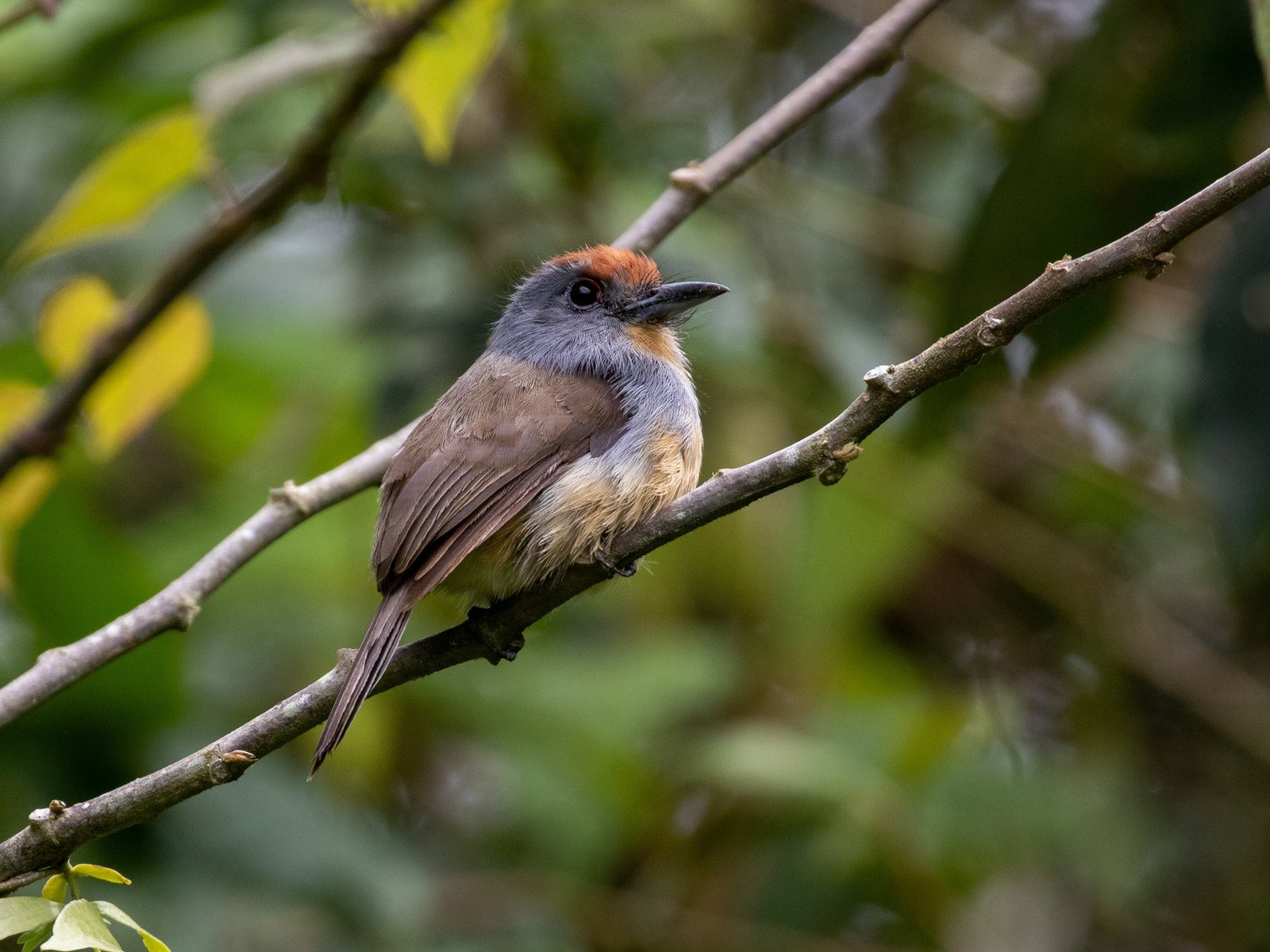
The Rufous-capped Nunlet is a small puffbird with a chestnut crown, a grey face and an orange-rufous breast. It lives in the understorey of lowland forest south of the Amazon and is often found in bamboo along rivers. Its long, rising series of clear whistles usually reveals it before it is seen.
Voice
A long series of about thirteen to thirty short, sharp, clear whistles rising in pitch; slightly softer and lower at the beginning and end.
Recording: Jerome Fischer — CC BY-NC-SA 4.0 · xeno-canto
Identification
14 cm, with a thin, slightly decurved, mostly silvery blue-grey bill. The crown is large and chestnut; the face, nape and sides of the breast are grey. The upperparts are plain dull brown with a reddish tinge. The chin and breast are orange-rufous, the flanks paler rufous and the centre of the belly whitish. The eye is brown, with a bare red eye-ring. The sexes are alike. Birds from north-eastern Peru have a darker cap and brighter breast, those from Bolivia a darker cap and duller breast.
Confusion species
Fulvous-chinned Nunlet Nonnula sclateri lacks the chestnut crown and has a paler, fulvous chin. Brown Nunlet Nonnula brunnea has a brown crown and a brown, not grey, face. Rusty-breasted Nunlet Nonnula rubecula has a white loral stripe and white eye-ring and no chestnut crown.
Habitat
Understorey and subcanopy of terra firme, secondary and transitional forest, and forest along rivers and streams, including igapó. Often in bamboo, especially dense bamboo thickets along riverbanks, but not exclusively. In hilly country often along streams. In the lowlands and lower foothills. It hunts insects from a perch. Nothing is known of its breeding.
Where the bird is most at home, classified by the vegetation units of the Andes and the west coast.


Range and movements
In Peru in the east, in the north-east and south of the Amazon south to the south-east. In Bolivia in the north, where uncommon to rare. Absent from Colombia, Ecuador and the Galápagos. Outside the guide area in Brazil south of the Amazon, east to the Tocantins.
- Resident
- dark = core range, pale = thinly spread
How and when to look
Listen in bamboo along rivers in south-eastern Peru for the rising series of clear whistles and then search the understorey for the red eye-ring and chestnut crown.
Conservation status
Least Concern. Fairly common in Brazil, less so in Peru and uncommon to rare in Bolivia; deforestation reduces its habitat locally.
Scientific name
Nonnula ruficapilla | (Tschudi, 1844)
Tschudi described the species in 1844 as Lypornix ruficapilla; because it was later moved to another genus, the author and year stand in brackets. The genus Nonnula was introduced in 1854 by Sclater. The genus name is a diminutive of Late Latin nonna, 'nun': 'little nun'. The species name ruficapilla comes from Latin rufus, 'rufous', and capillus, 'hair of the head': 'rufous-capped'. The specimen the first description was based on came from Vitoc Valley, Junín, Peru.