All species › Jacamars and puffbirds › Puffbirds › Grey-cheeked Nunlet
Grey-cheeked Nunlet | Nonnula frontalis
Noordelijke grijswangtrappist | Monjilla carigrís | Freirinha-de-bochecha-cinza
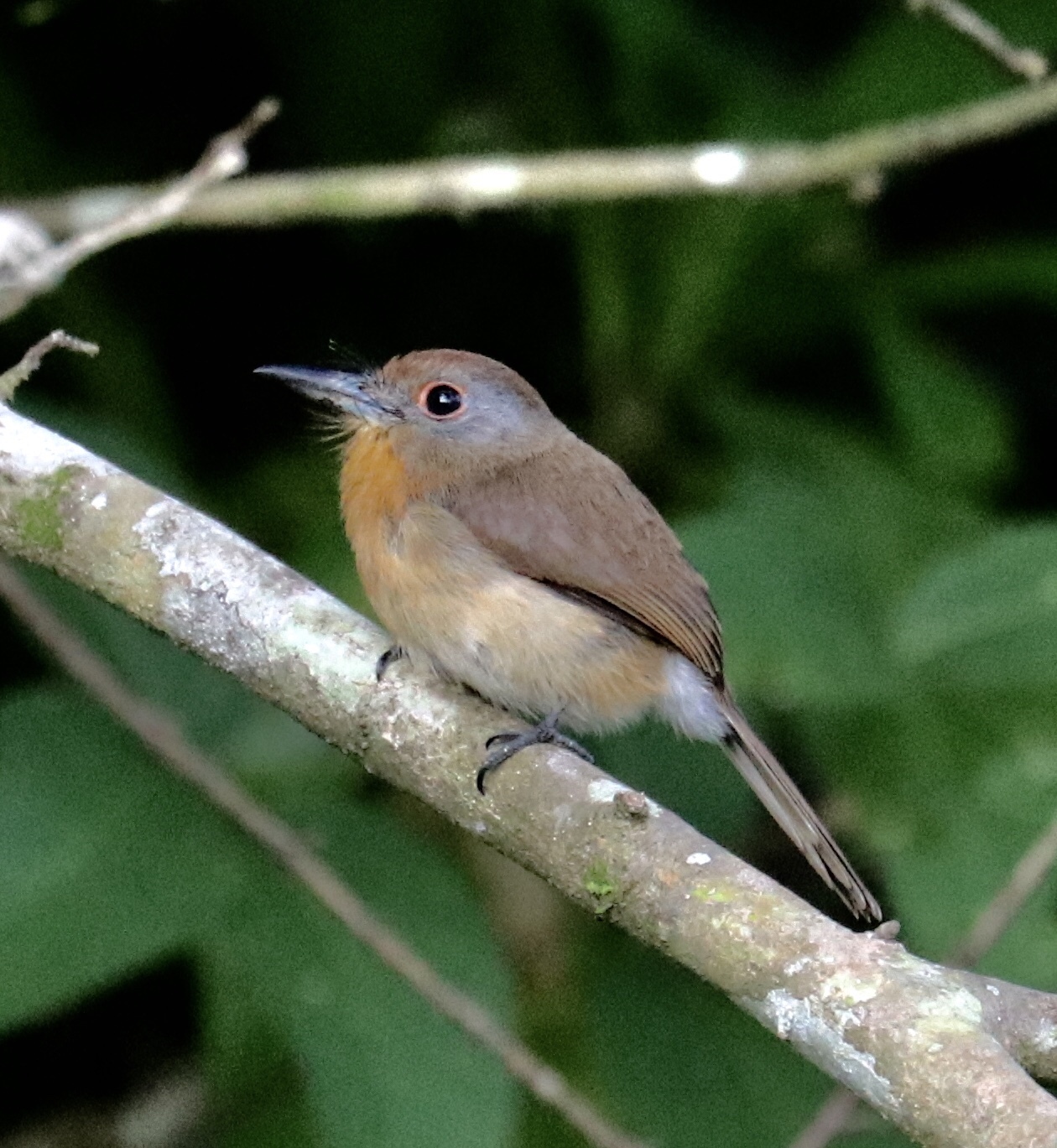
The Grey-cheeked Nunlet is a small puffbird with a dark chestnut crown, a grey face and a rufous breast. In the guide area it occurs only in northern Colombia, far from the other nunlets of Amazonia. It is sometimes lumped with Rufous-capped and Brown Nunlets.
Voice
A plaintive, measured series of up to twenty notes, wee-ip wee-ip wee-ip.
Recording: Kent Livezey — CC BY-NC-SA 4.0 · xeno-canto
Identification
14–15 cm, with a thin, slightly decurved, mostly blue-grey bill. The crown is very dark chestnut, the upperparts plain brown with a paler rump. The face is grey and the dark eye is surrounded by bare red skin. The chin, throat, breast and flanks are rufous, the belly buffy. The tail is dark brown, almost black towards the tip. The sexes are alike. Birds of the Caribbean lowlands are much paler above, with a buffy throat and breast.
Confusion species
No other nunlets occur in its range. White-whiskered Puffbird Malacoptila panamensis is larger and bulkier, streaked, with white whiskers and a white forehead. Collared Puffbird Bucco capensis and the jacamars differ completely in colour and shape.
Habitat
Moist to humid primary and secondary forest, gallery forest and thickets, especially woodland along rivers. From sea level to about 1000 m. It mostly stays in the lower strata, sometimes up to the subcanopy. In Colombia it breeds from February to June; little is known about the nest.
Where the bird is most at home, classified by the vegetation units of the Andes and the west coast.


Range and movements
In Colombia in the north: in the Caribbean lowlands, the northern interior including the lower Magdalena and Cauca valleys, and the far north-west. Absent from Ecuador, Peru, Bolivia and the Galápagos. Outside the guide area in central and eastern Panama.
- Resident
- dark = core range, pale = thinly spread
How and when to look
Search gallery forest and forest edges along rivers in northern Colombia, where the measured series of whistles comes from the lower strata.
Conservation status
Least Concern. Fairly common in Colombia, but the forest in its range is heavily fragmented by farming and ranching.
Scientific name
Nonnula frontalis | (Sclater, 1854)
Sclater described the species in 1854 as Malacoptila frontalis; because it was later moved to another genus, the author and year stand in brackets. The genus Nonnula was introduced in 1854 by Sclater. The genus name is a diminutive of Late Latin nonna, 'nun': 'little nun'. The species name frontalis comes from Latin frons, 'forehead', and refers to the forehead markings. The specimen the first description was based on came from Colombia.