All species › Jacamars and puffbirds › Puffbirds › Brown Nunlet
Brown Nunlet | Nonnula brunnea
Bruine trappist | Monjilla parda | Freirinha-parda
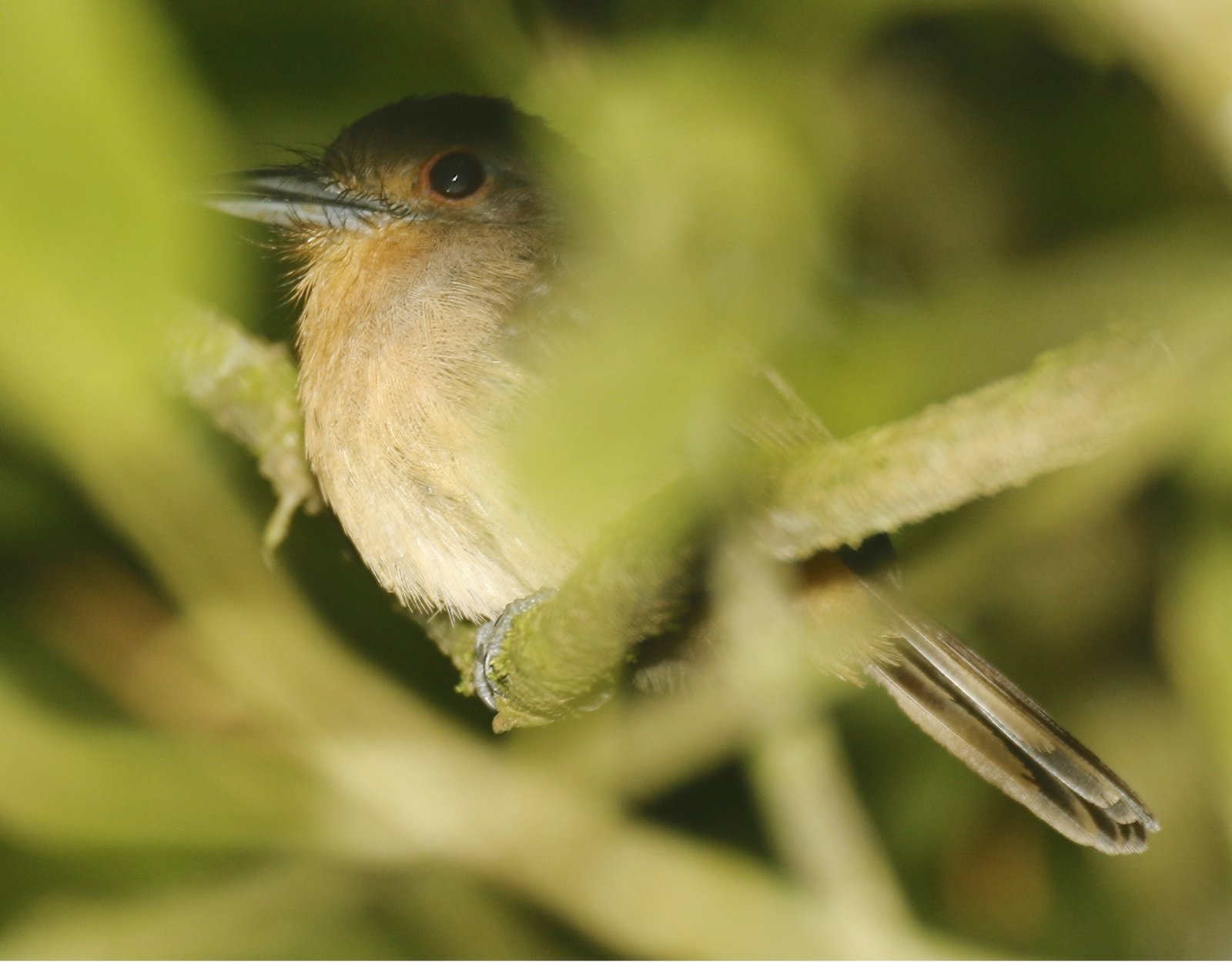
The Brown Nunlet is a small, warm rufous-brown puffbird of western Amazonia. Almost its entire range lies within the guide area, in southern Colombia, eastern Ecuador and northern Peru. It lives below the canopy of lowland forest and is rare to uncommon throughout.
Voice
A series of twenty to twenty-five notes, tree-oo tree-oo, at a steady pace; the series starts quietly, swells and fades away again at the end.
Recording: John V. Moore — CC BY-NC-SA 4.0 · xeno-canto
Identification
14–15 cm, with a thin, slightly decurved, dark bill. The crown and upperparts are plain brown. A buffy to rufous stripe runs from the bill to the eye, a narrow buffy eye-ring surrounds the eye and the cheek is dark greyish brown. The throat and flanks are dark rufous, the chin and breast paler rufous and the belly buffy rufous. The eye and legs are dark. The sexes are alike.
Confusion species
Rusty-breasted Nunlet Nonnula rubecula is greyer above, with a white loral stripe and white eye-ring and a whitish belly. Rufous-capped Nunlet Nonnula ruficapilla has a chestnut crown, a grey face and a bare red eye-ring. Lanceolated Monklet Micromonacha lanceolata has a white forehead and white underparts streaked black.
Habitat
Humid terra firme forest and dense secondary forest in the lowlands. In Ecuador mostly below 400 m, locally to 700 m. It stays below the canopy, in the lower and middle storeys, and sometimes joins mixed flocks of antwrens. Its diet and behaviour have hardly been studied. One described nest was a trench dug into the ground, roofed with sticks and leaves.
Where the bird is most at home, classified by the vegetation units of the Andes and the west coast.


Range and movements
In Colombia in the south, in the Amazonian lowlands. In Ecuador in the eastern lowlands and lower foothills. In Peru in the north. Absent from Bolivia and the Galápagos. Hardly or not at all outside the guide area.
- Resident
- dark = core range, pale = thinly spread
How and when to look
Listen in terra firme forest in eastern Ecuador for the swelling and fading series of notes and follow mixed flocks in the understorey and mid-storey.
Conservation status
Least Concern. Its range is small compared with related species, but lies largely in still extensive forest; clearance along roads and rivers is the main threat.
Scientific name
Nonnula brunnea | Sclater, 1881
Sclater described the species in 1881 and placed it straight away in the genus where it still stands. The genus Nonnula was introduced in 1854 by Sclater. The genus name is a diminutive of Late Latin nonna, 'nun': 'little nun'. The species name brunnea comes from Medieval Latin brunneus, 'brown'. The specimen the first description was based on came from Sarayacu, Ecuador.