All species › Jacamars and puffbirds › Puffbirds › Fulvous-chinned Nunlet
Fulvous-chinned Nunlet | Nonnula sclateri
Geelkintrappist | Monjilla de Sclater | Freirinha-amarelada
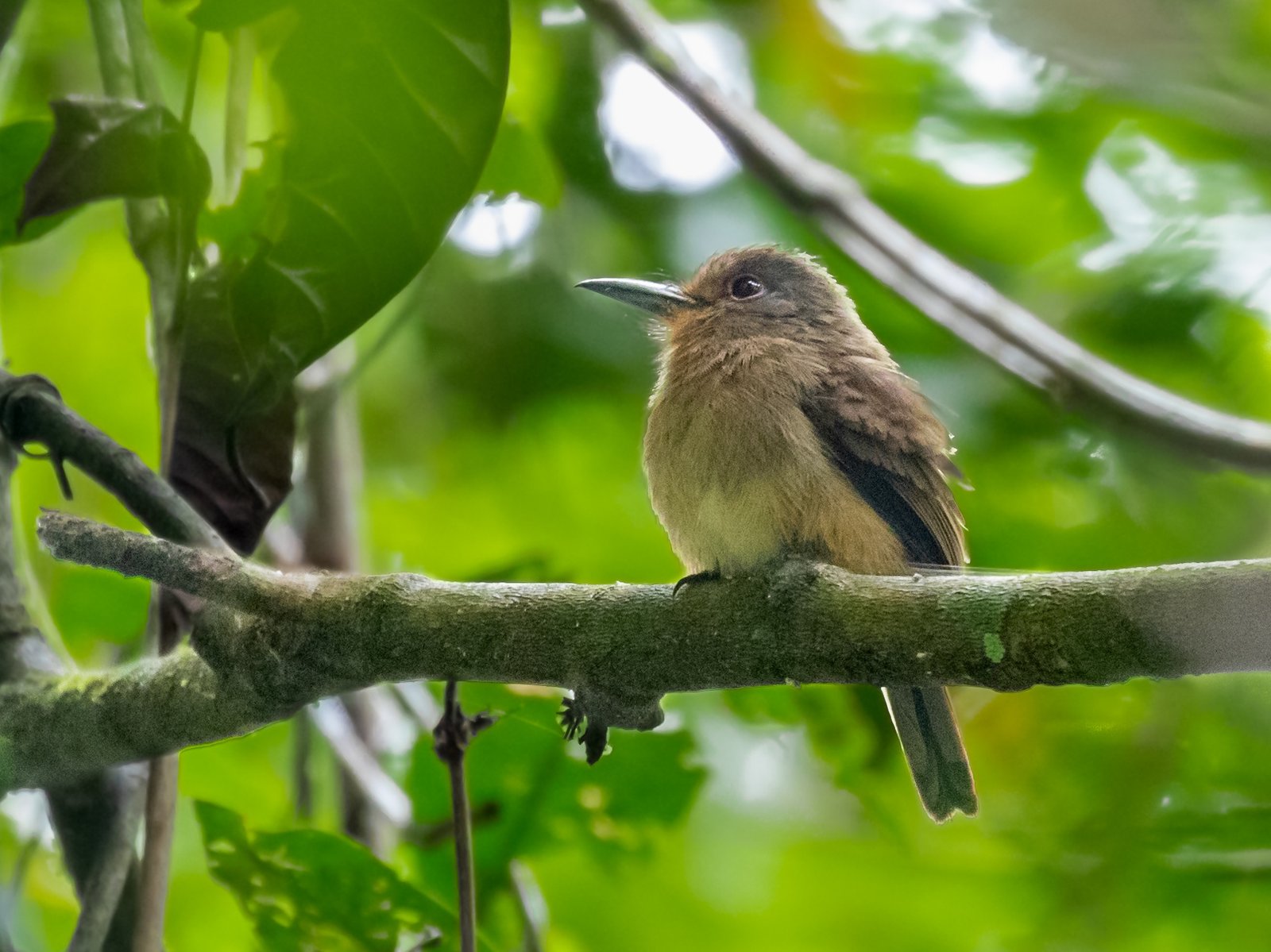
The Fulvous-chinned Nunlet is a small, brown puffbird of south-western Amazonia, with a dark grey cheek, a rufous-brown breast and a narrow red eye-ring. It lives in the lower strata of lowland forest and is known mainly from its weak, mewing song. Little is known of its behaviour and breeding.
Voice
A weak series of thin, mewing whistles.
Recording: Jacob Wijpkema — CC BY-NC-SA 4.0 · xeno-canto
Identification
14–15 cm, with a thin, slightly decurved bill: the upper mandible black, the lower grey. The upperparts, wings and tail are dull brown. The cheek is dark grey and the lores rufous-brown; a narrow coral-red to purplish-red eye-ring surrounds the dark eye. The chin is pale fulvous, blending into rufous-brown on the throat and breast; the flanks are dull fulvous and the centre of the belly whitish. The sexes are alike; females average slightly heavier.
Confusion species
Rufous-capped Nunlet Nonnula ruficapilla has an obvious chestnut crown, a grey nape and a brighter orange-rufous breast. Rusty-breasted Nunlet Nonnula rubecula has a white eye-ring and white loral stripe instead of a red eye-ring; their ranges barely meet in the guide area. Lanceolated Monklet Micromonacha lanceolata has a white forehead and streaked white underparts.
Habitat
Humid lowland forest, mainly the understorey of terra firme forest; also at the edges of várzea. Rarely above 300 m. It hunts insects from a low perch. The nest has not been reliably described; related species make a shallow, roofed scrape on the ground.
Where the bird is most at home, classified by the vegetation units of the Andes and the west coast.


Range and movements
In Peru in the east and south-east, south of the Amazon. In Bolivia in the north. Absent from Colombia, Ecuador and the Galápagos. Outside the guide area in south-western Brazil, east to the Madeira.
- Resident
- dark = core range, pale = thinly spread
How and when to look
Listen in terra firme forest in south-eastern Peru and northern Bolivia for the thin, mewing series and scan the understorey at eye level.
Conservation status
Least Concern. Its habitat is declining locally through deforestation.
Scientific name
Nonnula sclateri | Hellmayr, 1907
Hellmayr described the species in 1907 and placed it straight away in the genus where it still stands. The genus Nonnula was introduced in 1854 by Sclater. The genus name is a diminutive of Late Latin nonna, 'nun': 'little nun'. The species name sclateri honours Philip Lutley Sclater (1829–1913), English ornithologist, who described the genus Nonnula. The specimen the first description was based on came from Humaitá (Rio Madeira), Amazonas, Brazil.