All species › Jacamars and puffbirds › Puffbirds › Rusty-breasted Nunlet
Rusty-breasted Nunlet | Nonnula rubecula
Roodborsttrappist | Monjilla macurú | Macuru
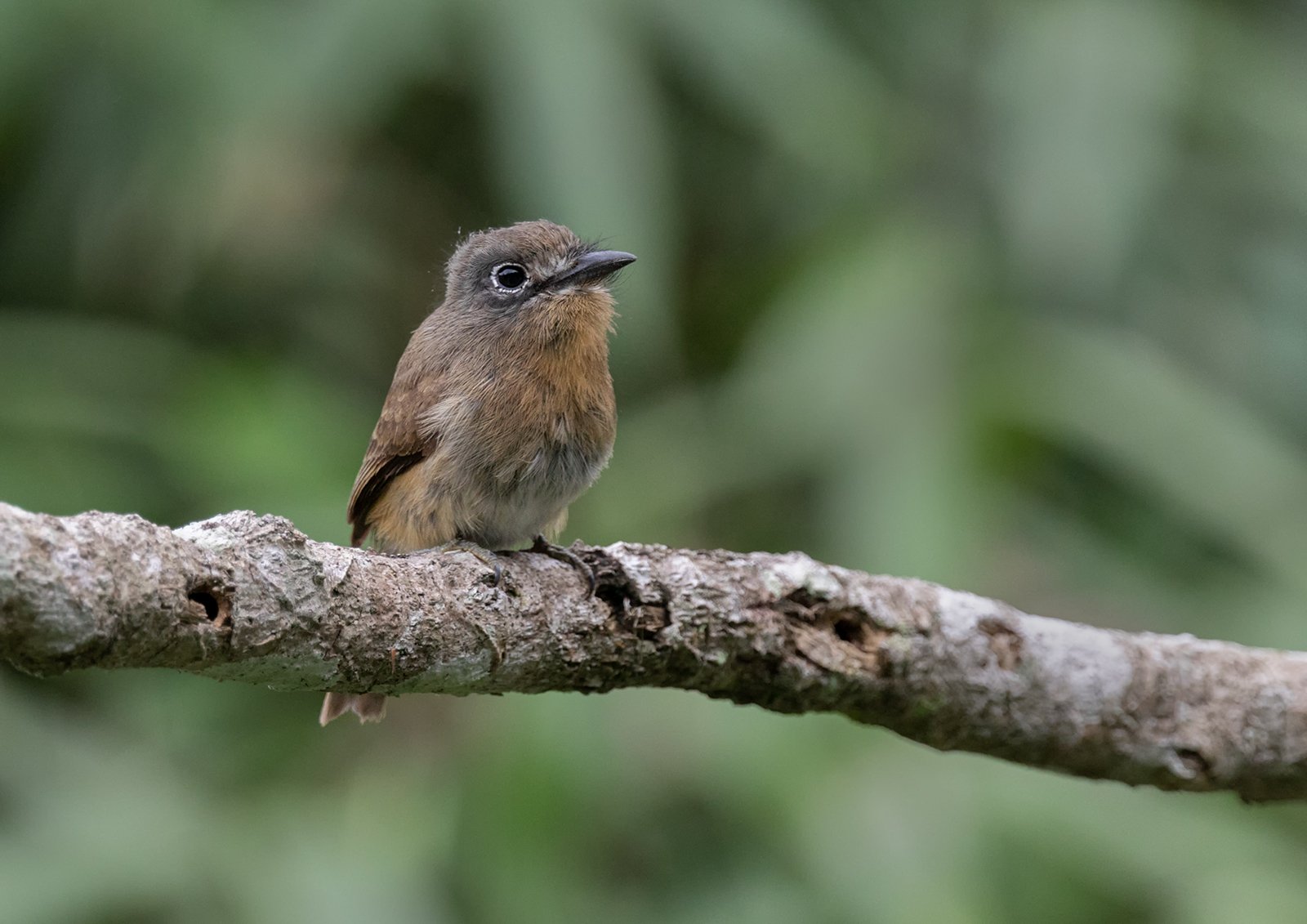
The Rusty-breasted Nunlet is a small, brown puffbird with a rusty breast and a white eye-ring. It sits motionless for long periods in the mid-storey of lowland forest and is mostly noticed by its series of plaintive whistles. In the guide area it lives only in the north-west of the Amazon basin; most of its range lies further east in South America.
Voice
A mewing series of up to about twenty whistles, wee-ip wee-ip wee-ip, rising in pitch and volume. It sings infrequently.
Recording: JAYRSON ARAUJO DE OLIVEIRA — CC BY-NC-SA 4.0 · xeno-canto
Identification
14–15 cm, with a thin, slightly decurved, dark bill and a fairly long tail. The upperparts are plain greyish brown, the crown slightly greyer. A whitish stripe across the lores joins a narrow white eye-ring. The throat and breast are rusty brown to cinnamon, the flanks browner and the centre of the belly whitish. The sexes are alike. Juveniles resemble adults.
Confusion species
Brown Nunlet Nonnula brunnea is almost entirely warm rufous-brown below, with a buffy stripe from bill to eye and no white eye-ring. Rufous-capped Nunlet Nonnula ruficapilla has a chestnut crown, a grey face and a bare red eye-ring. Lanceolated Monklet Micromonacha lanceolata is smaller and shorter-tailed, with a white forehead and white underparts streaked black.
Habitat
Humid lowland forest on terra firme and in várzea, also older secondary forest and edges; it avoids igapó. In the guide area in the lowlands, mostly below 500 m. It sits still on a branch in the mid-storey for long periods and catches insects with short sallies to leaves and twigs. The nest is a shallow scrape on sloping ground, roofed with twigs and leaves; usually four eggs.
Where the bird is most at home, classified by the vegetation units of the Andes and the west coast.


Range and movements
In Colombia in the Amazonian lowlands of the south-east. In Ecuador very locally in the north-east. In Peru in the north-east. Absent from Bolivia and the Galápagos. Outside the guide area in southern Venezuela, the Guianas and much of Brazil, south to Paraguay and north-eastern Argentina.
- Resident
- dark = core range, pale = thinly spread
How and when to look
In the morning, listen in terra firme forest for the rising series of whistles and then scan the mid-storey slowly; the bird often sits still and becomes visible when it sallies for prey.
Conservation status
Least Concern. The population is probably declining slowly through deforestation, but the range is large.
Scientific name
Nonnula rubecula | (Spix, 1824)
Spix described the species in 1824 as Bucco rubecula; because it was later moved to another genus, the author and year stand in brackets. The genus Nonnula was introduced in 1854 by Sclater. The genus name is a diminutive of Late Latin nonna, 'nun': 'little nun'. The species name rubecula is a diminutive of Latin ruber, 'red': 'little red one', after the rusty breast. The specimen the first description was based on came from Malhada (Rio São Francisco), Bahia, Brazil.