All species › Jacamars and puffbirds › Puffbirds › Yellow-billed Nunbird
Yellow-billed Nunbird | Monasa flavirostris
Geelsnaveltrappist | Monja piquiamarilla | Chora-chuva-de-bico-amarelo
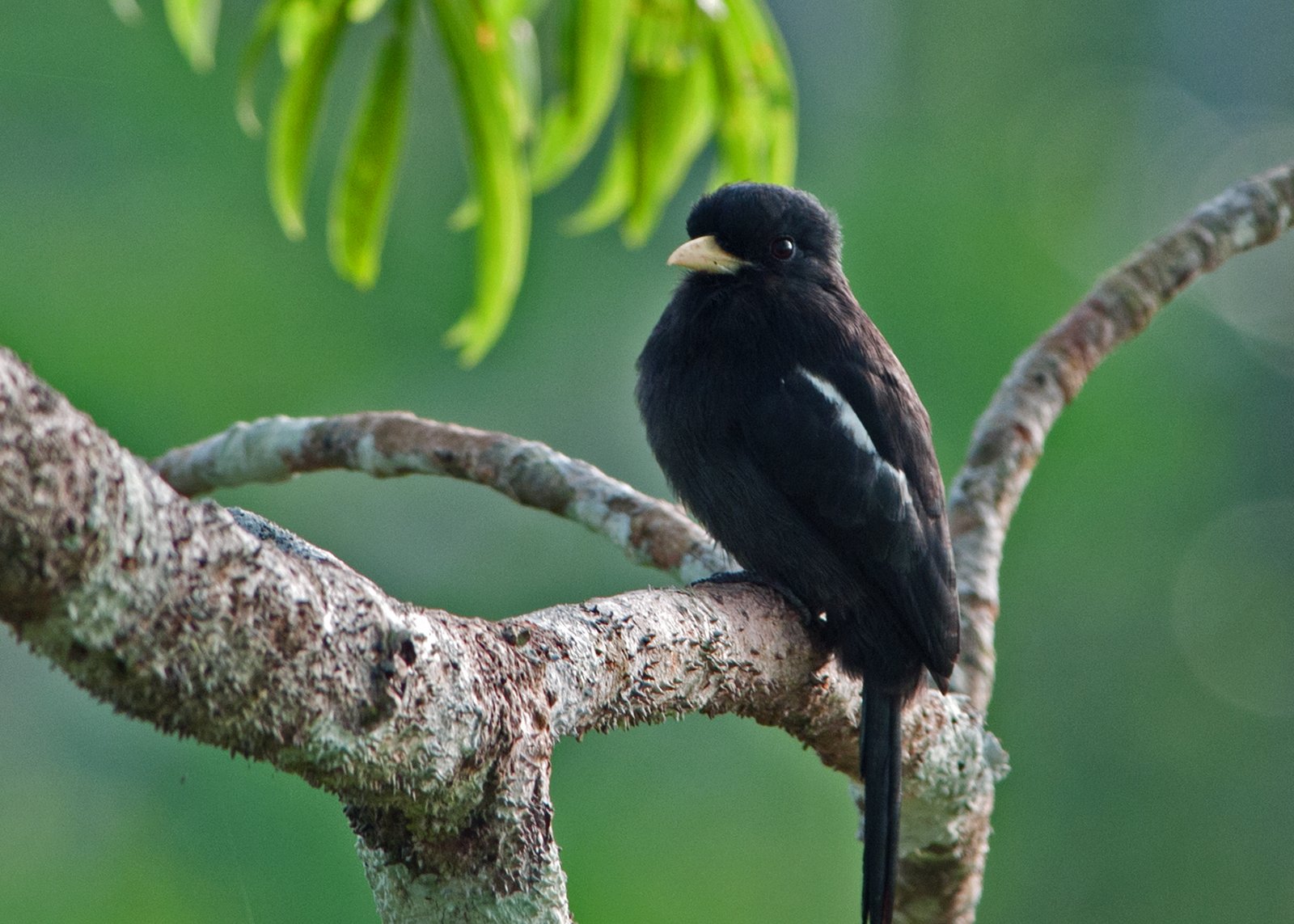
The Yellow-billed Nunbird is the smallest nunbird of the guide area, black with a yellow bill and white shoulders. It sits higher than the other nunbirds, often in the upper canopy and at forest edges. It lives in pairs or small groups in western Amazonia.
Voice
Loud, rolling choruses, as in other nunbirds but usually shorter; also single whistled calls.
Recording: Mauricio Cuellar Ramirez (@Birding.travel) — CC BY-NC-SA 4.0 · xeno-canto
Identification
24–25 cm, with a long tail and a slightly decurved, bright yellow bill. The plumage is black to dark slate-grey. The lesser wing coverts carry a white patch, visible as a white shoulder, and the bend of the wing is white. The sexes are alike; juveniles are duller and browner, with a less yellow bill.
Confusion species
Black-fronted Nunbird Monasa nigrifrons and White-fronted Nunbird Monasa morphoeus are larger, with a red bill and no white shoulder. Black Nunbird Monasa atra has white shoulders and a red bill and lives far to the north-east.
Habitat
Forest edges, secondary forest, várzea and terra firme forest, clearings with tall trees and the lower foothills, from the lowlands up to about 1300 m. It often sits high on an open branch and takes large insects in flight or from leaves and branches. The nest is at the end of a tunnel in the ground.
Where the bird is most at home, classified by the vegetation units of the Andes and the west coast.


Range and movements
In Colombia in the south-east, in Amazonia. In Ecuador in the eastern lowlands and foothills. In Peru in the Amazonian lowlands and the foothills of the eastern slope, less so towards the south. In Bolivia only in the far north-west. Absent from the Galápagos. Outside the guide area in western Brazilian Amazonia.
- Resident
- dark = core range, pale = thinly spread
How and when to look
Along forest edges, rivers and roads in the lowlands and lower foothills; look for black birds with a yellow bill high on open branches.
Conservation status
Least Concern. The species tolerates forest edges and secondary forest.
Scientific name
Monasa flavirostris | Strickland, 1850
Strickland described the species in 1850 and placed it straight away in the genus where it still stands. The genus Monasa was introduced in 1816 by Vieillot. The genus name comes from Greek monas, 'solitary'. The species name comes from Latin flavus, 'yellow', and rostrum, 'bill'. The specimen the first description was based on came from Peru.