All species › Jacamars and puffbirds › Puffbirds › White-fronted Nunbird
White-fronted Nunbird | Monasa morphoeus
Witvoorhoofdtrappist | Monja frentiblanca | Chora-chuva-de-cara-branca
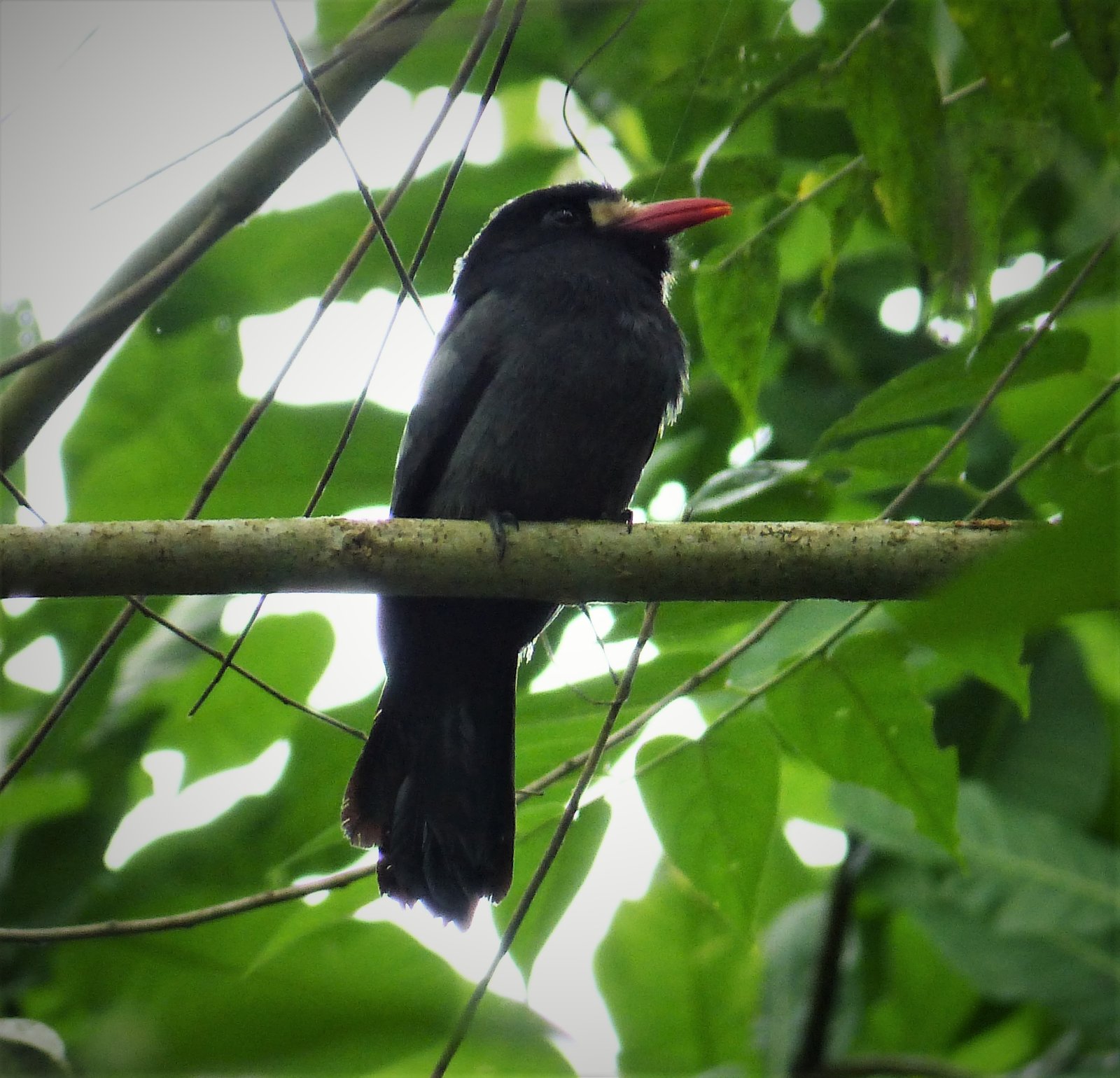
The White-fronted Nunbird is a dark grey nunbird with a white blaze around the base of its red bill. It lives in small groups in the interior of tall rainforest, mainly terra firme, and is a regular member of mixed flocks. Outside Amazonia it also occurs in northern Colombia and Central America.
Voice
Loud, rolling and cackling choruses by several birds at once, often long sustained; also single whistled calls, which appear to keep mixed flocks together.
Recording: JAYRSON ARAUJO DE OLIVEIRA — CC BY-NC-SA 4.0 · xeno-canto
Identification
24–26 cm, with a long tail and a coral-red, slightly decurved bill. The forehead, lores and chin are white, forming a white blaze around the base of the bill. The head is blackish and the rest of the plumage slate-grey, slightly paler below. The sexes are alike; juveniles are browner and have less white.
Confusion species
Black-fronted Nunbird Monasa nigrifrons lacks the white around the bill and lives mainly along rivers and in flooded forest. Yellow-billed Nunbird Monasa flavirostris has a yellow bill and white shoulders and usually sits higher, at forest edges.
Habitat
Humid terra firme lowland forest, also foothill forest, old secondary forest and forest edges, from the lowlands up to about 1100 m. It sits in small groups at mid-height and takes large insects, spiders and small vertebrates, often with mixed flocks. The nest is at the end of a tunnel in the ground, often with a collar of leaves around the entrance.
Where the bird is most at home, classified by the vegetation units of the Andes and the west coast.


Range and movements
In Colombia in the north-west, from the Panama border to the middle Magdalena Valley, and in the lowlands east of the Andes. In Ecuador in the eastern lowlands and lower foothills. In Peru in the Amazonian lowlands and the lower foothills of the eastern slope. In Bolivia in the lowlands of the north and centre. Absent from the Galápagos. Outside the guide area from Honduras to Panama, in southern Venezuela, Brazilian Amazonia and the Atlantic Forest of Brazil.
- Resident
- dark = core range, pale = thinly spread
How and when to look
Walk trails through tall terra firme forest and listen for the choruses; then follow mixed flocks, in which the nunbirds often sit upright and still at mid-height.
Conservation status
Least Concern. The species depends on forest and disappears where forest is cleared on a large scale.
Scientific name
Monasa morphoeus | (Hahn & Küster, 1823)
Hahn & Küster described the species in 1823 as Bucco Morphoeus; because it was later moved to another genus, the author and year stand in brackets. The genus Monasa was introduced in 1816 by Vieillot. The genus name comes from Greek monas, 'solitary'. The species name refers to Morpheus, in Greek mythology the son of Sleep and god of dreams; Cabanis and Heine thought Wagler named the 'dreamy, sleepy' bird this way. The specimen the first description was based on came from Brazil.