All species › Passerines › Ovenbirds and woodcreepers › Rusty-winged Barbtail
Rusty-winged Barbtail | Premnornis guttuliger
Roestvleugelboomloper | Subepalo alirrojizo | Subepalo-de-asa-ruiva
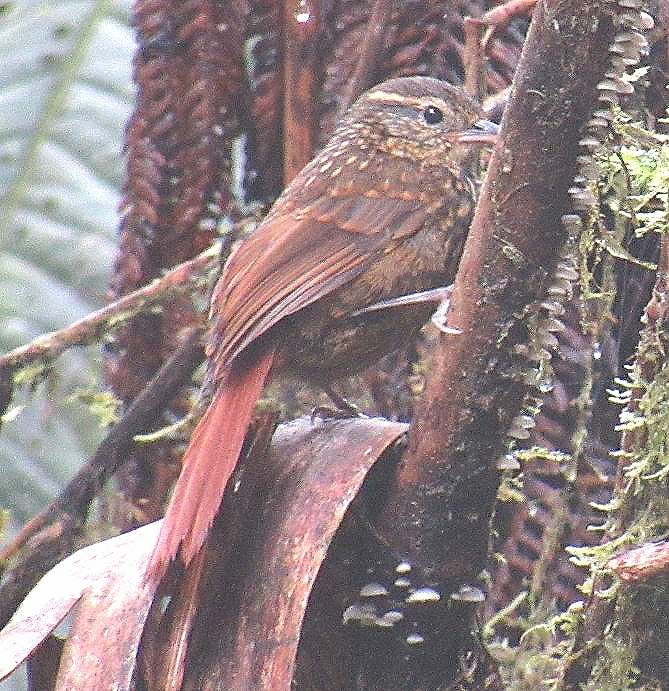
The Rusty-winged Barbtail is a small, brown ovenbird of humid montane forest in the northern and central Andes. Despite its name it seldom climbs trunks: it forages mostly like a foliage-gleaner among dead leaves, moss and epiphytes in the undergrowth. It is the only species in its genus.
Voice
Mostly silent. Gives a high, thin tseet; the song is a short, high trill.
Recording: Mitch Lysinger — CC BY-NC-SA 4.0 · xeno-canto
Identification
14–15 cm, with a thin, straight bill. The crown and mantle are brown with fine buff streaks; the wings and tail are rufous. A buff supercilium. The throat is buff, the breast brown with buff, drop-shaped spots and streaks, the belly plainer brown. The tail feathers end in short, stiff points. The sexes are alike.
Confusion species
Spotted Barbtail Premnoplex brunnescens is darker, with dense buff spots on the underparts and a shorter, dark tail, and creeps up trunks. Pearled Treerunner Margarornis squamiger is bright rufous above, with a white throat and white, black-edged drops on the underparts. Lineated Foliage-Gleaner Syndactyla subalaris is larger, with a heavier bill and narrow pale streaks on the mantle.
Habitat
Undergrowth and middle storey of humid montane forest and cloud forest, mostly between 1500 and 2600 m. It searches clusters of dead leaves, moss and epiphytes for insects and spiders, often in mixed flocks. Little is known about the nest.
Where the bird is most at home, classified by the vegetation units of the Andes and the west coast.


Range and movements
Colombia: in all three Andean ranges. Ecuador: on both slopes of the Andes, more locally on the western slope. Peru: on the eastern slope south to Cusco. Absent from Bolivia and the Galápagos. Outside the guide area in the Andes of western Venezuela.
- Resident
- dark = core range, pale = thinly spread
How and when to look
Watch for mixed flocks with treerunners and foliage-gleaners in cloud forest and check the lower storey for a small brown bird with rufous wings tugging at dead leaves.
Conservation status
Least Concern. Clearance of montane forest locally reduces its habitat.
Scientific name
Premnornis guttuliger | (Sclater, 1864)
Sclater described the species in 1864 as Thripophaga guttuligera; because it was later moved to another genus, the author and year stand in brackets. The genus Premnornis was introduced in 1909 by Ridgway. The genus name combines Greek premnon, 'tree trunk', and ornis, 'bird'. The species name guttuliger combines Latin guttula, 'small spot', and -ger, 'bearing'. The specimen the first description was based on came from Bogotá, Colombia.