All species › Passerines › Ovenbirds and woodcreepers › Cactus Canastero
Cactus Canastero | Pseudasthenes cactorum
Cactuscanastero | Canastero de los cactus | Lenheiro-dos-cactos
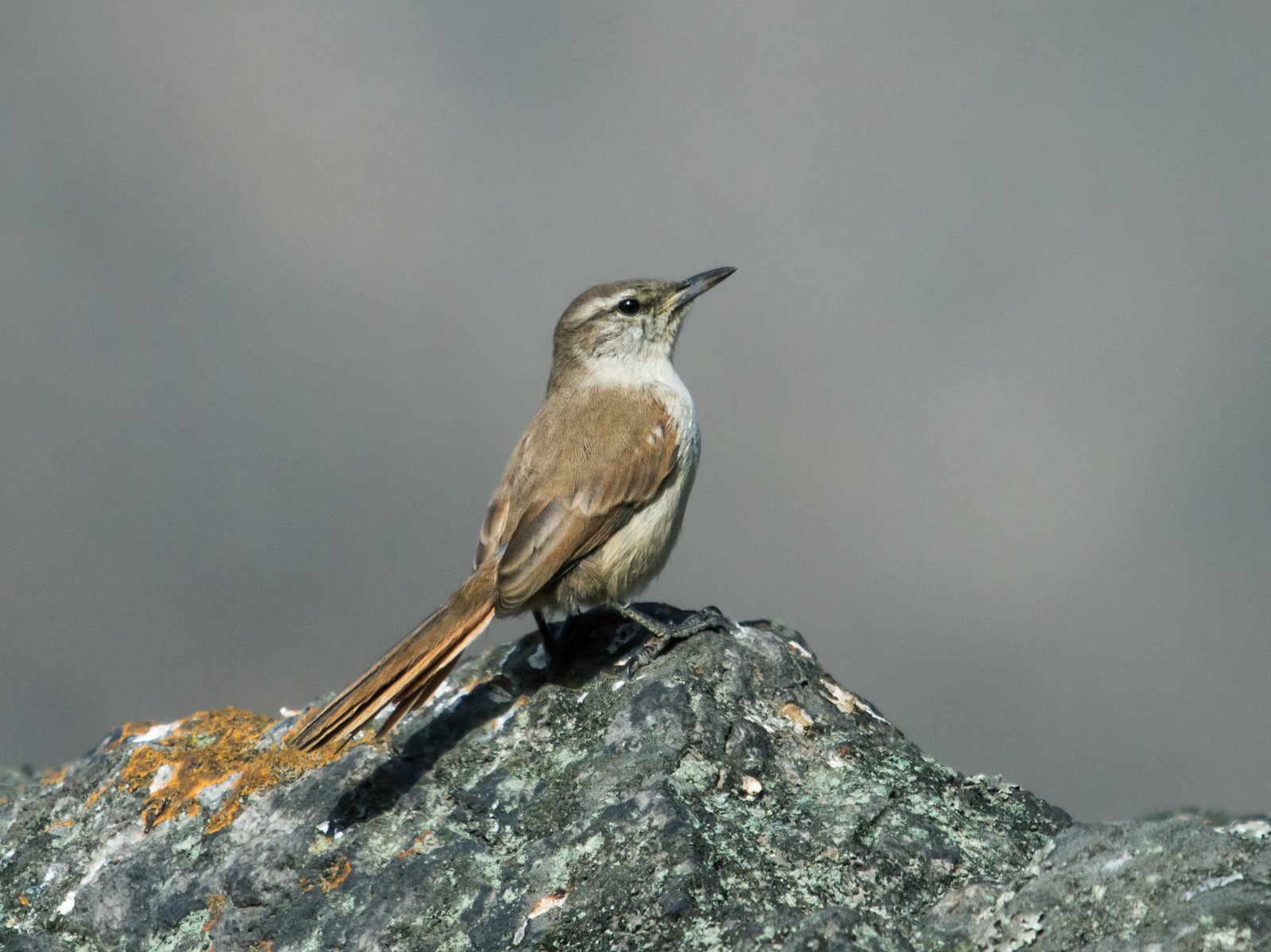
The Cactus Canastero is a small, greyish-brown canastero found only in Peru, on the dry western slope of the Andes. It lives on rocky slopes with columnar cacti and scattered shrubs and builds its nest in those cacti, to which its name refers. It is the only species of the genus Pseudasthenes in the guide area.
Voice
The song is a weak, dry trill lasting up to about six seconds. The call is a low, fast, dry trill, often repeated.
Recording: Scott Olmstead — CC BY-NC-SA 4.0 · xeno-canto
Identification
15–16 cm, with a fairly long tail and a thin, straight bill. Crown and upperparts are plain dull brown, with a pale buff supercilium and a dark eye-stripe. The chin and centre of the throat are pale orange-tawny, the rest of the underparts pale buff. The wing coverts are dull rufous and the closed wing shows a rufous band. The central tail feathers are brown, the outer ones largely rufous. The sexes are alike.
Confusion species
Canyon Canastero Asthenes pudibunda is slightly larger and warmer rufous, especially on the wings and tail, and usually lives higher, in shrubby ravines up into Polylepis woodland. Pale-tailed Canastero Asthenes huancavelicae has a pale tail and lives in the dry inter-Andean valleys, not on the western slope.
Habitat
Arid montane scrub with scattered shrubs and columnar cacti on the western slope of the Andes, from about 50 to 2500 m. It searches for arthropods on the ground, on rocks and on cacti, possibly also in low vegetation. The nest is placed in columnar cacti; the species breeds in the austral spring and summer.
Where the bird is most at home, classified by the vegetation units of the Andes and the west coast.


Range and movements
Peru: endemic, on the western slope of the Andes in La Libertad and from Lima south to Arequipa. Absent from Colombia, Ecuador, Bolivia and the Galápagos. Does not occur outside the guide area.
- Resident
- dark = core range, pale = thinly spread
How and when to look
Search dry, rocky slopes with columnar cacti in the valleys that run from the western slope to the coast, for example in the valleys east of Lima. Birds often perch on or among the cacti and give themselves away by their dry trill.
Conservation status
Least Concern. The range is small, but the arid montane scrub is under little pressure in most places.
Scientific name
Pseudasthenes cactorum | (Koepcke, 1959) (GBIF: Asthenes cactorum)
Koepcke described the species in 1959 as Asthenes cactorum; because it was later moved to another genus, the author and year stand in brackets. The genus Pseudasthenes was introduced in 2010 by Derryberry, Claramunt, O'Quin, Aleixo, Chesser, Remsen & Brumfield. The genus name combines Greek pseudos, 'false', with the genus Asthenes, in which these species were formerly placed. The species name cactorum is Latin for 'of the cacti', after its habitat with columnar cacti. The specimen the first description was based on came from Atico, Arequipa, Peru.