All species › Passerines › Ovenbirds and woodcreepers › Spot-throated Woodcreeper
Spot-throated Woodcreeper | Certhiasomus stictolaemus
Vlekkeelmuisspecht | Trepatroncos gorjipunteado | Arapaçu-de-garganta-pintada
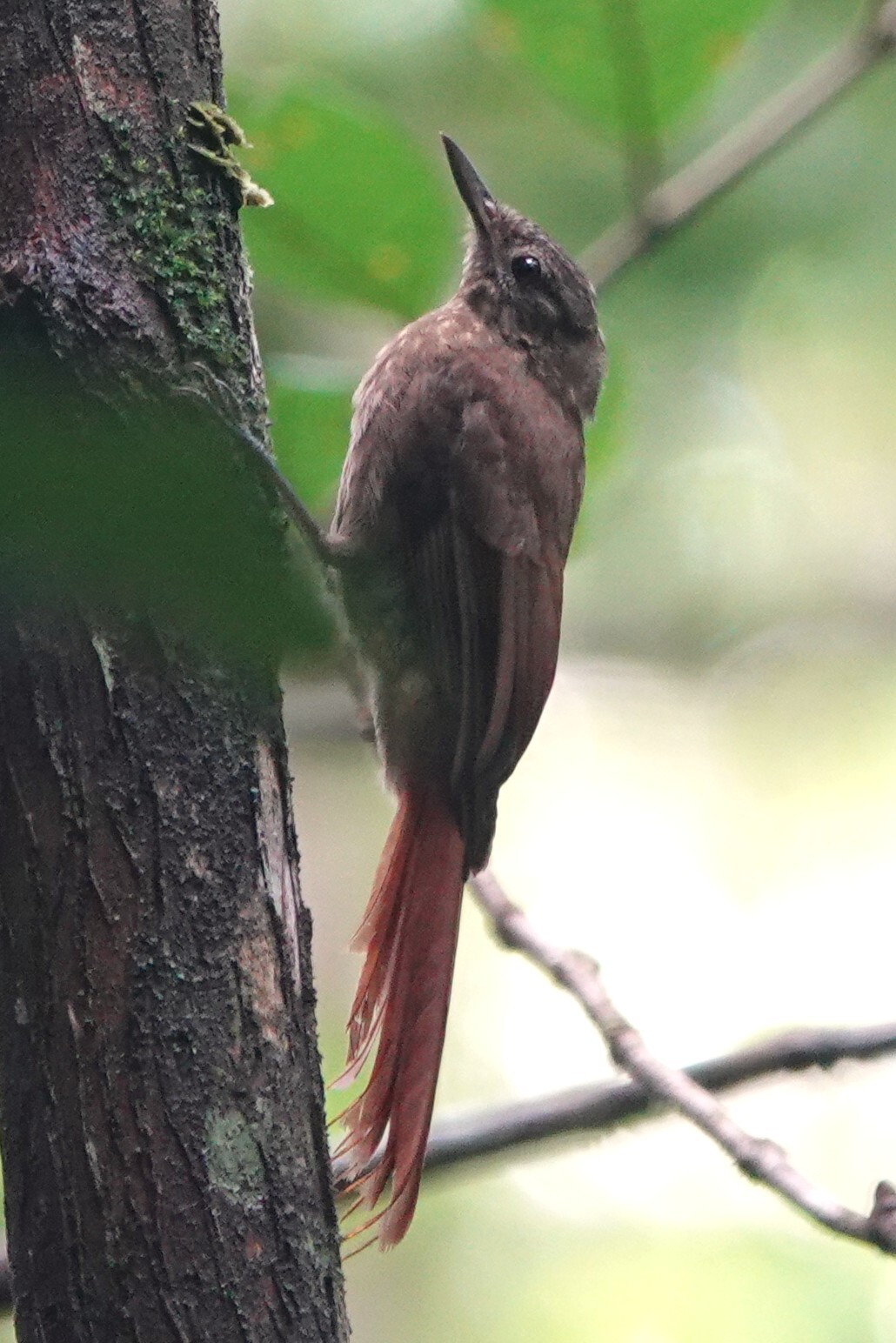
The Spot-throated Woodcreeper is a small, plainly marked woodcreeper of terra firme rainforest in the north-western Amazon. It is the only species in the genus Certhiasomus and was formerly placed in Deconychura. It climbs trunks in the lower and middle levels of the forest, usually in mixed flocks.
Voice
The song is a high, rapid trill or series of thin notes, often slightly descending. The call is a short, sharp tseet.
Recording: Paul Lenrumé — CC BY-NC-SA 4.0 · xeno-canto
Identification
16–17 cm, small and slim, with a thin, straight bill and a stiff, rufous tail. The upperparts are olive-brown, and the wings, rump and tail rufous. A narrow, pale supercilium runs behind the eye. The throat is buff with fine, dark scales or spots, and the breast olive-brown with small, pale spots that fade towards the belly. The crown is dark with fine pale dots. The sexes are alike.
Confusion species
Wedge-billed Woodcreeper Glyphorynchus spirurus is smaller, with a short, wedge-shaped bill with an upturned lower mandible. Olivaceous Woodcreeper Sittasomus griseicapillus has an unspotted, greyish-olive head and breast. Mournful Long-tailed Woodcreeper Deconychura pallida is larger, with a clearly longer tail and a finely streaked rather than spotted throat. Foliage-gleaners (Automolus, Philydor) do not climb trunks using the tail as a prop.
Habitat
The interior of tall, humid terra firme rainforest, also in the foothills, from the lowlands to about 1000 m. It searches trunks and thick branches in the lower and middle levels for insects and spiders in bark, moss and crevices. It usually joins mixed flocks. The nest is in a tree cavity.
Where the bird is most at home, classified by the vegetation units of the Andes and the west coast.


Range and movements
Colombia: in the Amazon region of the south-east. Ecuador: in the lowlands and foothills east of the Andes. Peru: in the north of the Amazon basin, mainly north of the Amazon and the Marañón. Absent from Bolivia and the Galápagos. Outside the guide area in southern Venezuela and north-western Brazil, with a separate population south of the Amazon.
- Resident
- dark = core range, pale = thinly spread
How and when to look
Follow mixed flocks in the interior of terra firme forest and watch for a small, slim woodcreeper climbing trunks at mid-levels. The thin bill and spotted throat separate it from Wedge-billed Woodcreeper, which often travels in the same flock.
Conservation status
Least Concern. The species has a large range in undisturbed rainforest and is locally fairly common there, but depends on continuous forest.
Scientific name
Certhiasomus stictolaemus | (Pelzeln, 1868) (GBIF: Deconychura stictolaema)
Pelzeln described the species in 1868 as Sittasomus stictolaemus; because it was later moved to another genus, the author and year stand in brackets. The genus Certhiasomus was introduced in 2010 by Derryberry, Claramunt, Chesser, Aleixo, Cracraft, Moyle & Brumfield. The genus name comes from Greek certhia, 'treecreeper', and sōma, 'body', referring to the similarity of this small woodcreeper to the treecreepers; its form parallels Sittasomus, the genus in which the species was first described. The species name comes from Ancient Greek stiktos, 'spotted', and laimos, 'throat'. The specimen the first description was based on came from Borba, Rio Madeira, Brazil.