All species › Passerines › Ovenbirds and woodcreepers › Black-banded Woodcreeper
Black-banded Woodcreeper | Dendrocolaptes picumnus
Blauwsnavelmuisspecht | Trepatroncos vientre barrado | Arapaçu-meio-barrado
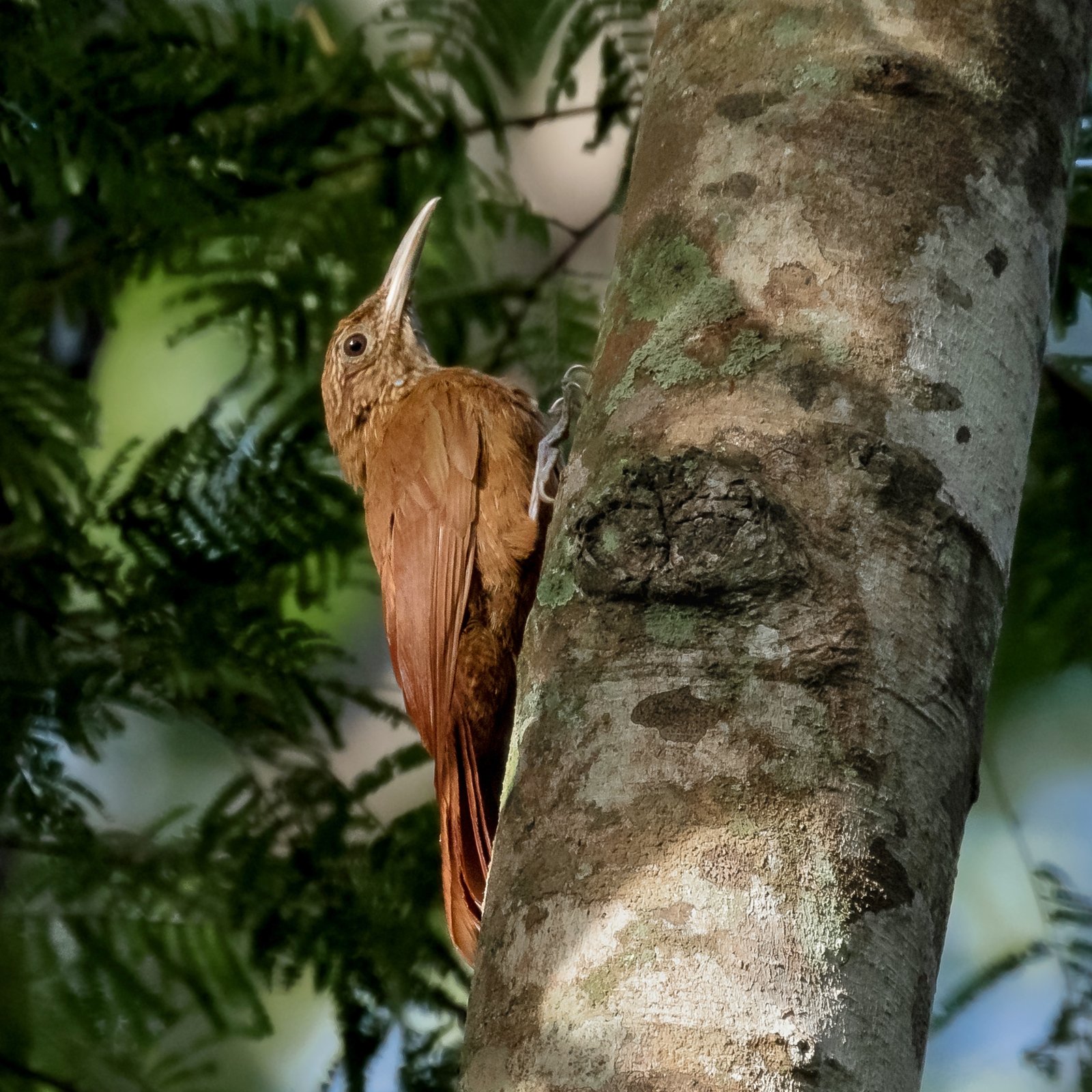
The Black-banded Woodcreeper is a large woodcreeper with a streaked head and breast and a finely barred belly. It has a strikingly broad elevational range: from the Amazonian lowlands and the dry forests of eastern Bolivia to the montane forest of the Andes. In the guide area it is most widespread in the montane forest of the eastern slope.
Voice
The song is a loud series of nasal, slightly hoarse notes that first rises and then falls, mainly at dawn. Also short, dry calls.
Recording: Jacob Wijpkema — CC BY-NC-SA 4.0 · xeno-canto
Identification
26–29 cm, with a long, straight, dark to bluish-grey horn-coloured bill. The head, neck and breast are brown with pale buff streaks; the belly is paler brown with narrow black bars. The back and wing coverts are olive-brown, the wings and tail rufous. Birds from the dry forests of Bolivia are paler and greyer. The sexes are alike.
Confusion species
Amazonian Barred Woodcreeper Dendrocolaptes certhia is barred all over, without streaks on the head and breast. Strong-billed Woodcreeper Xiphocolaptes promeropirhynchus is larger, with a heavier, slightly decurved bill and hardly any bars on the belly. Olive-backed Woodcreeper Xiphorhynchus triangularis is smaller, with a scaled throat and a slightly decurved bill. Montane Woodcreeper Lepidocolaptes lacrymiger is much smaller, with a thin, decurved bill.
Habitat
Humid montane forest and its edges on the Andean slopes, roughly between 1000 and 2800 m, also foothill forest; in addition locally in the Amazonian lowlands and in the dry Chiquitano and Chaco forests of Bolivia. It searches trunks, thick branches and epiphytes for insects and other arthropods, joins mixed flocks and sometimes follows army ants. The nest is in a tree cavity.
Where the bird is most at home, classified by the vegetation units of the Andes and the west coast.


Range and movements
Colombia: in the three Andean ranges and the Santa Marta mountains, locally in the eastern lowlands. Ecuador: mainly on the eastern slope of the Andes, also in the eastern lowlands. Peru: on the eastern slope of the Andes, scarce in the Amazonian lowlands. Bolivia: in the Yungas, in the lowlands and in the dry forests of the east and south-east. Absent from the Galápagos. Outside the guide area from southern Mexico to Panama, in Venezuela, the Guianas, Brazil, Paraguay and northern Argentina.
- Resident
- dark = core range, pale = thinly spread
How and when to look
In montane forest on the eastern slope, watch for a large woodcreeper in a mixed flock working mossy trunks with its long bill. At dawn it gives itself away by its nasal series.
Conservation status
Least Concern. The species has a very large range and a broad elevational range; locally it declines through deforestation.
Scientific name
Dendrocolaptes picumnus | Lichtenstein, 1820
Lichtenstein described the species in 1820 and placed it straight away in the genus where it still stands. The genus Dendrocolaptes was introduced in 1804 by Hermann. The genus name comes from Ancient Greek dendron, 'tree', and kolaptēs, 'chiseller, pecker'. The species name comes from Picumnus, a Roman deity associated with the woodpecker (picus). The specimen the first description was based on came from Cayenne, French Guiana.