All species › Passerines › Ovenbirds and woodcreepers › Amazonian Barred Woodcreeper
Amazonian Barred Woodcreeper | Dendrocolaptes certhia
Gebandeerde muisspecht | Trepatroncos barrado amazónico | Arapaçu-barrado
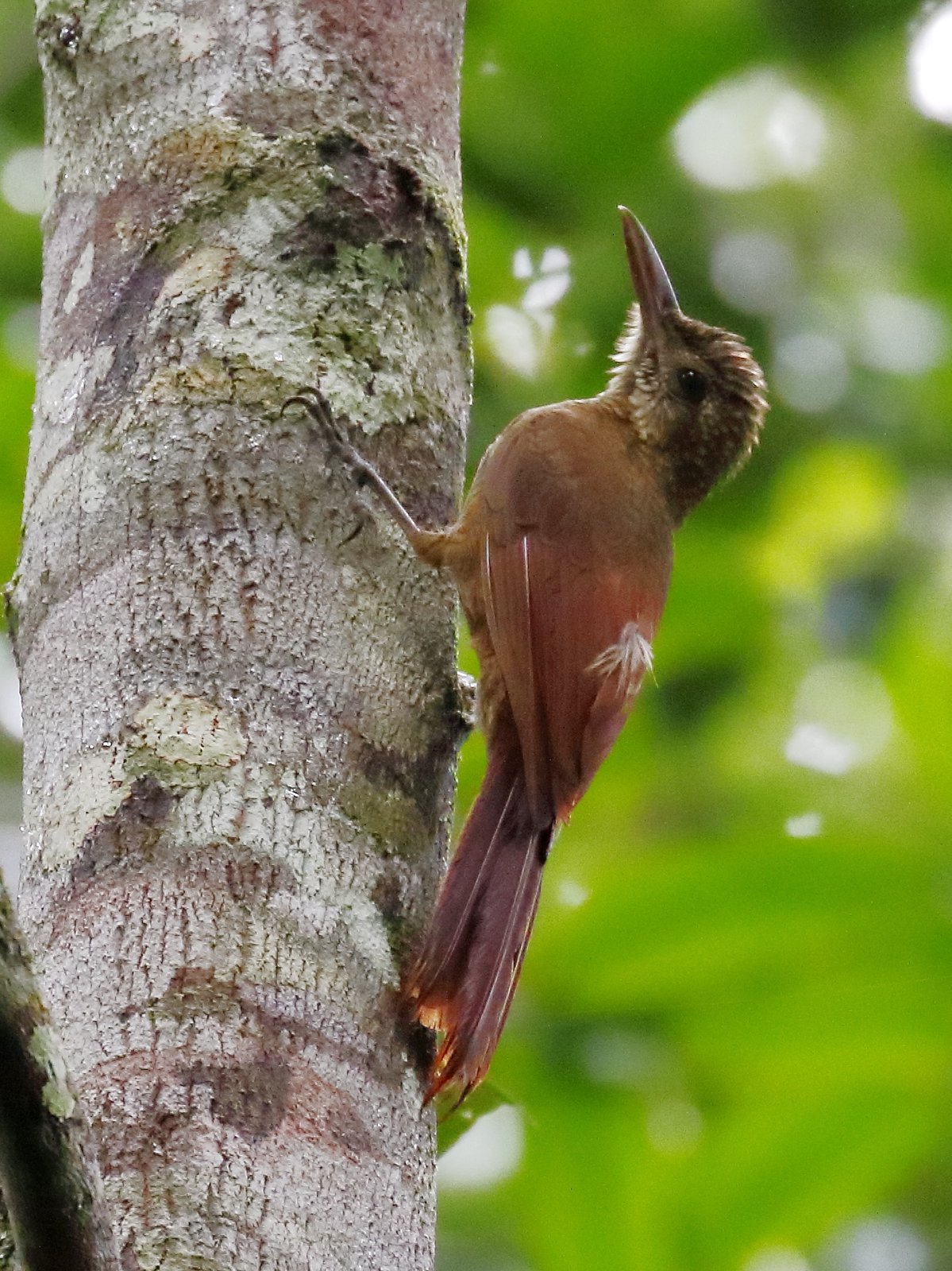
The Amazonian Barred Woodcreeper is a large woodcreeper, finely barred all over, of the Amazonian rainforest. It is a regular follower of army-ant swarms, where it often forages alongside antbirds and other woodcreepers. West of the Andes it is replaced by the Northern Barred Woodcreeper.
Voice
The song is a loud series of whistles, too-weed too-weed too-weed, first rising and then falling, mainly at dawn and dusk. A dry, nasal chatter is also given at ant swarms.
Recording: JAYRSON ARAUJO DE OLIVEIRA — CC BY-NC-SA 4.0 · xeno-canto
Identification
26–28 cm, with a stout, straight bill that is dark to reddish horn-coloured. The head, back and underparts are brown, densely and finely barred blackish throughout. The wings and tail are rufous and unbarred. The sexes are alike.
Confusion species
Black-banded Woodcreeper Dendrocolaptes picumnus has a streaked head and breast and is barred only on the belly; it lives mainly higher, on the Andean slopes. Bar-bellied Woodcreeper Hylexetastes stresemanni is heavier, with a short, massive, red bill, a streaked throat and bars only on the belly. Strong-billed Woodcreeper Xiphocolaptes promeropirhynchus is larger and streaked, not barred. Northern Barred Woodcreeper Dendrocolaptes sanctithomae is almost identical, but lives only west of the Andes.
Habitat
The interior of humid rainforest on terra firme and in várzea, also older secondary forest, in the lowlands and foothills up to about 1000 m. It follows army-ant swarms and catches flushed insects, spiders and small vertebrates; it also searches trunks. The nest is in a tree cavity.
Where the bird is most at home, classified by the vegetation units of the Andes and the west coast.


Range and movements
Colombia: in the lowlands east of the Andes. Ecuador: in the Amazonian lowlands. Peru: in the Amazonian lowlands and foothills. Bolivia: in the lowlands of the north and north-east. Absent from the Galápagos. Outside the guide area in southern Venezuela, the Guianas and Amazonian Brazil.
- Resident
- dark = core range, pale = thinly spread
How and when to look
In the rainforest interior, look for army-ant swarms; the bird then clings low on trunks, often together with other woodcreepers. Its series of whistles is heard mainly at dawn.
Conservation status
Least Concern. The species has a large range, but depends on continuous forest and is sensitive to fragmentation.
Scientific name
Dendrocolaptes certhia | (Boddaert, 1783)
Boddaert described the species in 1783 as Picus certhia; because it was later moved to another genus, the author and year stand in brackets. The genus Dendrocolaptes was introduced in 1804 by Hermann. The genus name comes from Ancient Greek dendron, 'tree', and kolaptēs, 'chiseller, pecker'. The species name refers to Certhia, the treecreeper genus (from Ancient Greek kerthios, a small tree-dwelling bird), for the climbing habits. The specimen the first description was based on came from Cayenne, French Guiana.