All species › Passerines › Ovenbirds and woodcreepers › Northern Barred Woodcreeper
Northern Barred Woodcreeper | Dendrocolaptes sanctithomae
Noordelijke gebandeerde muisspecht | Trepatroncos barrado norteño | Arapaçu-barrado-do-norte
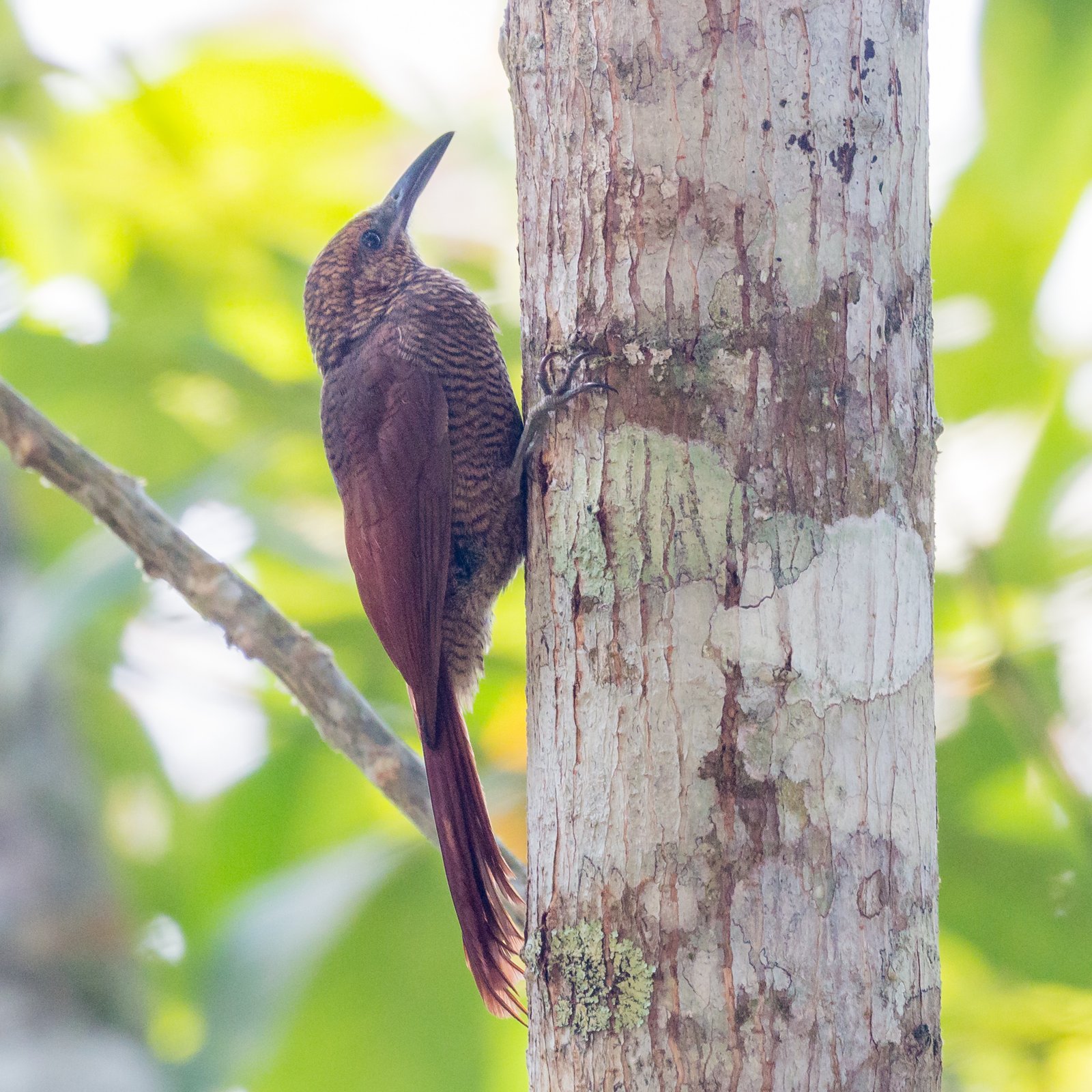
The Northern Barred Woodcreeper is a large woodcreeper, finely barred all over, of humid forest west of the Andes. It regularly follows army-ant swarms and then clings low on trunks. In the guide area it occurs only in the north-west; east of the Andes it is replaced by the Amazonian Barred Woodcreeper.
Voice
The song is a loud series of rising whistles, too-weed too-weed too-weed, which speeds up and then drops slightly. Heard mainly at dawn and dusk. Nasal calls are also given at ant swarms.
Recording: Iván Lau — CC BY-NC-SA 4.0 · xeno-canto
Identification
26–28 cm, with a stout, straight, dark horn-coloured bill. The head, back and underparts are brown, densely and finely barred blackish throughout. The wings and tail are rufous and unbarred. The throat is slightly paler. The sexes are alike.
Confusion species
Amazonian Barred Woodcreeper Dendrocolaptes certhia is almost identical, but lives east of the Andes; the ranges do not overlap. Black-striped Woodcreeper Xiphorhynchus lachrymosus has black-and-white streaks instead of bars and a slightly decurved bill. Strong-billed Woodcreeper Xiphocolaptes promeropirhynchus is larger and streaked, not barred. Black-banded Woodcreeper Dendrocolaptes picumnus has a streaked head and breast and is barred only on the belly.
Habitat
The interior and edges of humid lowland and foothill forest, also older secondary forest, up to about 1200 m. It follows army-ant swarms and catches flushed insects, spiders and small vertebrates; it also searches trunks and bark. The nest is in a tree cavity.
Where the bird is most at home, classified by the vegetation units of the Andes and the west coast.


Range and movements
Colombia: in the Pacific lowlands, in the northern lowlands and in the middle Magdalena valley. Ecuador: only in the north-west. Absent from Peru, Bolivia and the Galápagos. Outside the guide area from southern Mexico to Panama and in north-western Venezuela.
- Resident
- dark = core range, pale = thinly spread
How and when to look
In humid forest of the Pacific lowlands, look for ant swarms; the bird clings low on trunks above the front of the swarm. At dawn it gives itself away by its loud series of whistles.
Conservation status
Not Evaluated in the current circumscription of the species; as a whole widespread. The species depends on larger tracts of continuous forest and declines through deforestation in the lowlands west of the Andes.
Scientific name
Dendrocolaptes sanctithomae | (de Lafresnaye, 1852)
De Lafresnaye described the species in 1852 as Dendrocops Sancti-Thomoe; because it was later moved to another genus, the author and year stand in brackets. The genus Dendrocolaptes was introduced in 1804 by Hermann. The genus name comes from Ancient Greek dendron, 'tree', and kolaptēs, 'chiseller, pecker'. The species name means 'of Saint Thomas' and refers to Santo Tomás near Omoa in Honduras, which De Lafresnaye mistakenly took for an island. The specimen the first description was based on came from Santo Tomás, near Omoa, Honduras.