All species › Passerines › Ovenbirds and woodcreepers › Greater Thornbird
Greater Thornbird | Phacellodomus ruber
Grote stekelkruin | Espinero grande | Graveteiro
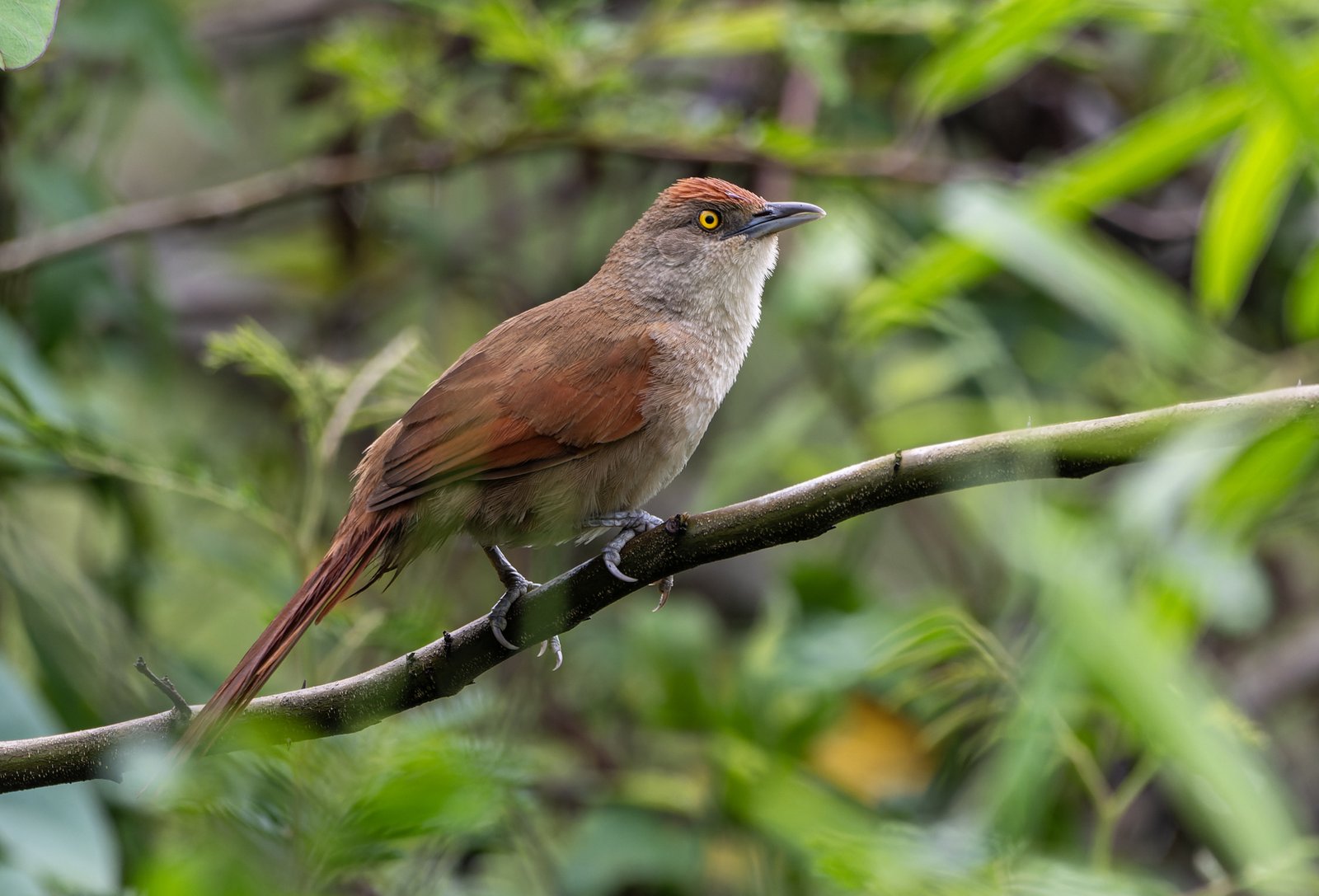
The Greater Thornbird is the largest of the thornbirds, a rufous-brown ovenbird of scrub and woodland edge near water in the eastern lowlands of Bolivia. Pairs build large, elongated nests of thorny twigs that hang from the tips of overhanging branches, often above water. Such a nest is enlarged year after year and can become more than a metre long.
Voice
A loud, fast series of shrill notes that first accelerates and then drops off, chep-chep-chep-chip-chip-chi-chi; pairs often sing in duet. Also calls with short, sharp chek notes.
Recording: Jacob Wijpkema — CC BY-NC-SA 4.0 · xeno-canto
Identification
19–20 cm, with a fairly long, straight, pointed bill and a long, rounded tail. The upperparts are brown, with a rufous crown and rufous wings and tail. The throat and belly are white, the breast and flanks buff. The eye is yellow to orange. The sexes are alike; young birds have a browner crown and a darker eye.
Confusion species
Rufous-fronted Thornbird Phacellodomus rufifrons is smaller and greyer brown, with only the forehead rufous, and the wings and tail are not rufous. Little Thornbird Phacellodomus sibilatrix is much smaller, with a small rufous patch on the forehead and on the wing, and lives in dry Chaco woodland. Yellow-chinned Spinetail Certhiaxis cinnamomeus lives in the same marshy scrub, but is smaller, with a pointed tail with spiny tips and a small yellow chin patch.
Habitat
Scrub, gallery forest, woodland edge and isolated trees along rivers, lakes and marshes, and shrubby savanna in the lowlands, up to about 800 m. It forages in pairs or family groups in the lower scrub and on the ground for insects and other invertebrates. The large stick nest with a side entrance hangs from a branch, often above water.
Where the bird is most at home, classified by the vegetation units of the Andes and the west coast.


Range and movements
In Bolivia in the eastern lowlands, from the Beni south to Santa Cruz and the edges of the Chaco. Absent from Colombia, Ecuador, Peru and the Galápagos. Outside the guide area in interior Brazil south of the Amazon, in Paraguay and in northern Argentina.
- Resident
- dark = core range, pale = thinly spread
How and when to look
Search the shores of lakes and rivers in the Beni and around Santa Cruz for large stick nests on overhanging branches; the birds often stay near the nest. The loud duet gives a pair away in the early morning.
Conservation status
Least Concern. The species is widespread, tolerates open country with scattered trees and shrubs and is locally common.
Scientific name
Phacellodomus ruber | (Vieillot, 1817)
Vieillot described the species in 1817 as Furnarius ruber; because it was later moved to another genus, the author and year stand in brackets. The genus Phacellodomus was introduced in 1853 by Reichenbach. The genus name combines Greek phakellos, 'bundle of twigs', and domos, 'house', after the large stick nests. The species name ruber comes from Latin ruber, 'red', after the rufous plumage. The specimen the first description was based on came from Paraguay.