All species › Passerines › Ovenbirds and woodcreepers › Spot-breasted Thornbird
Spot-breasted Thornbird | Phacellodomus maculipectus
Vlekborststekelkruin | Espinero pechimoteado | João-de-pau-de-peito-pintado
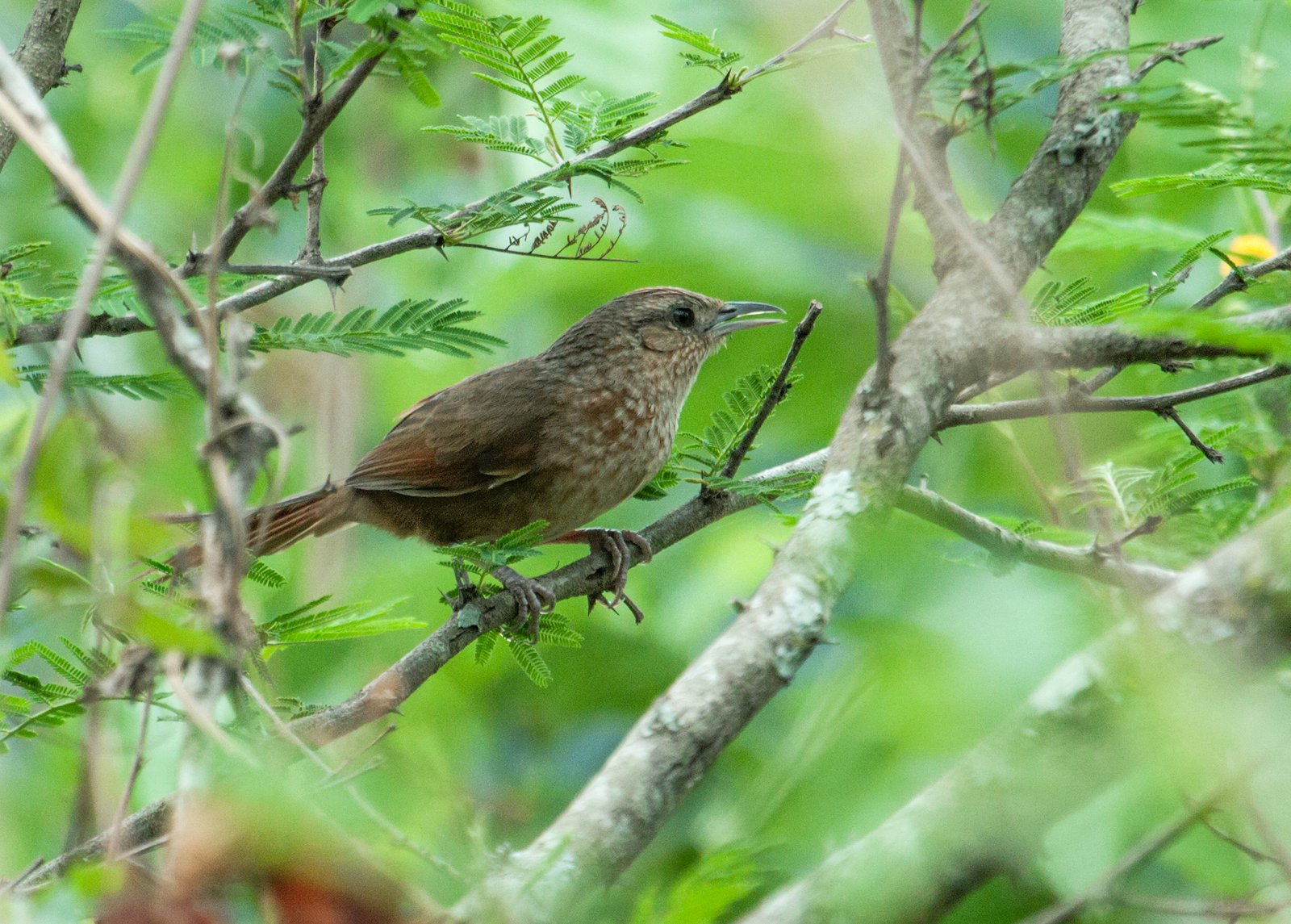
The Spot-breasted Thornbird is a brown ovenbird of forest edges in the eastern Andes of Bolivia and north-western Argentina. It has a rufous forehead and a buff breast with small dark spots. Like other thornbirds it builds large stick nests.
Voice
A loud, accelerating series of shrill notes, often as a duet. The call is a dry chek.
Recording: Niels Krabbe — CC BY-NC-SA 4.0 · xeno-canto
Identification
16–17 cm, with a straight, pointed bill and a fairly long tail. The forehead is rufous, the upperparts brown, the lesser wing coverts rufous. A pale supercilium. The throat is whitish, the breast buff with small dark spots, the belly paler. The sexes are alike.
Confusion species
Streak-fronted Thornbird Phacellodomus striaticeps has a streaked forehead and an unspotted breast, and lives higher in dry scrub. Greater Thornbird Phacellodomus ruber is larger and more rufous, with a yellow eye, and lives in the lowlands. Spinetails such as Line-cheeked Spinetail Cranioleuca antisiensis have a streaked cheek and an unspotted breast.
Habitat
Edges and clearings of montane and cloud forest, scrub, alder groves and shrubby slopes on the eastern slope of the Andes, roughly between 1000 and 2700 m. It searches for insects in shrubs and low trees. The nest is a large pile of twigs at the tips of branches.
Where the bird is most at home, classified by the vegetation units of the Andes and the west coast.


Range and movements
Colombia, Ecuador and Peru: absent. Bolivia: on the eastern slope of the Andes and in the valleys from Cochabamba and Santa Cruz to Chuquisaca and Tarija. Absent from the Galápagos. Outside the guide area in north-western Argentina.
- Resident
- dark = core range, pale = thinly spread
How and when to look
Search forest edges and shrubby roadsides in the mountains of southern Bolivia, for example in Tarija; pairs often give their duet from dense shrubs.
Conservation status
Least Concern. The species tolerates a partly cleared landscape with forest edges and scrub.
Scientific name
Phacellodomus maculipectus | Cabanis, 1883
Cabanis described the species in 1883 and placed it straight away in the genus where it still stands. The genus Phacellodomus was introduced in 1853 by Reichenbach. The genus name combines Greek phakellos, 'bundle of twigs', and domos, 'house', after the large stick nests. The species name maculipectus comes from Latin macula, 'spot', and pectus, 'breast': 'spot-breasted'. The specimen the first description was based on came from San Javier, Tucumán, Argentina.