All species › Passerines › Ovenbirds and woodcreepers › Chestnut-backed Thornbird
Chestnut-backed Thornbird | Phacellodomus dorsalis
Roodrugstekelkruin | Espinero dorsicastaño | João-de-pau-de-dorso-castanho
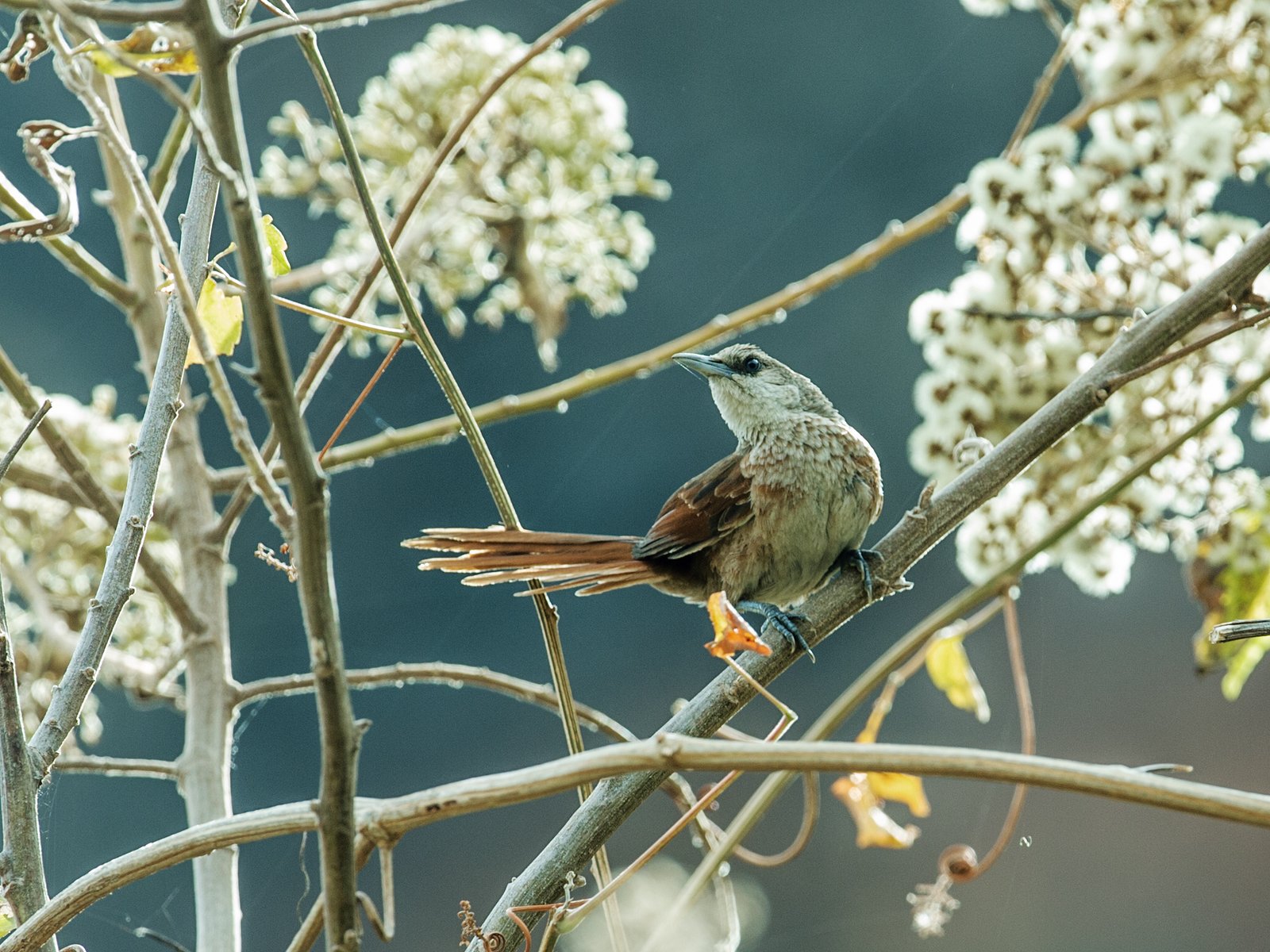
The Chestnut-backed Thornbird is the largest thornbird and occurs only in the dry Marañón valleys of northern Peru. It combines a greyish-brown head with a chestnut back, wings and tail. Because of its small range it is sensitive to the loss of scrub.
Voice
A loud, accelerating series of shrill notes, often as a duet by a pair. The call is a dry chek.
Recording: Jerome Fischer — CC BY-NC-SA 4.0 · xeno-canto
Identification
20–21 cm, with a straight, fairly stout bill and a long, rounded tail. The head and neck are greyish brown, with a pale supercilium. The back, wings and tail are warm chestnut. The throat is white, the underparts dull white to pale greyish brown, browner on the flanks. The eye is pale. The sexes are alike.
Confusion species
Rufous-fronted Thornbird Phacellodomus rufifrons lives lower in the same drainage, is smaller and has a rufous forehead and a greyish-brown back. Streak-fronted Thornbird Phacellodomus striaticeps occurs only further south. Necklaced Spinetail Synallaxis stictothorax is much smaller and lives in the lowlands on the Pacific side.
Habitat
Dry scrub, shrubby slopes, hedgerows and groves along fields in the inter-Andean valleys, roughly between 1800 and 3000 m. It searches for insects in shrubs and on the ground. The nest is a large pile of thorny twigs in a shrub or small tree.
Where the bird is most at home, classified by the vegetation units of the Andes and the west coast.


Range and movements
Only in Peru: in the dry valleys of the upper Marañón and its tributaries, in Cajamarca, La Libertad, Ancash and Huánuco. Absent from Colombia, Ecuador, Bolivia and the Galápagos.
- Resident
- dark = core range, pale = thinly spread
How and when to look
Search the scrub of the Marañón valleys, for example along the road from Cajabamba to the Marañón or around Balsas; pairs often sit in shrubs along fields and give their duet.
Conservation status
Near Threatened. The species has a small range, and the scrub in which it lives is cut for firewood and converted to fields and pasture.
Scientific name
Phacellodomus dorsalis | Salvin, 1895
Salvin described the species in 1895 and placed it straight away in the genus where it still stands. The genus Phacellodomus was introduced in 1853 by Reichenbach. The genus name combines Greek phakellos, 'bundle of twigs', and domos, 'house', after the large stick nests. The species name dorsalis comes from Latin dorsum, 'back', after the chestnut back. The specimen the first description was based on came from Malca, Cajabamba, Peru.