All species › Waders, gulls and terns › Skimmers, noddies, terns and gulls › Sabine's Gull
Sabine's Gull | Xema sabini
Vorkstaartmeeuw | Gaviota de Sabine | Gaivota-de-sabine
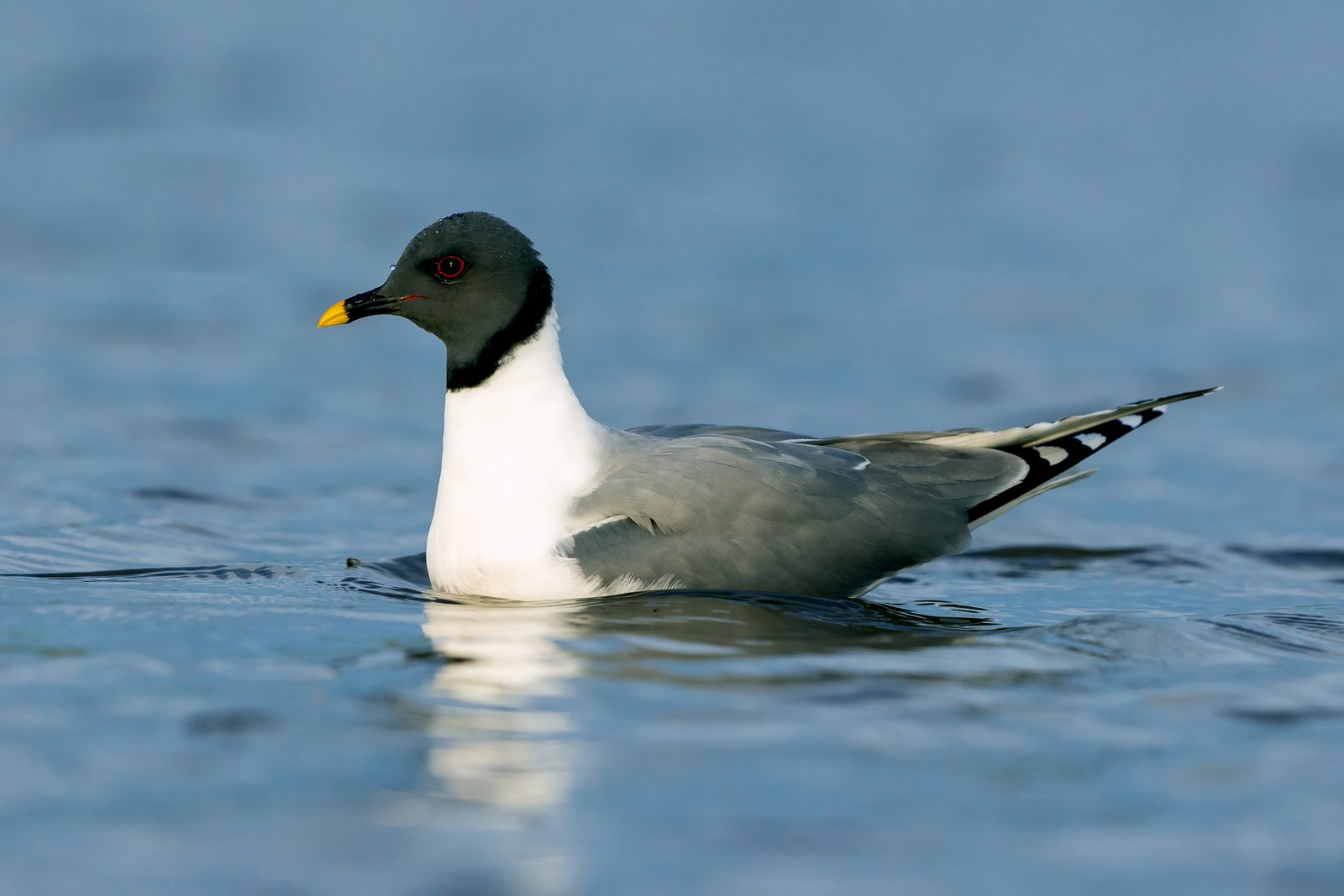
Sabine's Gull is a small, tern-like gull that breeds on the Arctic tundra and spends the rest of the year at sea. A large part of the Pacific breeding population winters in the cool Humboldt Current off Peru. It is the only gull with a forked tail and a wing pattern of three sharp triangles.
Voice
Usually silent in winter quarters. Sometimes a grating, tern-like krrree.
Recording: Patrik Åberg — CC BY-NC-SA 4.0 · xeno-canto
Identification
30–34 cm, with a small head, a short black bill with a yellow tip and a slightly forked tail. Adults have a grey mantle and upperwing, a black outer wing and a white triangle between them; in flight this three-part pattern is diagnostic. In breeding plumage a dark grey hood with a narrow black border; in non-breeding plumage the head is white with a greyish brown hindneck. Juveniles are scaled greyish brown above, with the same wing pattern and a black tail tip. The sexes are alike.
Confusion species
Juvenile Black-legged Kittiwake Rissa tridactyla has a black zigzag band across the wing and a square tail. Franklin's Gull Leucophaeus pipixcan is larger and darker, with a grey upperwing without a white triangle and black only at the wingtip. At a distance the flight recalls a tern, but terns have a longer, pointed bill and no black outer wing with a white triangle.
Habitat
Open sea, especially over the cool, productive water of the Humboldt Current and along fronts where water masses meet; it rarely comes close inshore. It flies lightly and low over the water and picks small crustaceans, fish larvae and other zooplankton from the surface, often in small groups and with phalaropes. It does not breed in the guide area.
Where the bird is most at home, classified by the vegetation units of the Andes and the west coast.


Range and movements
In Colombia and northern Ecuador mainly a passage migrant at sea. Off southern Ecuador and Peru a numerous winter visitor, usually some distance from land; also in the waters around the Galápagos. Inland, including Bolivia, at most exceptional. Breeds on the tundra of Alaska, Canada, Greenland and Siberia; Pacific birds winter off the west coast of South America.
- Winter visitor (c. Oct–Mar)
- Passage (Mar–Apr, Oct–Nov)
- dark = core range, pale = thinly spread
How and when to look
Join a pelagic trip from a Peruvian port between November and April; Sabine's Gulls often sit among phalaropes and storm petrels at the boundary between inshore water and open sea. In flight, look for the three-part wing pattern.
Conservation status
Least Concern. The world population is large and spread over remote areas; changes in the Humboldt Current during El Niño can shift its distribution at sea.
Scientific name
Xema sabini | (Sabine, 1819)
Sabine described the species in 1819 as Larus Sabini; because it was later moved to another genus, the author and year stand in brackets. The genus Xema was introduced in 1819 by Leach. The genus name Xema was introduced by William Elford Leach in 1819 and appears to be an invented name without meaning. The specific name honours Edward Sabine (1788–1883), British officer, physicist and Arctic explorer, who collected the specimens; his brother Joseph Sabine described the species. The specimen the first description was based on came from Sabine Islands, Melville Bay, western Greenland.