All species › Waders, gulls and terns › Skimmers, noddies, terns and gulls › Swallow-tailed Gull
Swallow-tailed Gull | Creagrus furcatus
Zwaluwstaartmeeuw | Gaviota tijereta | Gaivota-rabo-de-andorinha
The Swallow-tailed Gull is the only gull that feeds almost entirely at night. For this it has very large eyes, and it hunts in the dark on the open sea for squid and small fish that rise to the surface. Almost the entire world population breeds on the Galápagos; a small number breeds on Malpelo Island off the coast of Colombia.
Voice
A harsh, rattling call and a high, whistled wheee; in the colony also clicking sounds, which may help with orientation in the dark.
Recording: Eric DeFonso — CC BY-NC-SA 3.0 · xeno-canto
Identification
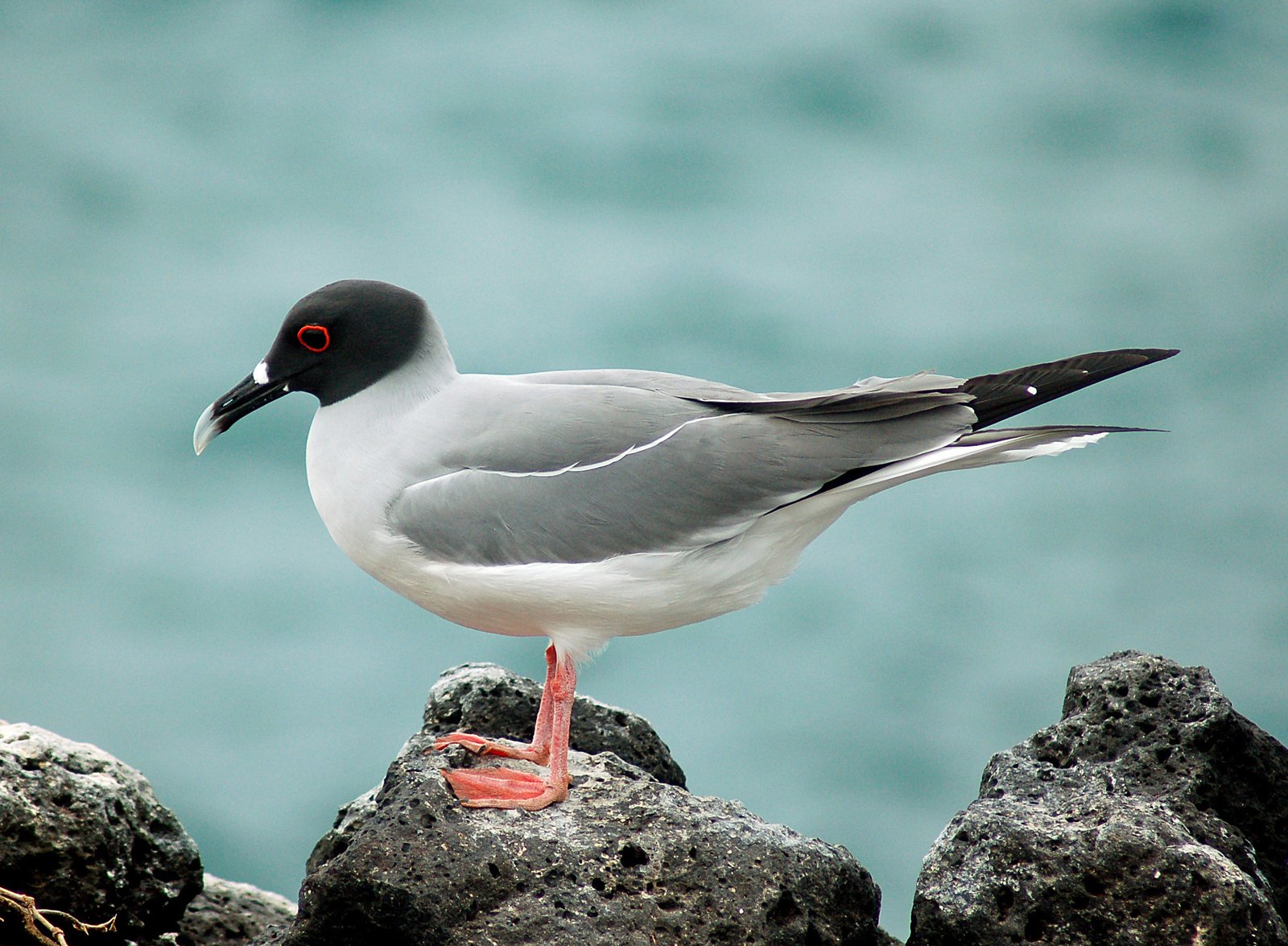
55–60 cm, a slender gull with long, pointed wings and a deeply forked white tail. The eye is very large and dark, with a red eye-ring. The bill is black with a pale grey to whitish tip; the legs are pink to red. In breeding plumage the head is slate grey to blackish, with a white spot at the base of the bill; the mantle and upperwing are grey and the underparts white. Outside the breeding season the head is white with a dark patch around the eye and a grey wash on the hindneck. In flight a tricoloured wing pattern: black outer primaries, a large white triangle on the trailing edge of the wing and a grey forewing. Juveniles are white with brown-scaled upperparts, a dark eye patch and a black tail band. The sexes are alike.
Confusion species
Sabine's Gull Xema sabini has a similar tricoloured wing pattern but is much smaller, with a black bill with a yellow tip and a less deeply forked tail; it occurs at sea as a winter visitor from the north. Lava Gull Leucophaeus fuliginosus, also of the Galápagos, is entirely dark grey with a blackish head and a square tail. Laughing Gull Leucophaeus atricilla and Franklin's Gull Leucophaeus pipixcan have dark wingtips without a white triangle and a square tail.
Habitat
It breeds on rocky coasts and cliffs, on ledges and among lava boulders close to the water. It feeds at night on the open sea, often tens of kilometres from the colony, picking squid and small fish from the surface. By day the birds rest in the colony or on the water. The nest is a scrape lined with pebbles and pieces of coral; the clutch is a single egg. Breeding takes place year-round, with a cycle per pair of less than a year.
Where the bird is most at home, classified by the vegetation units of the Andes and the west coast.


Range and movements
On the Galápagos on most islands with suitable coasts, including Genovesa, Española, South Plaza and North Seymour. A small colony breeds on Malpelo (Colombia). Outside the breeding season birds disperse east and stay at sea off the coasts of Colombia, Ecuador and Peru, as far as northern Chile; rarely seen from the mainland. Absent from Bolivia.
- Resident
- Summer visitor (c. Apr–Sep)
- Winter visitor (c. Oct–Mar)
- Passage (Mar–Apr, Oct–Nov)
- dark = core range, pale = thinly spread
How and when to look
On the Galápagos Swallow-tailed Gulls sit by day on cliffs at the landing sites, as on Genovesa and South Plaza, and you can watch them at close range. At dusk they leave for the sea; from boats they are sometimes seen at night flying around the lights.
Conservation status
Least Concern. Because almost the whole population breeds on the Galápagos, the species is vulnerable to introduced predators such as rats and to food shortage in El Niño years.
Scientific name
Creagrus furcatus | (Néboux, A-S, 1842)
Néboux, A-S described the species in 1842 as Larus furcatus; because it was later moved to another genus, the author and year stand in brackets. The genus Creagrus was introduced in 1854 by Bonaparte. The genus name is from Greek kreagra, 'meat hook', after the hooked bill. The species name is Latin furcatus, 'forked', from furca, 'fork', after the forked tail. The specimen the first description was based on came from Galápagos Islands.