All species › Passerines › Manakins › Saffron-crested Tyrant-Manakin
Saffron-crested Tyrant-Manakin | Neopelma chrysocephalum
Geelkuiftiranmanakin | Saltarín coronigualdo | Fruxu-do-carrasco
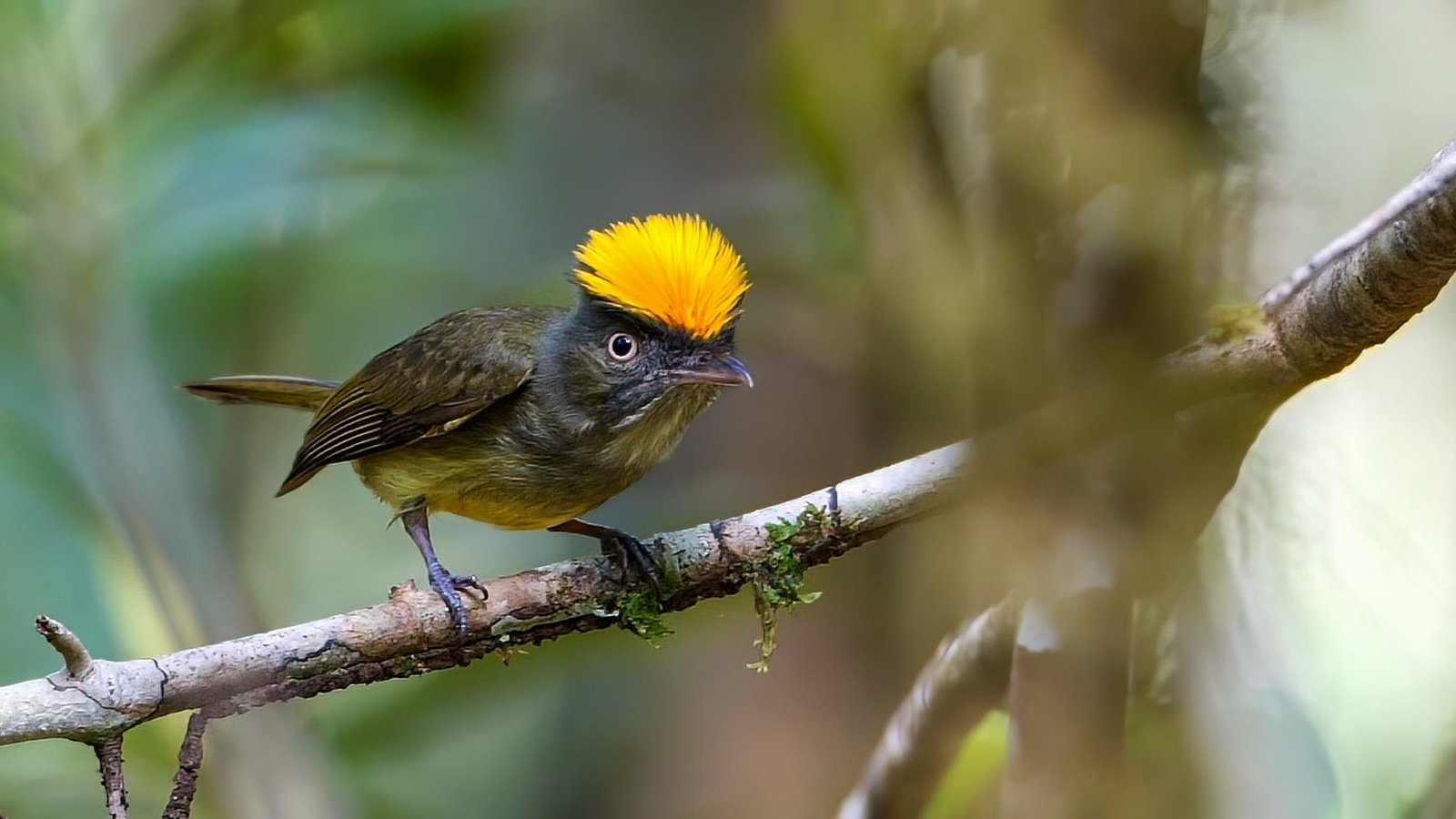
The Saffron-crested Tyrant-Manakin is an olive-green manakin with a conspicuous saffron-yellow crown stripe. It is closely tied to low, open forest on white sand, such as the varillales near Iquitos. Outside that forest type it hardly occurs.
Voice
A nasal, buzzy, slightly rising phrase, repeated at long intervals from a song perch in the middle storey, and short dry calls.
Recording: Barry Edmonston — CC BY-NC-SA 4.0 · xeno-canto
Identification
13 cm, with a fairly long tail and a small bill. The upperparts are olive-green. A broad orange-yellow to saffron-yellow stripe runs over the crown and is raised as a small crest when excited; the sides of the head are greyish. The throat and breast are grey with an olive wash, and the belly is pale yellow. The iris is whitish to pale yellow. The sexes are alike.
Confusion species
Sulphur-bellied Tyrant-Manakin Neopelma sulphureiventer has a smaller, less obvious crown stripe and lives further south, in várzea and riverine forest. Dwarf Tyrant-Manakin Tyranneutes stolzmanni is much smaller, with a very short tail and no yellow crown. Yellow-crowned Elaenia Myiopagis flavivertex has a dark iris and pale wing bars.
Habitat
Low, open forest and scrubby woodland on white sand (varillal, campinarana) and its edges, in the lowlands. It lives in the lower and middle storeys and eats mainly small fruits and also insects.
Where the bird is most at home, classified by the vegetation units of the Andes and the west coast.


Range and movements
In Colombia in the east, in the lowlands of the Orinoco and Amazon drainages near the borders with Venezuela and Brazil. In Peru in the north-east, in Loreto. Not confirmed with certainty in Ecuador. Absent from Bolivia and the Galápagos. Outside the guide area in southern Venezuela, the Guianas and north-western Brazil.
- Resident
- dark = core range, pale = thinly spread
How and when to look
In the varillales of the Allpahuayo-Mishana reserve near Iquitos. Listen for the buzzy song and look in the low forest for the yellow crown stripe.
Conservation status
Least Concern. The species depends on a forest type that is local in the guide area; white-sand forest near towns is threatened by logging and sand extraction.
Scientific name
Neopelma chrysocephalum | (Pelzeln, 1868)
Pelzeln described the species in 1868 as Heteropelma chrysocephalum; because it was later moved to another genus, the author and year stand in brackets. The genus Neopelma was introduced in 1861 by Sclater. The genus name comes from Greek neos, 'new, different', and pelma, 'sole of the foot'. The species name comes from Greek khrusos, 'gold', and kephalē, 'head': 'golden-headed', after the yellow crown. The specimen the first description was based on came from San Carlos de Río Negro, Amazonas, Venezuela.