All species › Passerines › Manakins › Sulphur-bellied Tyrant-Manakin
Sulphur-bellied Tyrant-Manakin | Neopelma sulphureiventer
Geelbuiktiranmanakin | Saltarín ventrisulfúreo | Fruxu-de-barriga-amarela
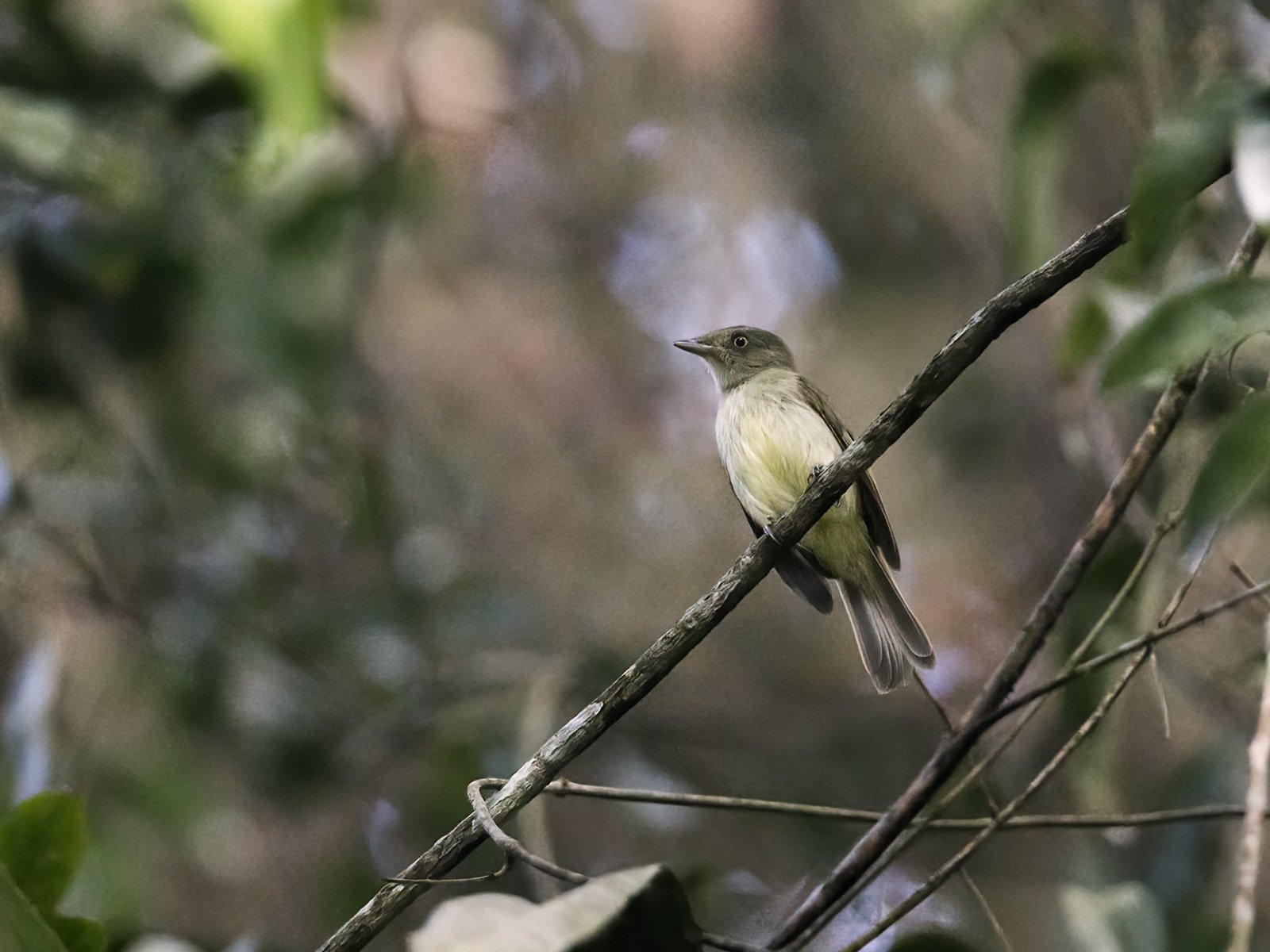
The Sulphur-bellied Tyrant-Manakin is an olive-green manakin with a sulphur-yellow belly from south-western Amazonia. It lives in riverine forest and forest in the transition to drier regions, and sings for long periods from a fixed branch. Its colours are more like those of an elaenia than those of most manakins.
Voice
A hoarse, buzzy, slightly rising phrase, often repeated for long periods at regular intervals from a song perch in the middle storey.
Recording: Jacob Wijpkema — CC BY-NC-SA 4.0 · xeno-canto
Identification
13 cm, with a fairly long tail and a small bill. The upperparts are olive-green. The crown has a narrow, partly concealed yellow stripe. The throat and breast are greyish with an olive wash, and the belly is sulphur-yellow. The iris is grey to pale brown. The sexes are alike.
Confusion species
Pale-bellied Tyrant-Manakin Neopelma pallescens has a white to very pale yellow belly and lives further east, in drier forest. Saffron-crested Tyrant-Manakin Neopelma chrysocephalum has a broad saffron-yellow crown stripe and a whitish iris and lives on white sand in the north. Forest Elaenia Myiopagis gaimardii has a dark iris, distinct wing bars and sits higher in the canopy.
Habitat
Riverine forest, várzea, gallery forest and forest in the transition to savanna and drier woodland, also forest edges and older secondary forest, in the lowlands. It lives in the lower and middle storeys and eats small fruits and insects.
Where the bird is most at home, classified by the vegetation units of the Andes and the west coast.


Range and movements
In Peru in the south-east, mainly in Madre de Dios, and locally further north in Ucayali. In Bolivia in the north and centre of the lowlands, in Pando, Beni, La Paz and northern Santa Cruz and Cochabamba. Absent from Colombia, Ecuador and the Galápagos. Outside the guide area in south-western Amazonian Brazil.
- Resident
- dark = core range, pale = thinly spread
How and when to look
Along forest edges and in riverine forest in Madre de Dios, such as around Puerto Maldonado and in the lower parts of Manu, and in northern Bolivia. The buzzy song gives the bird away; then scan the middle storey.
Conservation status
Least Concern. The species is fairly common in a region with much forest remaining; locally forest is lost to deforestation and gold mining.
Scientific name
Neopelma sulphureiventer | (Hellmayr, 1903)
Hellmayr described the species in 1903 as Scotothorus sulphureiventer; because it was later moved to another genus, the author and year stand in brackets. The genus Neopelma was introduced in 1861 by Sclater. The genus name comes from Greek neos, 'new, different', and pelma, 'sole of the foot'. The species name comes from Latin sulphureus, 'sulphur-yellow', and venter, 'belly': 'sulphur-bellied'. The specimen the first description was based on came from Vila Bela da Santíssima Trindade, Mato Grosso, Brazil.