All species › Passerines › Shrike-babblers, Erpornis and vireos › San Andres Vireo
San Andres Vireo | Vireo caribaeus
San-Andrésvireo | Vireo de San Andrés | Juruviara-de-san-andrés
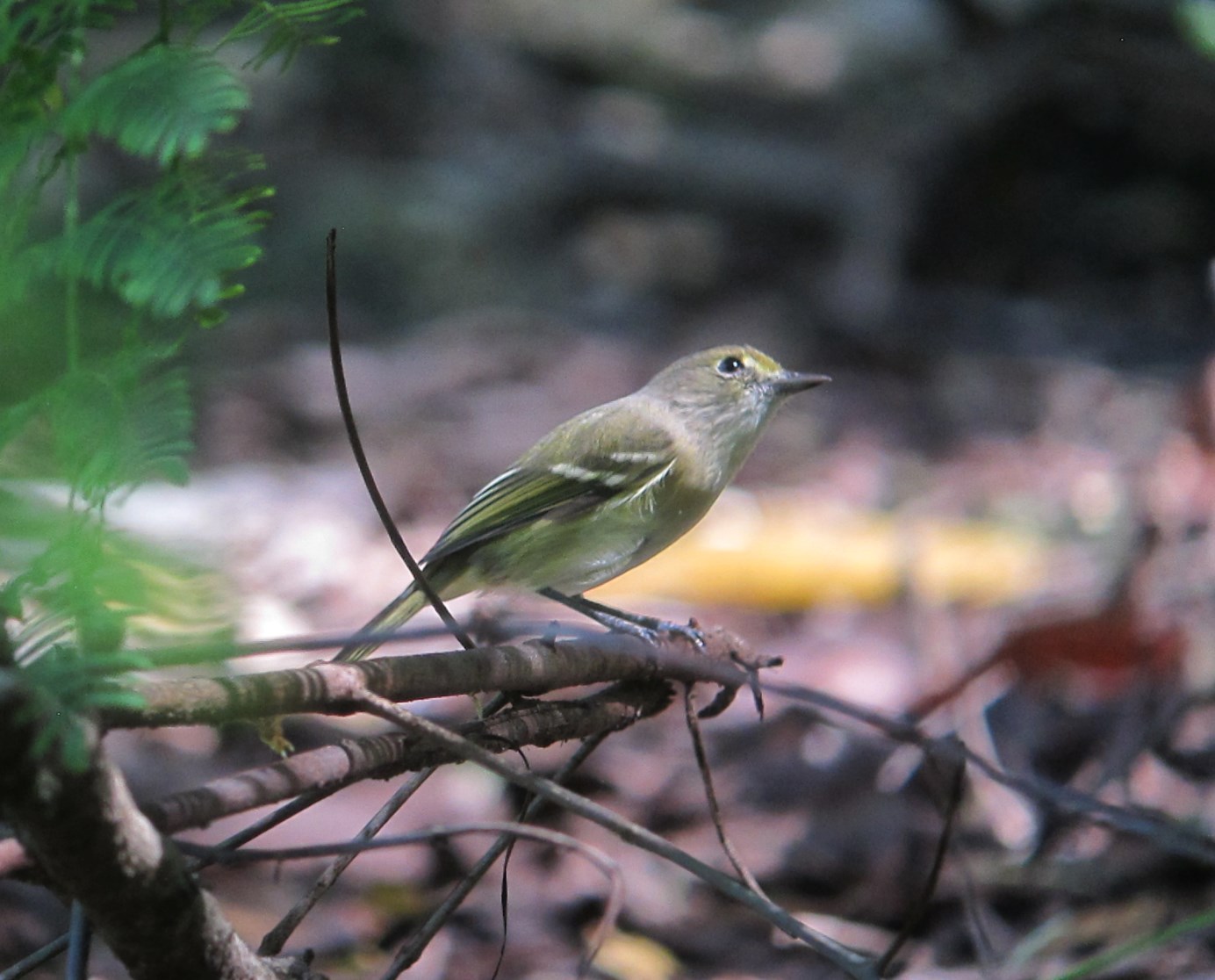
The San Andres Vireo is a small, olive-green vireo found only on San Andrés, a Colombian island in the Caribbean Sea off the coast of Nicaragua. Its closest relative is the Thick-billed Vireo. Its entire world range is an island of about 26 km².
Voice
The call is a single-syllable, chattering chick. The song consists of repeated phrases of two or three syllables, repeated at short intervals.
Recording: David Monroy Rengifo — CC BY-NC-SA 4.0 · xeno-canto
Identification
12–13 cm, with a fairly thin, dark bill. The upperparts are olive-green, the wings darker with pale edges to the flight feathers and two white wing bars. A pale yellow stripe from the bill to the eye and a dark eye-stripe. The underparts are whitish to pale yellow, yellowest on the flanks. The iris is grey-brown. The sexes are alike.
Confusion species
Black-whiskered Vireo Vireo altiloquus, which also breeds on San Andrés, is larger, with a white supercilium, a dark malar stripe and no wing bars. White-eyed Vireo Vireo griseus, a rare vagrant, has a white iris in adults and complete yellow spectacles. Nearctic warblers with wing bars have a thinner, more pointed bill.
Habitat
Almost all vegetated habitats on the island: woodland patches, cacao and other plantings, scrubby pastures and mangroves, with a preference for vegetation with a dense understorey. Commonest in the less built-up south. It searches for insects in dense foliage. The nest is a hanging cup in a shrub.
Where the bird is most at home, classified by the vegetation units of the Andes and the west coast.


Range and movements
Colombia: only on San Andrés island in the Caribbean Sea. Ecuador, Peru and Bolivia: absent. Absent from the Galápagos. Endemic to the guide area.
- Resident
- dark = core range, pale = thinly spread
How and when to look
Look in scrub and woodland patches in the south of San Andrés, where the species is locally common. Listen for the chattering call from dense shrubs.
Conservation status
Vulnerable. Habitat is being lost to the growth of building and tourism on the island; the species is confined to a few sites in the south, but is locally common there. Its small range makes it vulnerable to hurricanes. The population is estimated at about 8000 to 14,000 birds.
Scientific name
Vireo caribaeus | Bond & Meyer de Schauensee, 1942
Bond & Meyer de Schauensee described the species in 1942 and placed it straight away in the genus where it still stands. The genus Vireo was introduced in 1808 by Vieillot. The genus name is Latin vireo, a green migratory bird, perhaps the female golden oriole or the greenfinch; related to virere, 'to be green'. The species name refers to the Caribbean, not necessarily the type locality. The specimen the first description was based on came from Isla de San Andrés, Colombia.