All species › Passerines › Shrike-babblers, Erpornis and vireos › Thick-billed Vireo
Thick-billed Vireo | Vireo crassirostris
Dikbekvireo | Vireo piquigrueso | Juruviara-de-bico-grosso
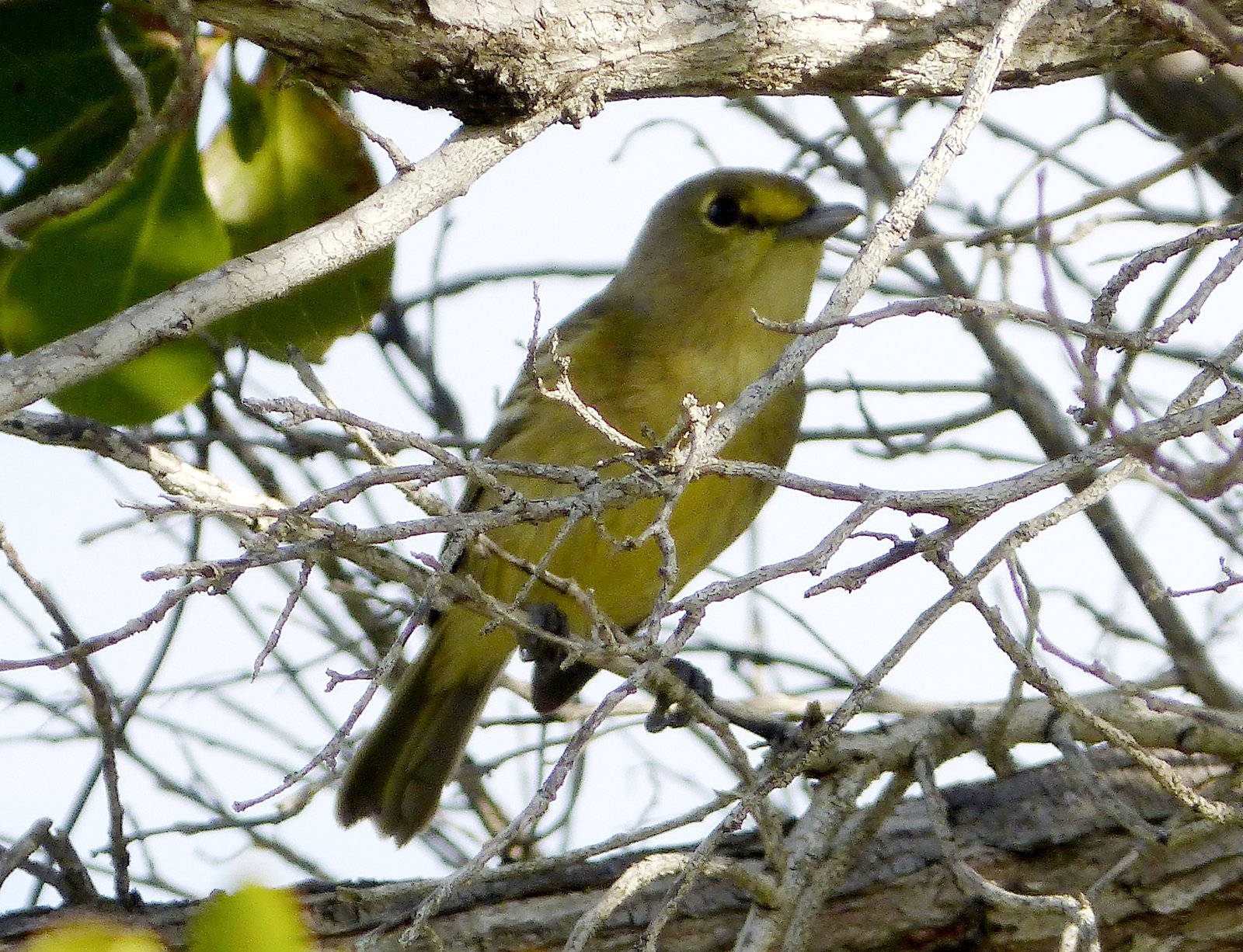
The Thick-billed Vireo is a greyish-green vireo with a markedly thick bill from the islands of the Caribbean. In the guide area it lives only on Providencia and Santa Catalina, Colombian islands off the coast of Nicaragua. The birds there form a separate subspecies, approximans, which is sometimes treated as a separate species.
Voice
The song is a fast, chattering phrase of a few notes, often with an emphatic final note, repeated at short intervals. The call is a hoarse, shrill chatter.
Recording: Paul Driver — CC BY-NC-SA 3.0 · xeno-canto
Identification
13–14 cm, with a short, thick, grey bill. The upperparts are greyish olive-green, the crown and nape greyer. Yellow lores and a yellow eye-ring form spectacles; a dark loral line. Two white wing bars. The underparts are dull yellow to buffy, the throat paler. The iris is dark. The sexes are alike.
Confusion species
Black-whiskered Vireo Vireo altiloquus, on the same island, is larger, with a dark malar stripe, a white supercilium and no wing bars. White-eyed Vireo Vireo griseus has a white iris in adults and a thinner bill, and occurs only as a vagrant. San Andres Vireo Vireo caribaeus lives only on San Andrés and has a thinner bill and whiter underparts.
Habitat
Scrub, dry woodland, forest edges, mangroves and vegetation in pastures and around houses, from sea level to the highest parts of the island. It searches for insects and fruit in dense vegetation at low to middle height. The nest is a hanging cup in a shrub.
Where the bird is most at home, classified by the vegetation units of the Andes and the west coast.


Range and movements
Colombia: only on Providencia and Santa Catalina in the Caribbean Sea. Ecuador, Peru and Bolivia: absent. Absent from the Galápagos. Outside the guide area in the Bahamas, the Cayman Islands and Tortuga island off Haiti.
How and when to look
On Providencia it can be found in scrub and thickets around the villages and on the hills. Follow the chattering song from dense shrubs.
Conservation status
Least Concern. The subspecies on Providencia has a very small range and is vulnerable to hurricanes and loss of vegetation.
Scientific name
Vireo crassirostris | (Bryant, 1859)
Bryant described the species in 1859 as Lanivireo crassirostris; because it was later moved to another genus, the author and year stand in brackets. The genus Vireo was introduced in 1808 by Vieillot. The genus name is Latin vireo, a green migratory bird, perhaps the female golden oriole or the greenfinch; related to virere, 'to be green'. The species name comes from Latin crassus, 'thick', and rostrum, 'bill': 'thick-billed'. The specimen the first description was based on came from New Providence, Bahamas.