All species › Swifts › Hummingbirds › Santa Marta Woodstar
Santa Marta Woodstar | Chaetocercus astreans
Santamartaboself | Estrellita de Santa Marta | Estrelinha-de-santa-marta
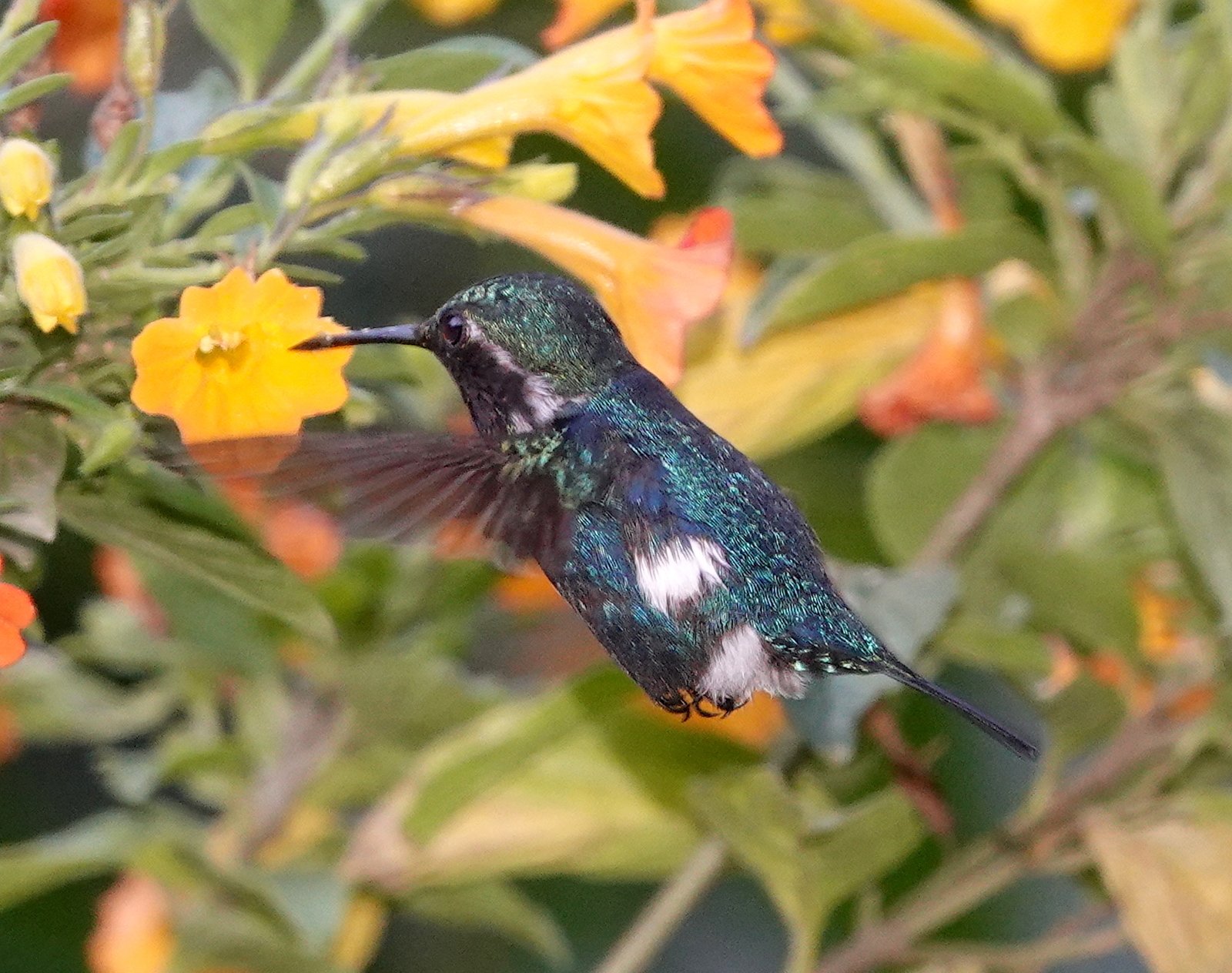
The Santa Marta Woodstar occurs only in the Sierra Nevada de Santa Marta in northern Colombia and is one of the many endemic birds of this isolated massif. The male has a rose-purple throat and a white breast band, like the White-bellied Woodstar of the Andes. Little is known of its life history.
Voice
Usually silent. Soft, high tsip notes; the wings hum in flight.
Recording: Oswaldo Cortes — CC BY-NC-SA 3.0 · xeno-canto
Identification
6–7 cm, with a short, straight black bill. The male is dark green above, with a glittering rose-purple throat, a white spot behind the eye and a white band across the breast. The flanks are green, with a white patch on the side of the rump. The tail is short and forked. The female is green above and cinnamon to buff below, with a dark ear patch, a pale spot behind the eye and a rufous tail with a black band.
Confusion species
Within its small range there are few confusion species. Rufous-shafted Woodstar Chaetocercus jourdanii lives in the nearby Serranía del Perijá; the male has rufous shafts in the tail. White-bellied Woodstar Chaetocercus mulsant is very similar but occurs only in the Andes. Other small hummingbirds in the massif, such as Coppery Emerald Chlorostilbon russatus, are larger, with a longer tail and no coloured throat.
Habitat
Edges of humid montane forest, clearings, shrubby slopes, shade-coffee plantations and gardens on the slopes of the Santa Marta mountains, mainly at middle elevations, roughly between 1000 and 2500 m. It takes nectar at small flowers and catches small insects. Little is known about the nest.
Where the bird is most at home, classified by the vegetation units of the Andes and the west coast.


Range and movements
Only in Colombia, in the Sierra Nevada de Santa Marta in Magdalena, La Guajira and Cesar. Absent from Ecuador, Peru, Bolivia and the Galápagos. Does not occur outside the guide area.
- Resident
- dark = core range, pale = thinly spread
How and when to look
Along the road from Minca to El Dorado and San Lorenzo on the north-western slope of the Santa Marta mountains, at flowering shrubs along forest edges and in gardens. Look for very small hummingbirds hovering at flowers with a buzzing sound.
Conservation status
Least Concern. The range is small, and the forests of the massif have partly been converted to farmland; the species also occurs at forest edges and in gardens.
Scientific name
Chaetocercus astreans | (Bangs, 1899)
Bangs described the species in 1899 as Acestrura astreans; because it was later moved to another genus, the author and year stand in brackets. The genus Chaetocercus was introduced in 1855 by Gray. The genus name combines Greek khaitē, 'hair', with kerkos, 'tail'. The species name is Latin astreans, 'gleaming like a star', from astrum, 'star'. The specimen the first description was based on came from San Sebastián, Sierra Nevada de Santa Marta, Colombia.