All species › Swifts › Hummingbirds › Gorgeted Woodstar
Gorgeted Woodstar | Chaetocercus heliodor
Zonneboself | Estrellita de gorguera | Estrelinha-de-gorjal
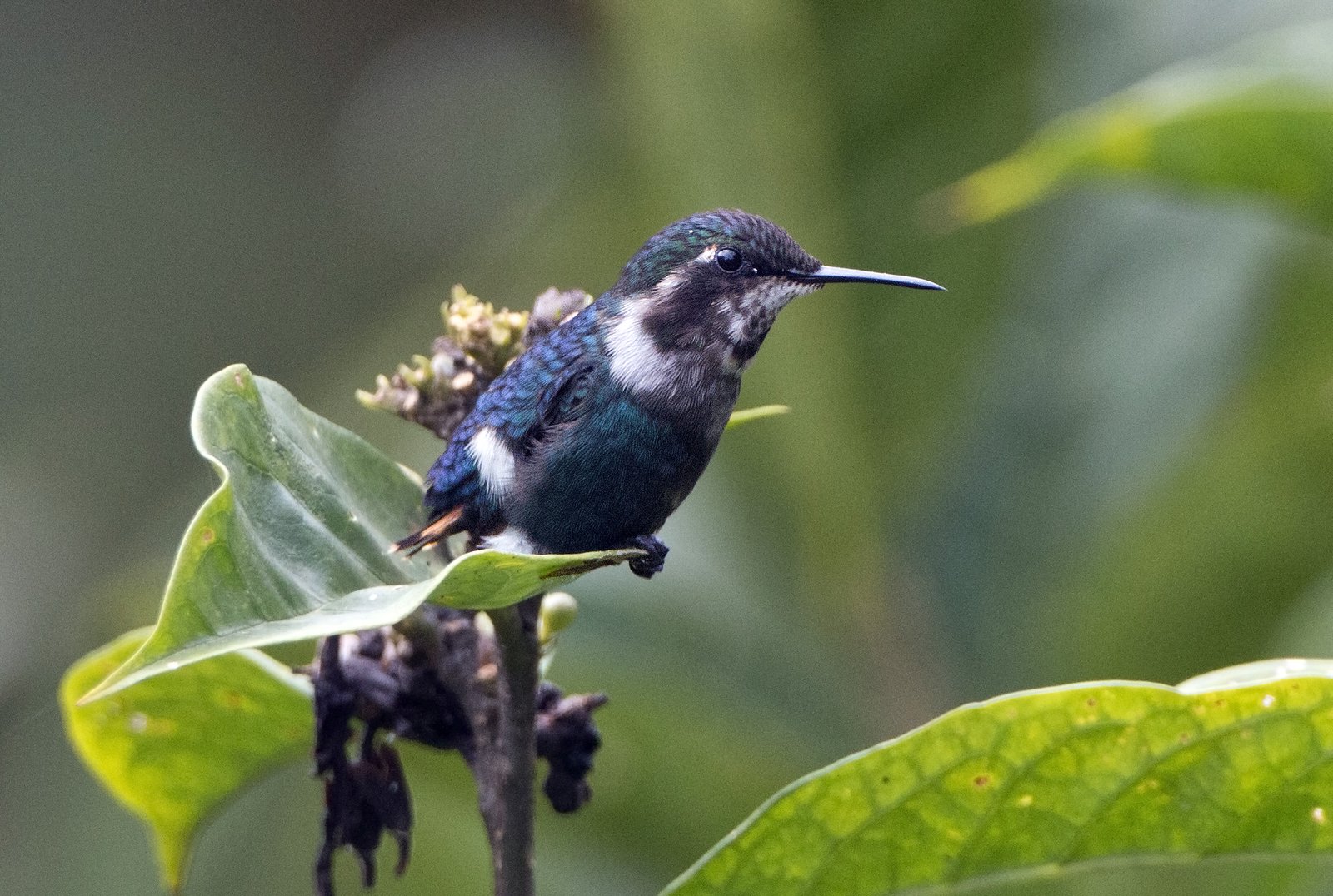
The Gorgeted Woodstar is one of the smallest hummingbirds of the Andes and lives in the north of the guide area, in Colombia and northern Ecuador. In the male the rose-purple throat extends at the sides into elongated points, the gorget to which the English name refers. The flight is slow and buzzing, like that of a bee.
Voice
Usually silent. Soft, high tsip notes; the wings make a buzzing sound in flight.
Recording: Mitch Lysinger — CC BY-NC-SA 4.0 · xeno-canto
Identification
6–7 cm, with a short, straight black bill. The male is dark green above, with a glittering rose-purple throat whose side feathers are elongated into points, a small white spot behind the eye and greyish-green underparts without a white breast band. There is a white patch on the side of the rump. The tail is short and forked. The female is green above and warm rufous to buff below, with a dark ear patch and a rufous tail with a black band.
Confusion species
The male White-bellied Woodstar Chaetocercus mulsant has a broad white breast band and a white belly; the female is paler below. Rufous-shafted Woodstar Chaetocercus jourdanii has rufous shafts in the tail and lives in north-eastern Colombia. Santa Marta Woodstar Chaetocercus astreans occurs only in the Santa Marta mountains. Female woodstars closely resemble each other; range and nearby males help with identification.
Habitat
Edges of humid montane forest and cloud forest, clearings, second growth, coffee plantations and gardens, roughly between 1200 and 3000 m. It takes nectar at small flowers in shrubs and trees, often together with other small hummingbirds, and catches small insects. The nest is a small cup of plant down.
Where the bird is most at home, classified by the vegetation units of the Andes and the west coast.


Range and movements
In Colombia locally in the Eastern and Central Andes and on the western slope. In Ecuador mainly in the north, on the western slope and locally elsewhere. Absent from Peru, Bolivia and the Galápagos. Outside the guide area in the Andes of western Venezuela.
- Resident
- dark = core range, pale = thinly spread
How and when to look
At flowering shrubs in lodge gardens and along forest edges in north-western Ecuador and in the Andes of Colombia. Look for very small hummingbirds hovering at small flowers with a buzzing sound.
Conservation status
Least Concern. The species is local and occurs in low numbers; it tolerates forest edges and gardens.
Scientific name
Chaetocercus heliodor | (Bourcier, 1840)
Bourcier described the species in 1840 as Ornismya heliodor; because it was later moved to another genus, the author and year stand in brackets. The genus Chaetocercus was introduced in 1855 by Gray. The genus name combines Greek khaitē, 'hair', with kerkos, 'tail'. The species name honours Claude Joseph Héliodore Bourcier (1826–1869), son of the French diplomat and hummingbird specialist Jules Bourcier. The specimen the first description was based on came from Bogotá, Colombia.