All species › Swifts › Hummingbirds › Little Woodstar
Little Woodstar | Chaetocercus bombus
Kleine boself | Estrellita chica | Estrelinha-pequena
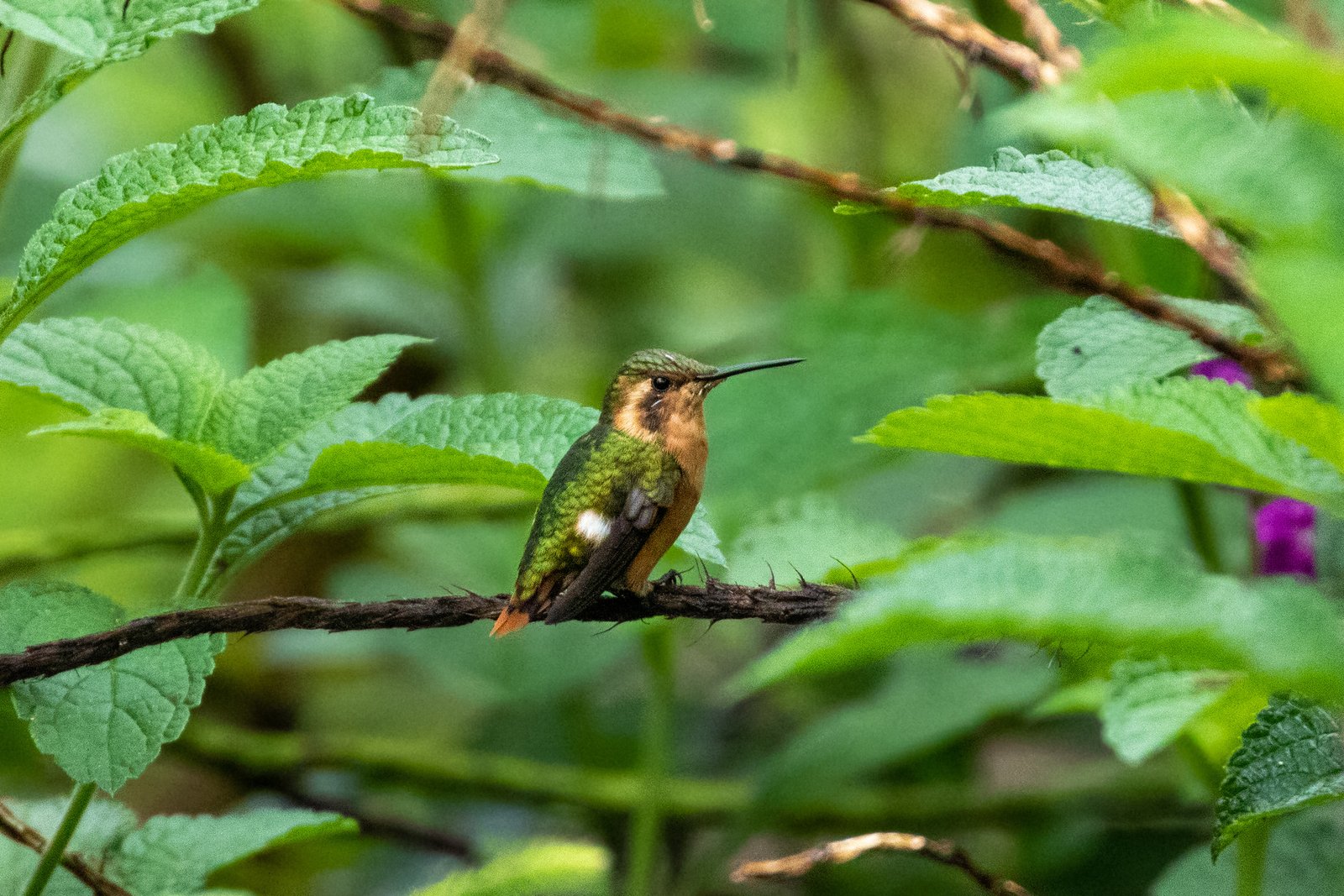
The Little Woodstar is one of the smallest birds of the guide area and lives mainly in the forests of western Ecuador and north-western Peru. The male has a rose-purple throat and a buff breast band. The species is local and occurs in low numbers, and has declined through forest loss.
Voice
Usually silent. Soft, dry tsip notes; the wings hum softly in flight.
Recording: Dušan M. Brinkhuizen — CC BY-NC-SA 3.0 · xeno-canto
Identification
6–7 cm, with a short, straight black bill. The male is bronzy green above, with a glittering rose-purple throat, a buff spot or stripe behind the eye and a buff band across the breast. The flanks are green mixed with cinnamon, and the short, forked tail is dark. The female is green above and warm cinnamon to buff below, with a dark ear patch and a rufous tail with a black band.
Confusion species
The male Esmeraldas Woodstar Chaetocercus berlepschi has a purple throat and a white breast band; the female is whitish below. Short-tailed Woodstar Myrmia micrura has a very short tail and whitish underparts and lives in dry coastal scrub. Purple-collared Woodstar Myrtis fanny is slightly larger, with a longer, slightly decurved bill; the male has a blue-green throat. White-bellied Woodstar Chaetocercus mulsant has a white breast band and belly and lives higher in the Andes.
Habitat
Edges and clearings of humid and semi-humid forest, dry forest, old second growth, shade plantations and gardens, from the lowlands to about 2000 m. It takes nectar at small flowers in shrubs and trees, often high up, and catches small insects. The nest is a small cup of plant down on a branch.
Where the bird is most at home, classified by the vegetation units of the Andes and the west coast.


Range and movements
In Ecuador in the west, from Esmeraldas and Pichincha south to El Oro and Loja. In Peru in the north-west, in Tumbes, Piura, Lambayeque and Cajamarca. In Colombia only a few records in the south-west, in Nariño. Absent from Bolivia and the Galápagos. Does not occur outside the guide area.
- Resident
- dark = core range, pale = thinly spread
How and when to look
At flowering trees and shrubs along forest edges and in gardens in the hills of western Ecuador and north-western Peru. Look for very small hummingbirds hovering at flowers like insects, often high in a tree.
Conservation status
Near Threatened. The species has a fragmented range, and its population is declining through the clearance and fragmentation of forest in western Ecuador and north-western Peru.
Scientific name
Chaetocercus bombus | Gould, 1871
Gould described the species in 1871 and placed it straight away in the genus where it still stands. The genus Chaetocercus was introduced in 1855 by Gray. The genus name combines Greek khaitē, 'hair', with kerkos, 'tail'. The species name comes from Latin bombus, 'humming', from Greek bombos; probably referring to its bumblebee-like flight. The specimen the first description was based on came from Citado, Ecuador.