All species › Swifts › Hummingbirds › White-bellied Woodstar
White-bellied Woodstar | Chaetocercus mulsant
Witbuikboself | Estrellita ventriblanca | Estrelinha-de-barriga-branca
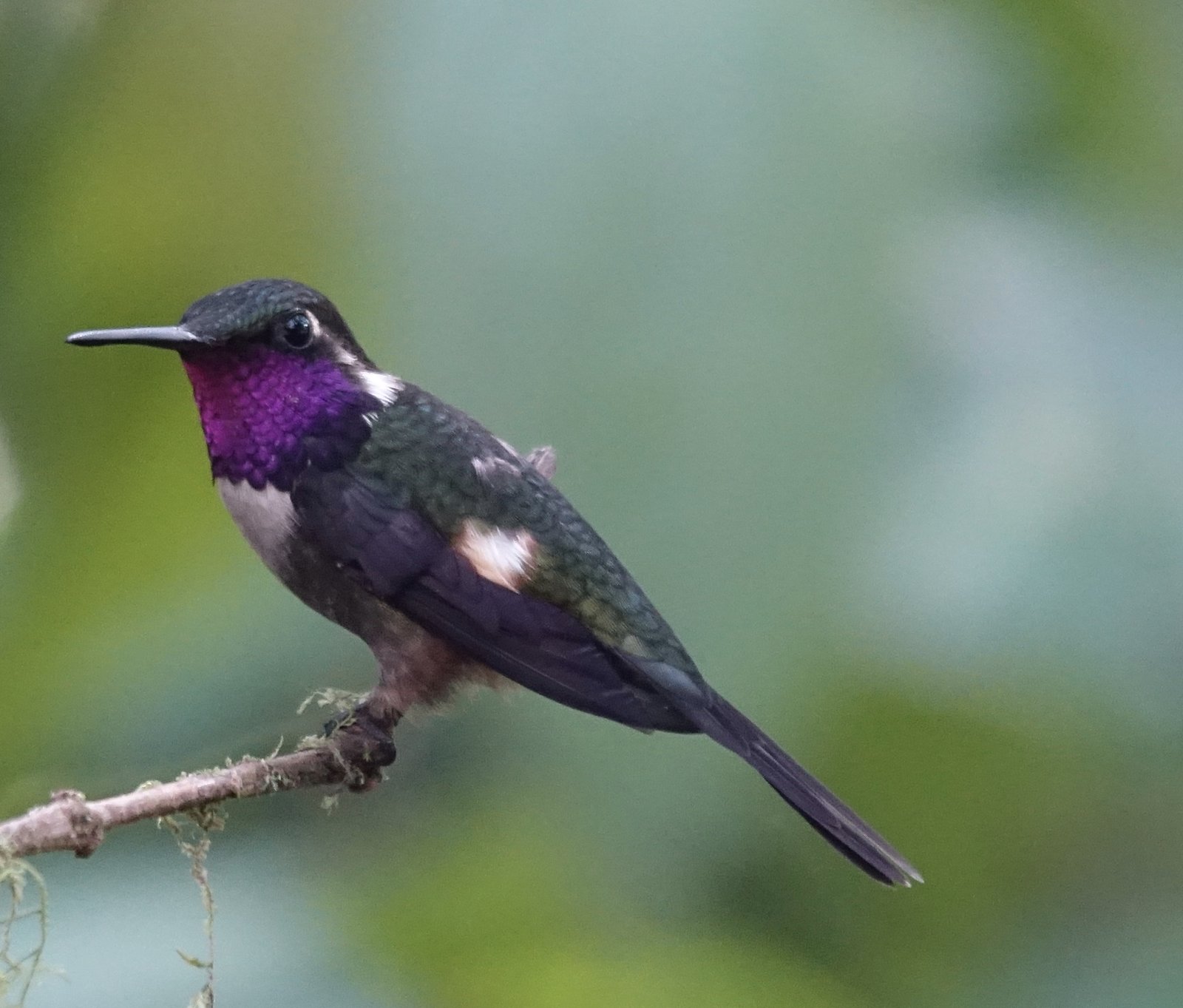
The White-bellied Woodstar is the most widespread woodstar of the Andes, occurring from Colombia to Bolivia. The male has a rose-purple throat and a white breast band that continues into a white belly. Like other woodstars it flies with a slow, bee-like hum and often holds its tail cocked when hovering at a flower.
Voice
Usually silent. Short, high tsit notes, sometimes in short series; the wings make a soft, insect-like hum.
Recording: Mitch Lysinger — CC BY-NC-SA 4.0 · xeno-canto
Identification
7–8 cm, with a short, straight black bill. The male is dark green above, with a glittering rose-purple throat, a white spot behind the eye and a broad white band across the breast that merges into the white belly. The flanks are green, with a white patch on the side of the rump. The tail is short, forked and dark. The female is green above, with a pale spot behind the eye and a dark ear patch; the underparts are whitish with buff flanks, and the tail is rufous with a black band.
Confusion species
Gorgeted Woodstar Chaetocercus heliodor is even smaller; the male has a throat with elongated side points and greyish-green rather than white underparts, and the female is warmer rufous below. The male Little Woodstar Chaetocercus bombus has a buff, not white, breast band and lives mainly lower down, in western Ecuador and north-western Peru. The male Slender-tailed Woodstar Microstilbon burmeisteri in Bolivia has a much longer, deeply forked tail.
Habitat
Edges of humid montane forest and cloud forest, shrubby slopes, old second growth, gardens and hedgerows in the Andes, roughly between 1500 and 3500 m. It takes nectar at small flowers, often at flowering shrubs and trees, and catches small insects in the air. It often perches on bare, exposed twigs. The nest is a small cup of plant down and moss on a branch.
Where the bird is most at home, classified by the vegetation units of the Andes and the west coast.


Range and movements
In Colombia in all three cordilleras of the Andes. In Ecuador on both slopes of the Andes and in the inter-Andean valleys. In Peru along the whole length of the Andes. In Bolivia on the eastern slope in the north and centre of the country. Absent from the Galápagos. Barely occurs outside the guide area.
- Resident
- dark = core range, pale = thinly spread
How and when to look
At flowering shrubs and trees along forest edges, in lodge gardens and in hedgerows at middle elevations in the Andes. Look for a very small hummingbird hovering at flowers with a buzzing sound like a large bee.
Conservation status
Least Concern. The species also occurs at forest edges, in scrub and in gardens, and tolerates changes in the landscape.
Scientific name
Chaetocercus mulsant | (Bourcier, 1843)
Bourcier described the species in 1843 as Ornismya Mulsanti; because it was later moved to another genus, the author and year stand in brackets. The genus Chaetocercus was introduced in 1855 by Gray. The genus name combines Greek khaitē, 'hair', with kerkos, 'tail'. The species name honours Martial Étienne Mulsant (1797–1880), a French entomologist and ornithologist who published on hummingbirds. The specimen the first description was based on came from Colombia and Yungas, Bolivia.