All species › Swifts › Hummingbirds › Slender-tailed Woodstar
Slender-tailed Woodstar | Microstilbon burmeisteri
Fijnstaartboself | Colibrí de Burmeister | Estrelinha-de-cauda-fina
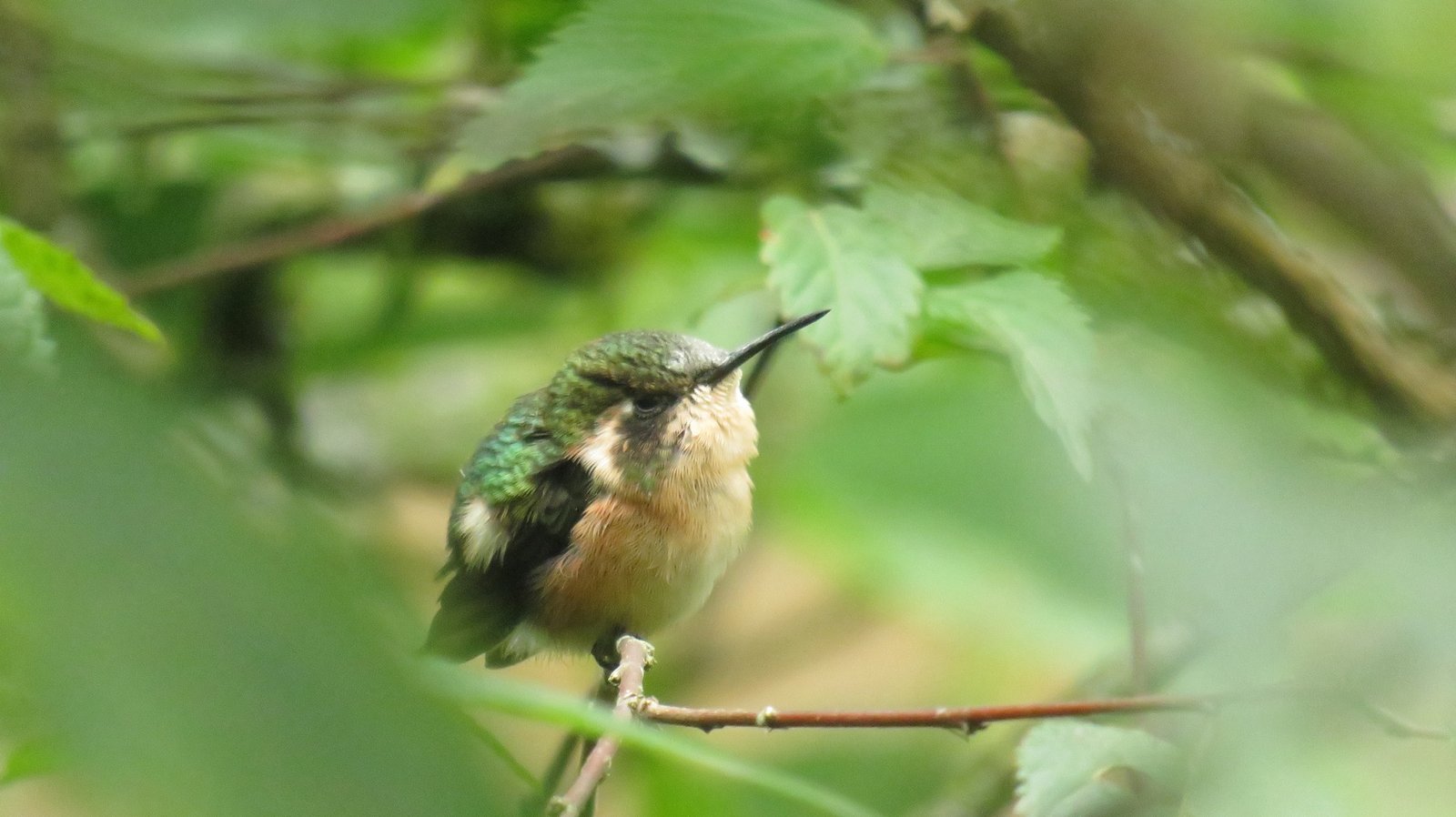
The Slender-tailed Woodstar is a very small hummingbird of the eastern slope of the Andes in Bolivia and north-western Argentina. The male has a long, deeply forked tail with narrow outer feathers, to which the name refers. It is the only species of the genus Microstilbon, which is related to the other woodstars.
Voice
Usually silent. Short, dry tsip notes; in flight a soft, insect-like hum of the wings.
Recording: Sjoerd Mayer — CC BY-NC-SA 3.0 · xeno-canto
Identification
8–9 cm in the male, including the long tail; the female is about 7.5 cm. The bill is short, straight and black. The male is bronzy green above, with a glittering rose-purple throat and a white spot behind the eye. A whitish band across the breast separates the throat from the greenish flanks and paler belly. The tail is long and deeply forked, with narrow, dark outer feathers. The female is green above and warm buff below, with a dark ear patch, a pale stripe behind the eye and a shorter, rufous tail with a black band. Young males resemble the female.
Confusion species
White-bellied Woodstar Chaetocercus mulsant has a short tail and, in the male, a white belly; it lives mainly in more humid forest and higher up. The male Amethyst Woodstar Calliphlox amethystina has a purple throat and a forked but less long tail, and lives in the lowlands. Females of both species closely resemble the female Slender-tailed Woodstar; note the region and the elevation.
Habitat
Edges of dry and semi-humid forest, scrub, groves in dry valleys and gardens on the eastern slope of the Andes, roughly between 1000 and 3000 m. It takes nectar at small flowers in shrubs and trees, with a slow, bee-like flight, and catches small insects. The nest is a small cup of plant down on a thin twig.
Where the bird is most at home, classified by the vegetation units of the Andes and the west coast.


Range and movements
In Bolivia on the eastern slope of the Andes and in the dry valleys of the centre and south of the country. In Peru only a few records. Absent from Colombia, Ecuador and the Galápagos. Outside the guide area in north-western Argentina.
- Resident
- dark = core range, pale = thinly spread
How and when to look
At flowering shrubs and trees along forest edges and in gardens in the dry valleys of central and southern Bolivia. Look for very small hummingbirds hovering at flowers with slow wingbeats like a bumblebee; the male then shows its long tail.
Conservation status
Least Concern. The species also occurs in man-made, semi-open country and in gardens.
Scientific name
Microstilbon burmeisteri | (Sclater, 1888)
Sclater described the species in 1888 as Chaetocercus burmeisteri; because it was later moved to another genus, the author and year stand in brackets. The genus Microstilbon was introduced in 1913 by Todd. The genus name combines Greek mikros, 'small', with stilbōn, 'glittering'. The species name honours Hermann Burmeister (1807–1892), a German-Argentine zoologist and director of the natural history museum in Buenos Aires. The specimen the first description was based on came from Valle de Tafí, Tucumán, Argentina.