All species › Swifts › Hummingbirds › Purple-throated Woodstar
Purple-throated Woodstar | Philodice mitchellii
Paarskeelboself | Estrellita gorgipúrpura | Estrelinha-de-garganta-roxa
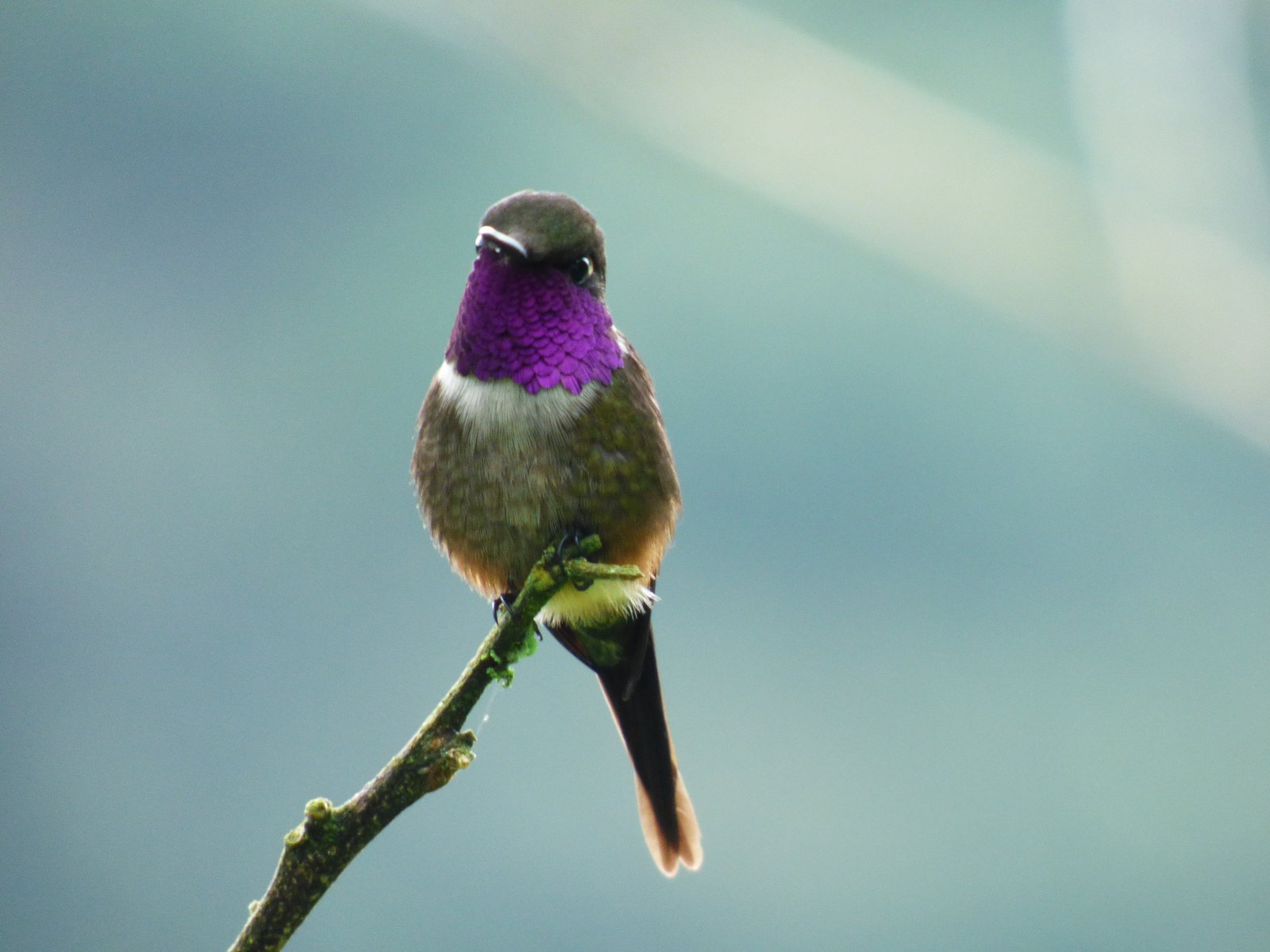
The Purple-throated Woodstar is a very small hummingbird of the Pacific slope and the western and central Andean ranges of Colombia and western Ecuador. The male has a glittering magenta-purple throat above a white breast band. Like other woodstars it flies slowly and with a buzz, often holding its tail cocked.
Voice
High, thin tsit calls and a soft, dry twittering.
Recording: Nick Athanas — CC BY-NC-SA 3.0 · xeno-canto
Identification
7–8 cm, with a short, straight, black bill and a forked tail. The male is dark bronze-green above, with a white patch on the side of the rump. The throat is glittering magenta to purple, with a white breast band below it; the rest of the underparts are dark grey-green with rufous tones on the flanks. The tail is dark and forked. The female is cinnamon below with a pale throat and breast band, a dark ear patch and a rounded tail with a rufous base, a black band and pale tips.
Confusion species
Gorgeted Woodstar Chaetocercus heliodor is smaller, with a shorter tail and, in the male, a rosy red gorget with projecting side corners. White-bellied Woodstar Chaetocercus mulsant has a white belly and a short tail. Little Woodstar Chaetocercus bombus is smaller and has a shorter tail; the female has a whitish throat and cinnamon underparts. Amethyst Woodstar Calliphlox amethystina lives in the lowlands east of the Andes.
Habitat
Edges of humid montane forest, clearings, secondary forest, coffee plantations and gardens, mainly between about 800 and 2000 m, locally lower or higher. It feeds at small flowers of shrubs and trees, often in the upper levels of the vegetation, and catches small insects. Males often sit on bare twigs at the top of a tree.
Where the bird is most at home, classified by the vegetation units of the Andes and the west coast.


Range and movements
In Colombia in the Western and Central Andes and on the Pacific slope, locally also further east. In Ecuador on the western slope of the Andes and in the western foothills. Absent from Bolivia and the Galápagos; from the far north of Peru there are at most a few records. Not found outside the guide area.
- Resident
- dark = core range, pale = thinly spread
How and when to look
Search forest edges and gardens with flowering shrubs on the western slope, for example around Mindo in Ecuador and in the coffee region of the Central Andes in Colombia. Watch for a very small hummingbird with a bumblebee-like flight high in a flowering tree.
Conservation status
Least Concern. The species also occurs in secondary forest and coffee plantations; deforestation affects its habitat locally.
Scientific name
Philodice mitchellii | (Bourcier, 1847) (GBIF: Calliphlox mitchellii)
Bourcier described the species in 1847 as Trochilus Mitchellii; because it was later moved to another genus, the author and year stand in brackets. The genus Philodice was introduced in 1866 by Mulsant, Verreaux & Verreaux. The genus name refers to Philodice, a figure from Greek mythology. The specific name honours David William Mitchell (1813–1859), English zoologist and artist, Secretary of the Zoological Society of London from 1847 to 1859. The specimen the first description was based on came from Zimapán, Hidalgo, Mexico.