All species › Passerines › Ovenbirds and woodcreepers › Scaly-throated Leaftosser
Scaly-throated Leaftosser | Sclerurus guatemalensis
Schubkeelbladkrabber | Tirahojas barbiescamado | Vira-folha-de-garganta-escamada
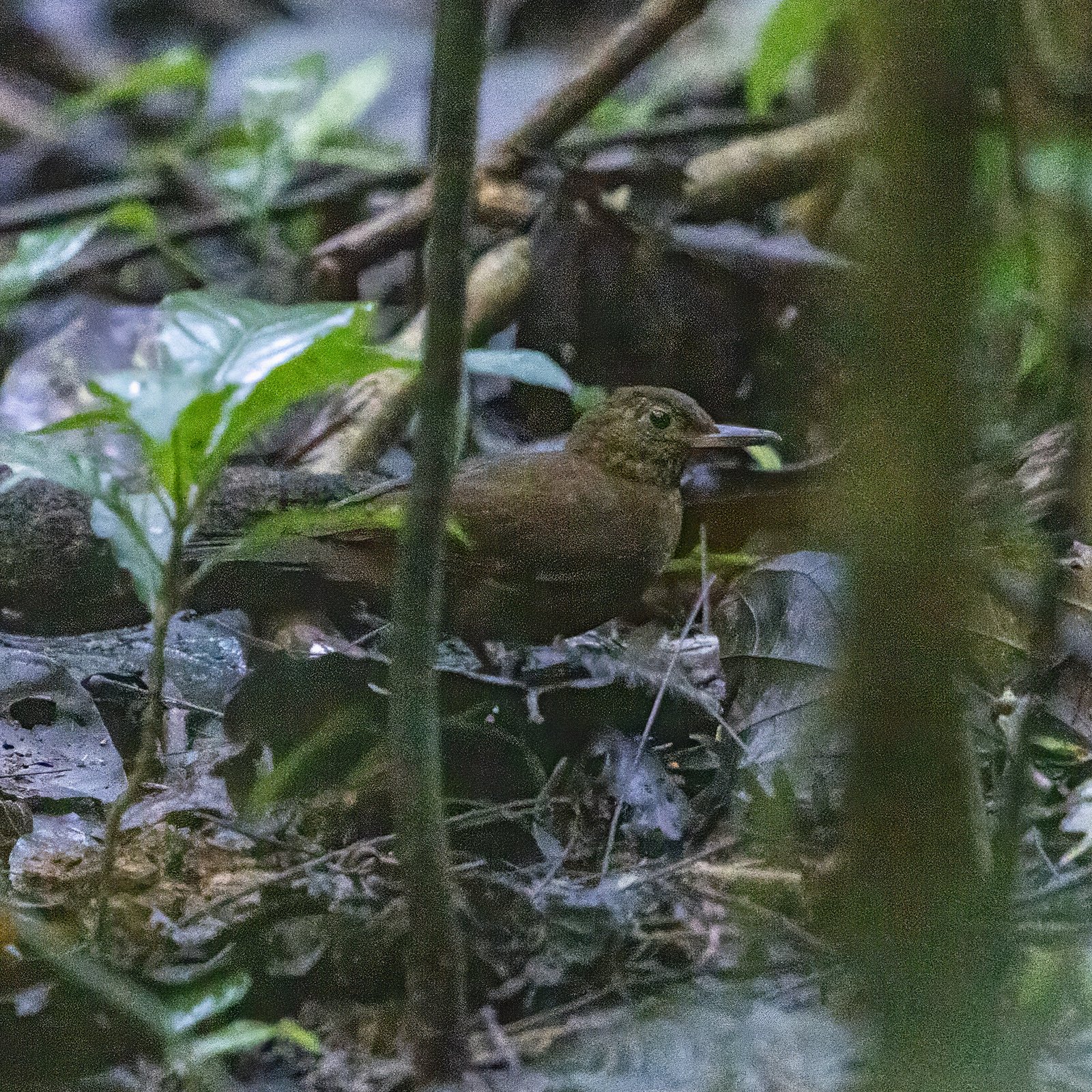
The Scaly-throated Leaftosser is a large, dark brown leaftosser of humid lowland forest west of the Andes. The white throat with black scaling separates it from the other leaftossers in its range. It lives on the forest floor and feeds among fallen leaves.
Voice
The song is a series of loud, clear whistles that accelerates and drops in pitch, often ending in a short chatter. The call is a sharp, metallic note.
Recording: Juan Freile — CC BY-NC-SA 4.0 · xeno-canto
Identification
17–18 cm, with a long, straight bill, a short blackish tail and short legs. The upperparts are uniform dark brown, without a rufous rump. The throat is white to dull white, with black feather edges forming a scaly pattern; the brown breast has pale scaling, and the belly is dark brown. The sexes are alike. Juveniles are duller, with a less sharply marked throat.
Confusion species
Dusky Leaftosser Sclerurus obscurior has a warm ochre throat without scaling and a rufous rump. Black-tailed Leaftosser Sclerurus caudacutus is very similar but lives in Amazonia, east of the Andes. Grey-throated Leaftosser Sclerurus albigularis has a plain greyish-white throat and a rufous breast band.
Habitat
The interior of humid evergreen lowland and hill forest, up to about 1100 m. It forages on the ground for insects and other invertebrates, flicking leaves aside and probing the leaf litter. The nest is at the end of a tunnel in an earth bank.
Where the bird is most at home, classified by the vegetation units of the Andes and the west coast.


Range and movements
In Colombia in the Pacific lowlands, the north and the Magdalena Valley. In Ecuador in the western lowlands and lower slopes south into the south-west. Absent from Peru, Bolivia and the Galápagos. Outside the guide area from southern Mexico through Central America to Panama.
- Resident
- dark = core range, pale = thinly spread
How and when to look
Search closed, humid forest in north-western Ecuador and the Pacific lowlands of Colombia, and listen in the early morning for the accelerating, descending series of whistles.
Conservation status
Least Concern. Much lowland forest has been lost in western Ecuador and Colombia, and the species is absent from heavily fragmented forest.
Scientific name
Sclerurus guatemalensis | (Hartlaub, 1844)
Hartlaub described the species in 1844 as Tinactor guatemalensis; because it was later moved to another genus, the author and year stand in brackets. The genus Sclerurus was introduced in 1827 by Swainson. The genus name combines Greek sklēros, 'stiff', and oura, 'tail'. The species name guatemalensis refers to Guatemala. The specimen the first description was based on came from Guatemala.