All species › Passerines › Tyrant flycatchers and allies › Sepia-capped Flycatcher
Sepia-capped Flycatcher | Leptopogon amaurocephalus
Bruinkapleptopogon | Mosquero gorra parda | Cabeçudo
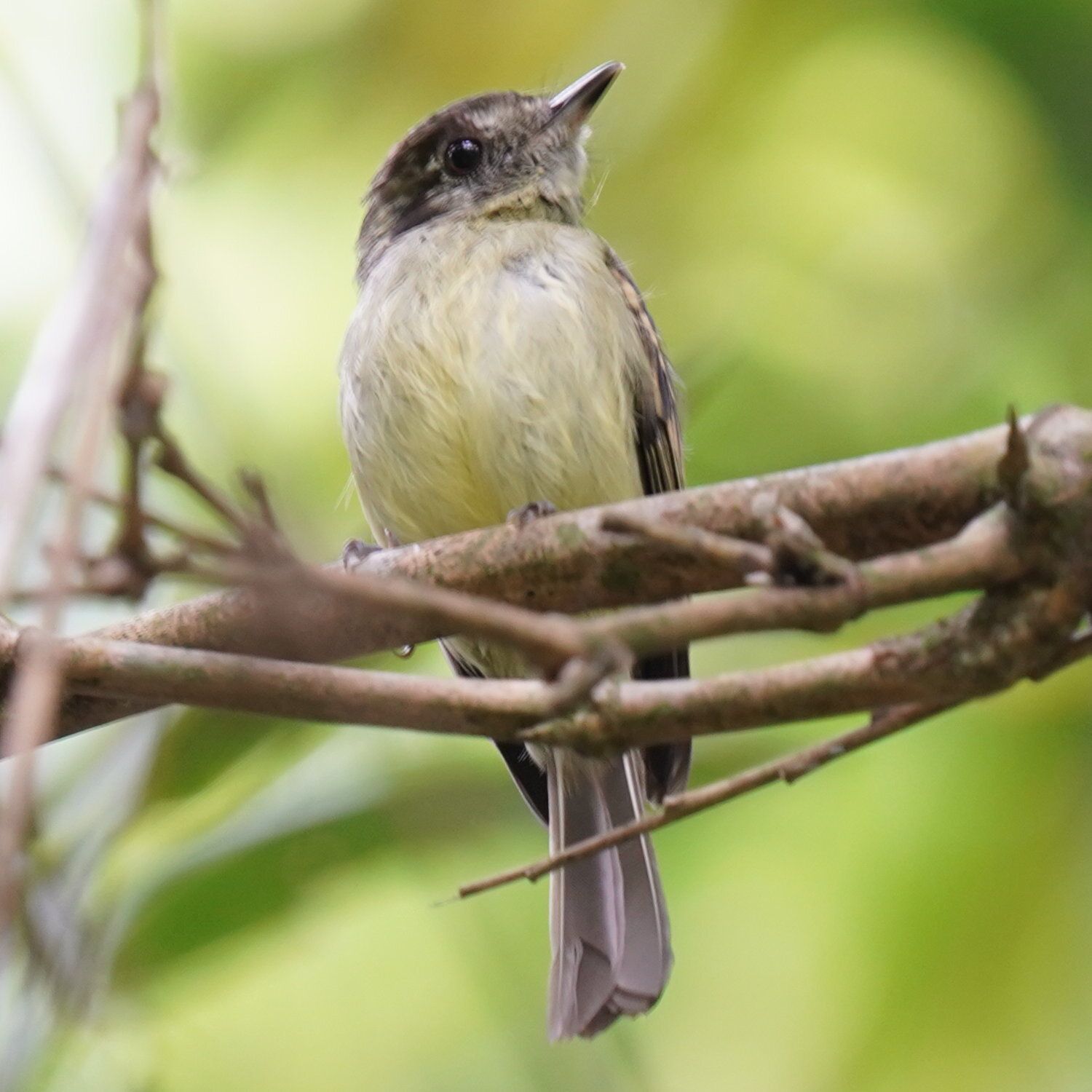
The Sepia-capped Flycatcher is a slender tyrant flycatcher of the lower and middle levels of lowland forest, with a dark brown cap and a dark patch on the ear coverts. Like all Leptopogon species it perches upright and often briefly lifts one wing. Of the three species in the guide area it is the only one of the lowlands.
Voice
A fast, harsh rattling series beginning with a sharp note and then falling: tchew-trrrrrrr. Also a sharp, short call note.
Recording: Aran Rodrigues Cardoso — CC BY-NC-SA 4.0 · xeno-canto
Identification
13–14 cm, with a thin bill. The cap is dark sepia-brown. The face is greyish with fine dark speckling and a blackish crescent on the ear coverts. The back is olive-green, the wings dusky with two ochre wing bars. The throat is greyish, the breast olive and the belly pale yellow. The sexes are alike.
Confusion species
Slaty-capped Flycatcher Leptopogon superciliaris has a slate-grey cap and lives higher, in montane forest. Ochre-bellied Flycatcher Mionectes oleagineus also often lifts a wing, but has an ochre belly and no dark ear patch. Mottle-cheeked Tyrannulet Phylloscartes ventralis is smaller, with a shorter bill, and often holds its tail cocked.
Habitat
The lower and middle levels of humid and semi-humid lowland forest, riverine forest, gallery forest and seasonally flooded forest, also dry forest and old secondary growth, up to about 1300 m. It perches upright on a branch and catches insects with short sallies to leaves. The nest is a hanging ball of moss and fibres, often under an overhanging bank, a rock or among roots.
Where the bird is most at home, classified by the vegetation units of the Andes and the west coast.


Range and movements
Colombia: in the northern lowlands, the Magdalena and Cauca valleys and locally east of the Andes. Ecuador: locally in the Amazonian lowlands. Peru: locally in the Amazonian lowlands and foothills. Bolivia: widespread in the lowlands and foothills of the north and east, also in Chiquitano forest. Absent from the Galápagos. Outside the guide area from southern Mexico to Venezuela, the Guianas, Brazil, Paraguay and north-eastern Argentina.
- Resident
- dark = core range, pale = thinly spread
How and when to look
Search the shady lower levels of riverine and gallery forest and watch for an upright bird that occasionally lifts a wing; the rattling call often gives it away first.
Conservation status
Least Concern. The species has a very large range and tolerates some disturbance of the forest.
Scientific name
Leptopogon amaurocephalus | Cabanis, 1846
Cabanis described the species in 1846 and placed it straight away in the genus where it still stands. The genus Leptopogon was introduced in 1844 by Cabanis. The genus name comes from Greek leptos, 'fine, slender', and pōgōn, 'beard', for the fine bristles at the base of the bill. The species name comes from Greek amauros, 'dark', and kephalē, 'head'. The specimen the first description was based on came from São Paulo, Brazil.