All species › Passerines › Tyrant flycatchers and allies › Little Ground Tyrant
Little Ground Tyrant | Syrtidicola fluviatilis
Kleine grondtiran | Dormilona chica | Gaúcha-d'água
The Little Ground Tyrant is a sand-coloured tyrant flycatcher of sandbars and river islands in southwestern Amazonia. It is the only lowland ground tyrant and is now placed in a genus of its own. It walks and runs across bare sandbars and perches on driftwood.
Voice
Usually silent. The call is described as a single, high, rising peeeep. Hardly any sound recordings are known.
No recording with a suitable Creative Commons licence is available for this species yet.
Identification
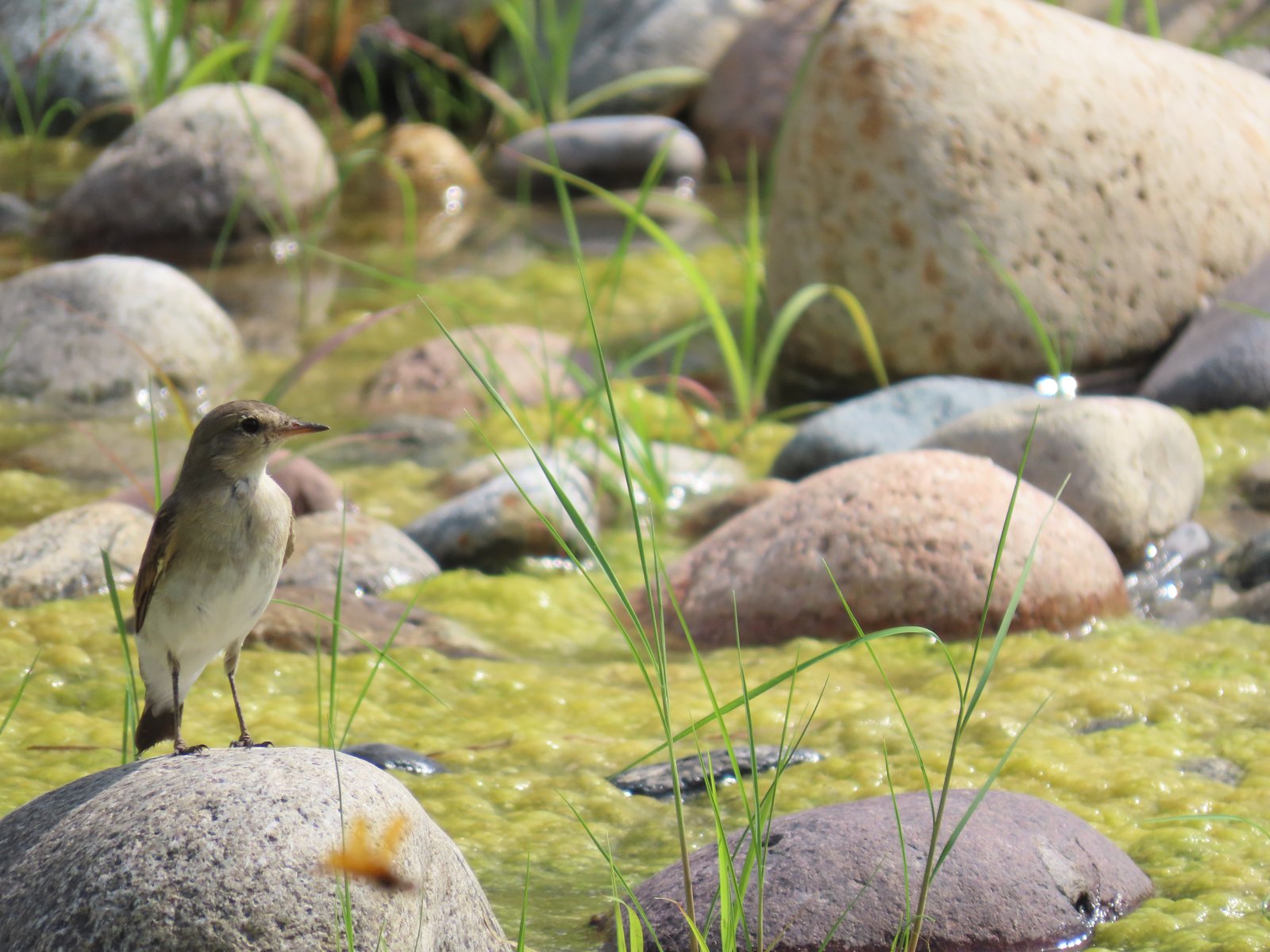
13–14 cm, slender and upright, with fairly long legs. The crown, nape, back and face are greyish sandy brown, with a pale buff supercilium and a pale line above the lores. The wings are dark, with narrow greyish-cinnamon edges to the inner flight feathers and buff tips to the coverts, which can form two wing bars. The tail is black, with white outer webs to the outer feathers. The throat and breast are buffy white, the belly almost white. The bill is black, with a pink or orange-yellow base to the lower mandible. The sexes are alike.
Confusion species
Drab Water Tyrant Ochthornis littoralis lives along the same rivers, but is larger and darker brown, without white in the tail, and usually perches on roots and branches on the bank. River Tyrannulet Serpophaga hypoleuca is grey and white and forages in shrubs. Spot-billed Ground Tyrant Muscisaxicola maculirostris looks similar, but lives high in the Andes.
Habitat
Sandbars and river islands with sparse vegetation, sometimes nearby open, grassy areas; mostly in the lowlands, in Peru up to 1500 m. It walks on the sand and catches insects on the ground or in short flights. Little is known about the nest.
Where the bird is most at home, classified by the vegetation units of the Andes and the west coast.


Range and movements
Colombia: possibly very local in the east, unconfirmed. Ecuador: vagrant, a few records in the northeast and the far south. Peru: along the rivers of Amazonia, mainly in the centre and south. Bolivia: along the rivers of the northern lowlands; a few records high in the Andes, up to about 3800 m, probably concern wanderers. Absent from the Galápagos. Outside the guide area in western Amazonian Brazil.
- Resident
- dark = core range, pale = thinly spread
How and when to look
On boat trips in southeastern Peru and northern Bolivia at low water, when the sandbars are exposed, look for a small sand-coloured bird running over the sand. Watch for the white tail sides when it flies up.
Conservation status
Least Concern. The species has a large range and is locally fairly common; sandbars are constantly re-formed by river dynamics.
Scientific name
Syrtidicola fluviatilis | (Sclater & Salvin, 1866) (GBIF: Muscisaxicola fluviatilis)
Sclater & Salvin described the species in 1866 as Muscisaxicola fluviatilis; because it was later moved to another genus, the author and year stand in brackets. The genus Syrtidicola was introduced in 2020 by Chesser, Harvey, Brumfield & Derryberry. The genus name comes from Latin syrtis (genitive syrtidis), 'sandbank', and -cola, 'dweller': 'sandbank dweller', after the river sandbars of Amazonia where the bird lives. The species name is Latin fluviatilis, 'of the river', after its riverside habitat. The specimen the first description was based on came from Lower Ucayali River, Peru.