All species › Passerines › Tyrant flycatchers and allies › Yellow-crowned Tyrannulet
Yellow-crowned Tyrannulet | Tyrannulus elatus
Geelkruinvliegenpikker | Mosquerito coroniamarillo | Maria-te-viu
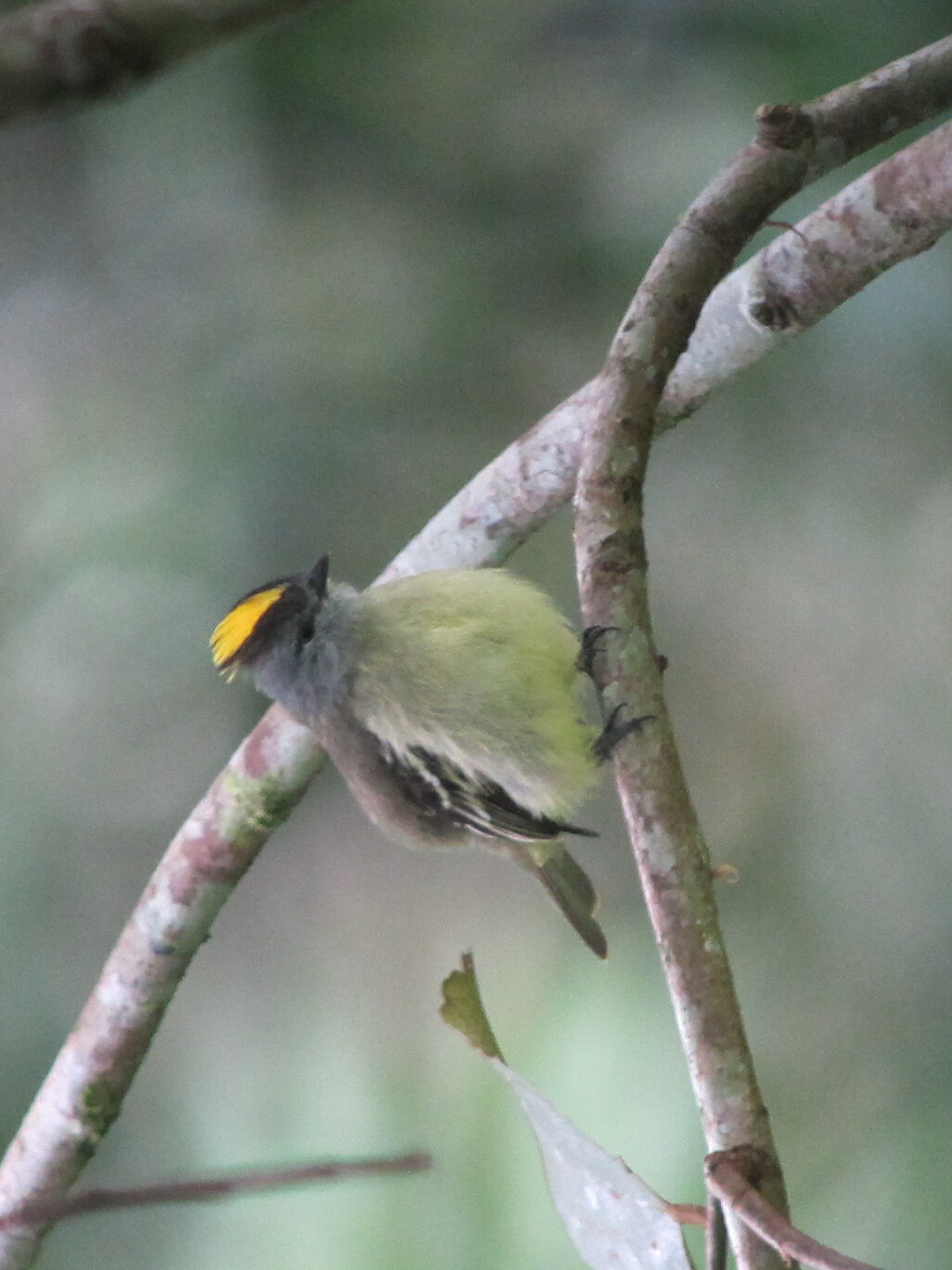
The Yellow-crowned Tyrannulet is a small, very short-billed tyrant of forest edges, open woodland and trees in farmland in the lowlands. It usually perches high in the trees and frequently gives its clear, two-note whistle. The yellow crown stripe is mainly visible when the bird raises its crown feathers.
Voice
A clear, two-note whistle, roughly pree-pew, the second note lower, repeated throughout the day. The Brazilian name maria-te-viu imitates this sound.
Recording: Johan Chaves — CC BY-NC-SA 4.0 · xeno-canto
Identification
10 cm, with a round head, a very short black bill and a rather short tail. The crown is dark grey, with a yellow central stripe that is often partly hidden. The face and throat are grey, the upperparts olive-green. The wings are dark, with two distinct whitish wing bars and pale edges to the secondaries. The breast is olive-grey, the belly pale yellow. The sexes are alike.
Confusion species
Forest Elaenia Myiopagis gaimardii is larger, with a longer bill, a faintly streaked breast and a whitish crown patch. Yellow-crowned Elaenia Myiopagis flavivertex is larger and lives in the understorey of flooded forest. Sooty-headed Tyrannulet Phyllomyias griseiceps has a similarly short bill, but a greyish-brown crown without yellow and no distinct wing bars. Southern Beardless Tyrannulet Camptostoma obsoletum has a ragged little crest and dull yellowish wing bars.
Habitat
The canopy and edges of humid forest, secondary forest, flooded forest, open country with scattered trees, plantations and gardens, from sea level to roughly 1000 m, locally higher. It eats small insects and berries, often of mistletoes. The nest is a small open cup high in a tree.
Where the bird is most at home, classified by the vegetation units of the Andes and the west coast.


Range and movements
Colombia: in the lowlands east of the Andes and also in the north and west, in the Caribbean lowlands, the Magdalena valley and along the Pacific coast. Ecuador: in the Amazonian lowlands and in the north-west. Peru: in the Amazonian lowlands and at the foot of the Andes. Bolivia: in the north and east, in Pando, Beni, La Paz and Santa Cruz. Absent from the Galápagos. Outside the guide area from Panama to the Guianas and Amazonian Brazil.
- Resident
- dark = core range, pale = thinly spread
How and when to look
Listen in forest edges, along riverbanks and in trees along roads and around houses in the lowlands for the two-note whistle, then search the treetops for a small bird with white wing bars.
Conservation status
Least Concern. The species is common in secondary forest and farmland with trees.
Scientific name
Tyrannulus elatus | (Latham, 1790)
Latham described the species in 1790 as S[ylvia] elata; because it was later moved to another genus, the author and year stand in brackets. The genus Tyrannulus was introduced in 1816 by Vieillot. The genus name is a Latin diminutive of tyrannus, 'tyrant', so 'little tyrant'. The specific name is Latin elatus, 'exalted, raised'; possibly referring to the crest the bird can raise. The specimen the first description was based on came from Cayenne, French Guiana.