All species › Passerines › Tyrant flycatchers and allies › White Monjita
White Monjita | Xolmis irupero
Witte monjita | Monjita blanca | Noivinha
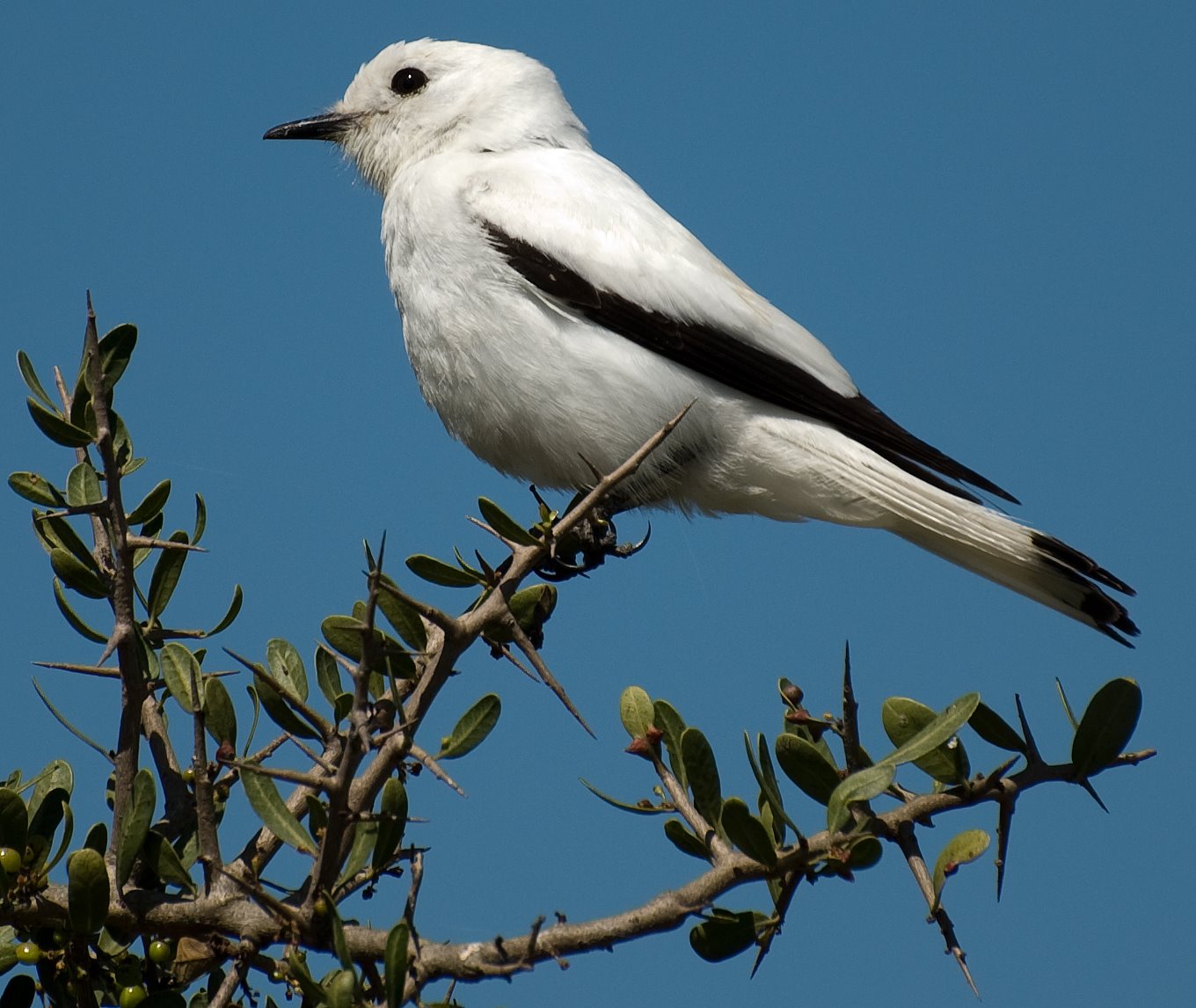
The White Monjita is a small, almost entirely white flycatcher of open, dry country in southern South America. It often perches in the open on top of shrubs, posts and wires; the white plumage with black wingtips is distinctive. In the guide area it lives in the Chaco and the savannas of eastern and southern Bolivia.
Voice
Usually silent. A soft, short prrt and in the breeding season soft whistles.
Recording: Jacob Wijpkema — CC BY-NC-SA 4.0 · xeno-canto
Identification
17–18 cm, with a small, black bill and dark eyes. The plumage is white; the primaries are black, as is a broad terminal tail band. The female has a faint greyish wash on the back. Juveniles have a brownish wash on the crown and back.
Confusion species
White-rumped Monjita Xolmis velatus has a grey-brown back, a grey crown and more black in the tail. Grey Monjita Nengetus cinereus is larger, with grey upperparts and a black malar stripe. The male White-headed Marsh Tyrant Arundinicola leucocephala has only a white head on a black body and lives in marshes.
Habitat
Open, dry country with scattered shrubs and trees, the Chaco, savanna, pastures and farmyards, in the lowlands and lower hills up to about 1500 m. It catches insects on the ground after a short flight from a lookout. The nest is in a cavity in a tree or post or in an old nest of another bird.
Where the bird is most at home, classified by the vegetation units of the Andes and the west coast.


Range and movements
Bolivia: in the lowlands of the east and south, from Beni and Santa Cruz to Chuquisaca and Tarija. Absent from Colombia, Ecuador, Peru and the Galápagos. Outside the guide area in Paraguay, Uruguay, northern and central Argentina and eastern and southern Brazil.
- Resident
- dark = core range, pale = thinly spread
How and when to look
Drive through the Chaco or the open ranchland of eastern Bolivia and check the tops of shrubs and posts along the road.
Conservation status
Least Concern. The species is widespread and also occurs in open, grazed country.
Scientific name
Xolmis irupero | (Vieillot, 1823)
Vieillot described the species in 1823 as T[yrannus] irupero; because it was later moved to another genus, the author and year stand in brackets. The genus Xolmis was introduced in 1826 by Boie. The origin of the genus name Xolmis (Boie, 1826) is unknown. It may be a misreading of Xomotl in Hernández (1651), or be based on an unrecorded Guaraní name. The specific name comes from Ihruperó, the Guaraní name Azara recorded for this bird in Paraguay; it possibly means 'troublesome bird'. The specimen the first description was based on came from Paraguay.