All species › Passerines › Tyrant flycatchers and allies › White-rumped Monjita
White-rumped Monjita | Xolmis velatus
Witstuitmonjita | Monjita velada | Noivinha-branca
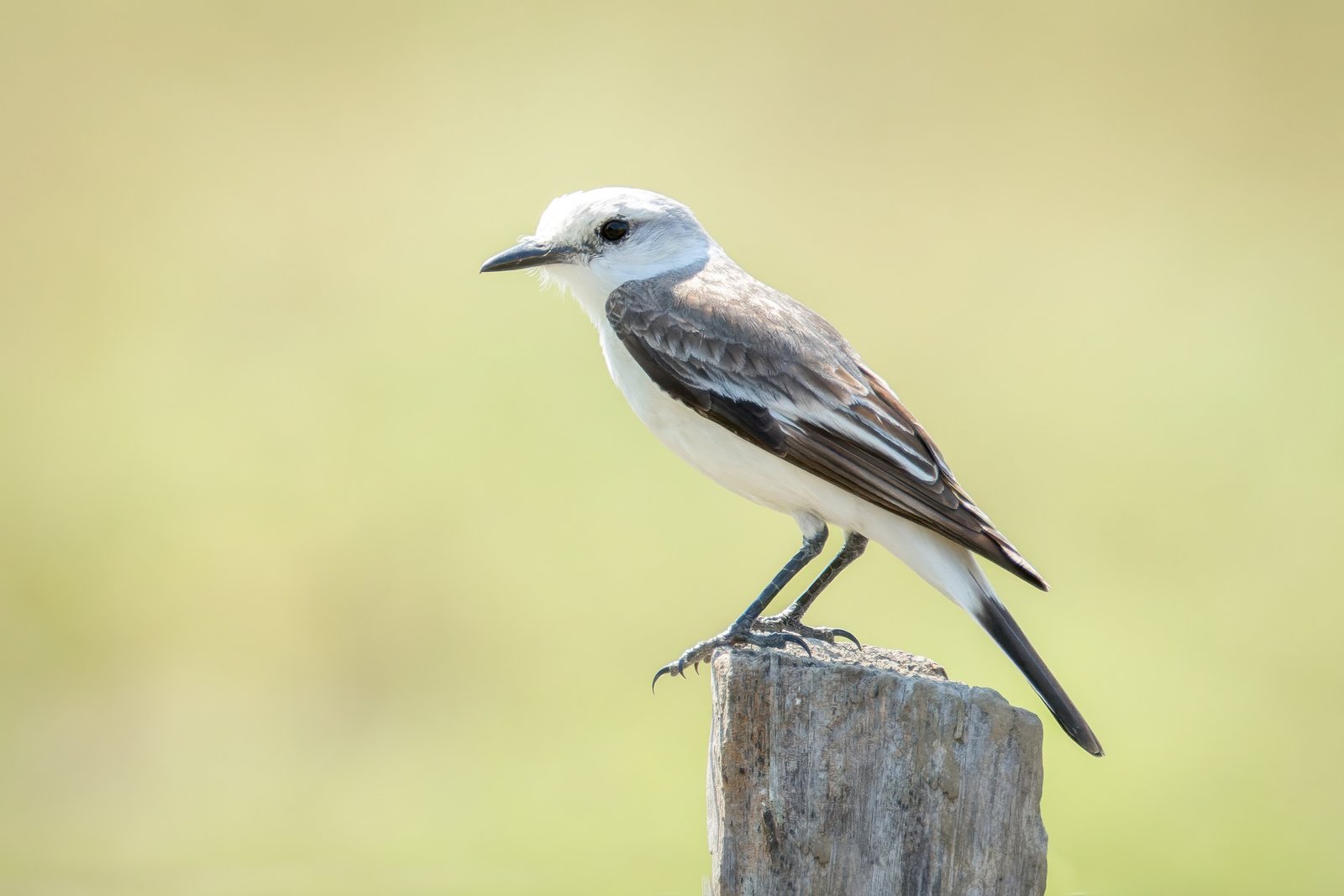
The White-rumped Monjita is a medium-sized, grey-brown and white flycatcher of open savannas and pastures in central South America. It perches upright on posts, shrubs and wires and shows a white rump and dark wings in flight. In the guide area it occurs only in the lowlands of northern and eastern Bolivia.
Voice
Usually silent. Soft, short calls, such as a dry tsip.
Recording: Dante Buzzetti — CC BY-NC-SA 4.0 · xeno-canto
Identification
19–20 cm, with a small, black bill. The forehead, supercilium and sides of the head are white, the crown and nape grey, the back greyish brown. The rump is white, the tail black with a white base. The wings are blackish with pale edges to the coverts. The underparts are white. The female has a browner crown; juveniles are browner and duller.
Confusion species
White Monjita Xolmis irupero is almost entirely white, with black wingtips and a black terminal tail band. Grey Monjita Nengetus cinereus is larger and greyer, with a black malar stripe and a white patch at the base of the primaries. Chalk-browed Mockingbird Mimus saturninus has a longer tail with white corners, a dark eyestripe and a streaked back.
Habitat
Open savanna and cerrado with scattered trees and shrubs, pastures, the edges of marshes and the surroundings of villages, in the lowlands up to about 1000 m. It perches on a lookout and catches insects on the ground or in short flights. The nest is an open cup in a tree or shrub.
Where the bird is most at home, classified by the vegetation units of the Andes and the west coast.


Range and movements
Bolivia: in the lowlands of Beni and Santa Cruz, in the north and east of the country. Absent from Colombia, Ecuador, Peru and the Galápagos. Outside the guide area in central and eastern Brazil, Paraguay and north-eastern Argentina.
- Resident
- dark = core range, pale = thinly spread
How and when to look
Search the savannas around Trinidad in Beni or the open country of Santa Cruz; check posts and wires along roads and pastures.
Conservation status
Least Concern. The species also occurs in pastures created in place of forest or savanna.
Scientific name
Xolmis velatus | (Lichtenstein, 1823)
Lichtenstein described the species in 1823 as M[uscicapa] velata; because it was later moved to another genus, the author and year stand in brackets. The genus Xolmis was introduced in 1826 by Boie. The origin of the genus name Xolmis (Boie, 1826) is unknown. It may be a misreading of Xomotl in Hernández (1651), or be based on an unrecorded Guaraní name. The specific name is Latin velatus, 'veiled, covered'. The specimen the first description was based on came from São Paulo, Brazil.