All species › Pigeons and doves › Doves and pigeons › Short-billed Pigeon
Short-billed Pigeon | Patagioenas nigrirostris
Kortsnavelduif | Paloma piquicorta | Pomba-de-bico-curto
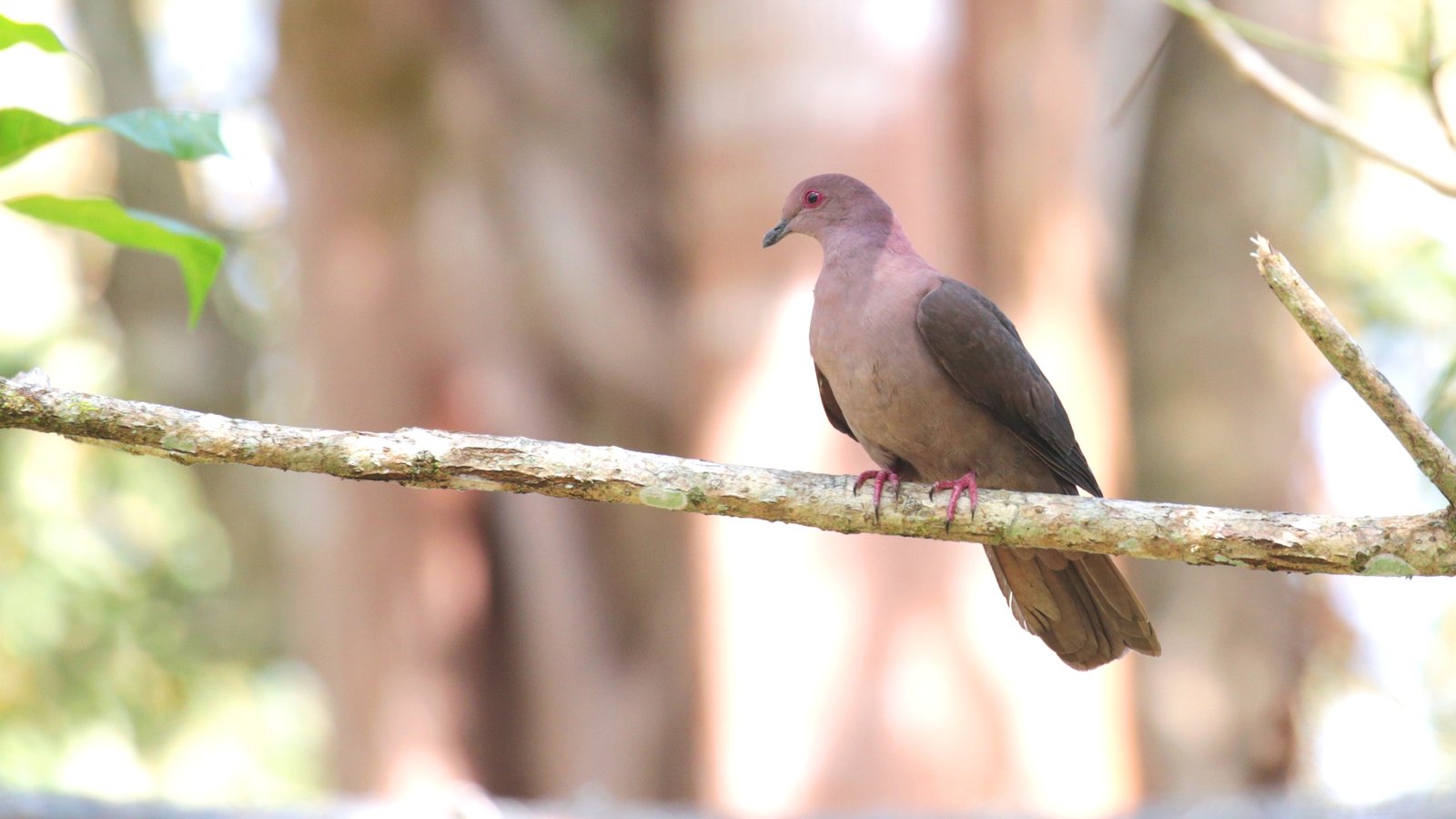
The Short-billed Pigeon is a fairly small, plain brown pigeon of humid lowland forest, ranging from southern Mexico to north-western Colombia. It lives high in the canopy and usually gives itself away by its four-syllable call. In the guide area the species reaches the southern limit of its range.
Voice
A clear, four-syllable cooing with the stress on the second syllable, roughly oo, cook-cook-coo, often repeated at length from the canopy. Also a low, growling grrr.
Recording: Jerome Fischer — CC BY-NC-SA 4.0 · xeno-canto
Identification
26–28 cm. A slender pigeon with a short, black bill. The head, neck and underparts are warm vinaceous brown, slightly greyer on the belly; the back and wings are olive-brown, and the tail is dark greyish brown without markings. The iris is reddish, the legs red. The sexes are alike; juveniles are duller and browner, with pale fringes to the wing feathers.
Confusion species
Ruddy Pigeon Patagioenas subvinacea is very similar and is separated in the field mainly by voice; it is redder in tone, with a slightly longer bill and cinnamon underwings. Plumbeous Pigeon Patagioenas plumbea is greyer, with a lead-grey head and underparts, and lives mainly further south in the Chocó. Pale-vented Pigeon Patagioenas cayennensis has a pale undertail and lives in semi-open country along rivers.
Habitat
Humid lowland and foothill forest, tall secondary forest and forest edge, in the guide area mainly below 1000 m. It lives in the canopy and eats fruit, berries and seeds; it rarely comes to the ground. The nest is a flimsy platform of twigs in a tree or among vines.
Where the bird is most at home, classified by the vegetation units of the Andes and the west coast.


Range and movements
In the guide area only in north-western Colombia: Urabá and the northern Chocó, east into the lowlands of Córdoba and northern Antioquia. Absent from Ecuador, Peru, Bolivia and the Galápagos. Outside the guide area from southern Mexico through Central America to Panama.
- Resident
- dark = core range, pale = thinly spread
How and when to look
In the early morning, listen at the edges of humid forest in Urabá and the northern Chocó for the four-syllable call; singing birds often sit on a high, sheltered branch.
Conservation status
Least Concern. In the guide area restricted to a small part of the north-west, where deforestation is removing habitat.
Scientific name
Patagioenas nigrirostris | (Sclater, 1860)
Sclater described the species in 1860 as Columba nigrirostris; because it was later moved to another genus, the author and year stand in brackets. The genus Patagioenas was introduced in 1853 by Reichenbach. The genus name combines Greek patageō, 'to clatter', with oinas, 'pigeon'. The species name combines Latin niger, 'black', with rostrum, 'bill'. The specimen the first description was based on came from Oaxaca, Mexico.