All species › Pigeons and doves › Doves and pigeons › Ruddy Pigeon
Ruddy Pigeon | Patagioenas subvinacea
Purperduif | Paloma rojiza | Pomba-botafogo
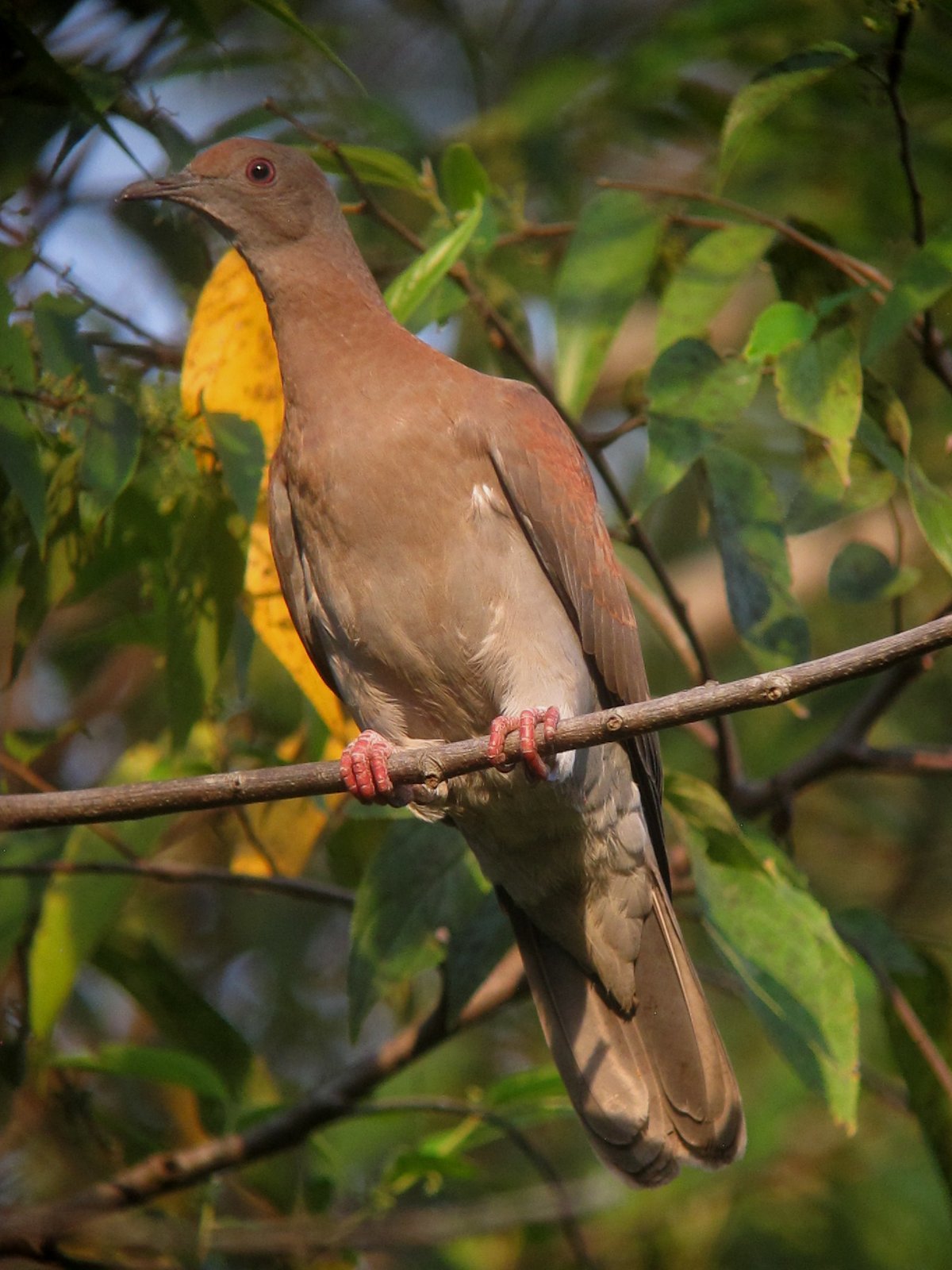
The Ruddy Pigeon is a medium-sized, reddish brown pigeon of the canopy of humid forest, from the lowlands into the lower montane forest of the Andes. It closely resembles Plumbeous Pigeon and in the field is recognized mainly by its four-note call.
Voice
A four-part cooing, the second note higher and stressed, roughly whoo, hoo-coo-cooo, faster than the call of Plumbeous Pigeon; often repeated from the canopy.
Recording: JAYRSON ARAUJO DE OLIVEIRA — CC BY-NC-SA 4.0 · xeno-canto
Identification
30 cm. Mostly dark reddish brown to vinaceous, with a purplish tinge on the head and underparts; the upperparts are darker and browner, with a rufous tinge on the mantle and wing coverts. The underwing is rufous. The bill is black, the eye reddish, the legs red. The sexes are similar; the female is slightly duller. Juveniles are browner, with pale feather edges.
Confusion species
Plumbeous Pigeon Patagioenas plumbea is slightly larger and greyer, with grey underwings, and has a three-note call; in lower montane forest Ruddy Pigeon usually occurs higher up. Scaled Pigeon Patagioenas speciosa is larger and scaled, with a red bill. Band-tailed Pigeon Patagioenas fasciata is larger and grey, with a white nape collar and a yellow bill, and lives higher up.
Habitat
Tall humid terra firme forest, foothill forest and lower montane forest, also forest edges and older secondary growth, from the lowlands to roughly 2500 m. It eats fruit and berries in the treetops. The nest is a platform of twigs in a tree.
Where the bird is most at home, classified by the vegetation units of the Andes and the west coast.


Range and movements
In Colombia on the slopes of the Andes, in the Chocó and in the Amazonian lowlands. In Ecuador in the west and in the east, mainly in the foothills and lower montane forest. In Peru and Bolivia in the lowlands, foothills and lower montane forest east of the Andes. Absent from the Galápagos. Outside the guide area from Costa Rica and Panama to Venezuela, the Guianas and Amazonian Brazil.
- Resident
- dark = core range, pale = thinly spread
How and when to look
In foothill forest on the eastern slope of the Andes, listen for the four-note call and then look for the bird on a projecting branch above the canopy; in the lowlands the difference from Plumbeous Pigeon can only be confirmed by voice.
Conservation status
Least Concern. Widespread, but dependent on tall forest and therefore sensitive to deforestation, especially in Amazonia; hunted locally.
Scientific name
Patagioenas subvinacea | (Lawrence, 1868)
Lawrence described the species in 1868 as Chloroenas subvinacea; because it was later moved to another genus, the author and year stand in brackets. The genus Patagioenas was introduced in 1853 by Reichenbach. The genus name combines Greek patageō, 'to clatter', with oinas, 'pigeon'. The species name combines Latin sub-, 'somewhat', with vinaceus, 'wine-coloured'. The specimen the first description was based on came from Dota, Costa Rica.