All species › Pigeons and doves › Doves and pigeons › Plumbeous Pigeon
Plumbeous Pigeon | Patagioenas plumbea
Loodgrijze duif | Paloma plomiza | Pomba-amargosa
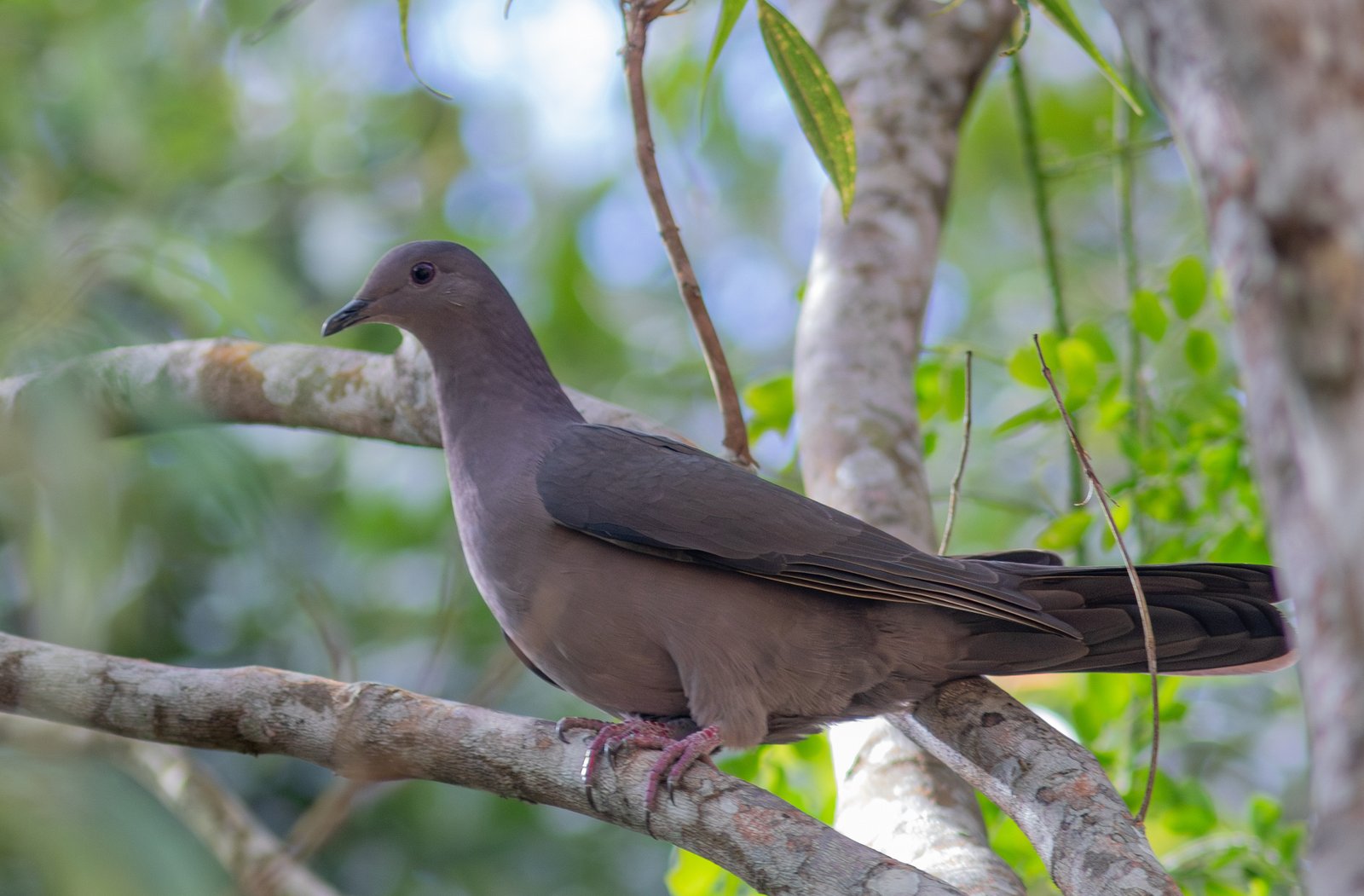
The Plumbeous Pigeon is a dark, plain-coloured pigeon of the canopy of humid lowland forest. It is heard more often than seen; its three-note cooing carries from the treetops throughout the day.
Voice
A three-part, calm cooing, roughly hoo, hoo-hooo, with the last note drawn out; often repeated from the canopy, also in the middle of the day.
Recording: Juan Freile — CC BY-NC-SA 4.0 · xeno-canto
Identification
33–34 cm. Mostly dark leaden grey, with a vinaceous to purplish tinge on the head, neck and breast; the upperparts are darker and browner grey. The underwing is grey. The bill is black, the eye pale yellow to reddish, the legs red. The sexes are similar; the female is slightly duller. Juveniles are browner, with rusty feather edges.
Confusion species
Ruddy Pigeon Patagioenas subvinacea is slightly smaller and more reddish brown, with rufous underwings, but in the field it is often separable only by voice: its call has four notes instead of three. Scaled Pigeon Patagioenas speciosa is larger, chestnut and scaled, with a red bill. Pale-vented Pigeon Patagioenas cayennensis has whitish undertail coverts and lives in semi-open country.
Habitat
Tall humid terra firme forest, várzea, foothill forest and older secondary forest edges, from the lowlands to roughly 1500 m, locally higher. It eats fruit and berries, including mistletoe, in the treetops and rarely comes to the ground. The nest is a platform of twigs high in a tree.
Where the bird is most at home, classified by the vegetation units of the Andes and the west coast.


Range and movements
In Colombia in the Amazonian lowlands and foothills east of the Andes, and in the Chocó in the west. In Ecuador in the east and in the northwest. In Peru and Bolivia in the lowlands and foothills east of the Andes. Absent from the Galápagos. Outside the guide area in Amazonia, the Guianas and the Atlantic Forest of Brazil.
- Resident
- dark = core range, pale = thinly spread
How and when to look
In the early morning in tall rainforest, listen for the three-note cooing and then look for the bird on a bare branch above the canopy, for example from a canopy tower.
Conservation status
Least Concern. Widespread, but dependent on tall forest and therefore sensitive to deforestation; hunted locally.
Scientific name
Patagioenas plumbea | (Vieillot, 1818)
Vieillot described the species in 1818 as Columba plumbea; because it was later moved to another genus, the author and year stand in brackets. The genus Patagioenas was introduced in 1853 by Reichenbach. The genus name combines Greek patageō, 'to clatter', with oinas, 'pigeon'. The species name comes from Latin plumbeus, 'leaden'. The specimen the first description was based on came from Brazil.