All species › Pigeons and doves › Doves and pigeons › Maranon Pigeon
Maranon Pigeon | Patagioenas oenops
Salvins duif | Paloma del Marañón | Pomba-do-marañón
The Maranon Pigeon is a large pigeon with a small range in the dry valley of the Marañón and its tributaries in northern Peru and extreme southern Ecuador. It depends on riparian woodland and tall trees in an otherwise dry landscape.
Voice
A deep, calm cooing of a few notes, roughly whooo, whoo-whooo, repeated at intervals from a tall tree.
Recording: Wilson Diaz — CC BY-NC-SA 4.0 · xeno-canto
Identification
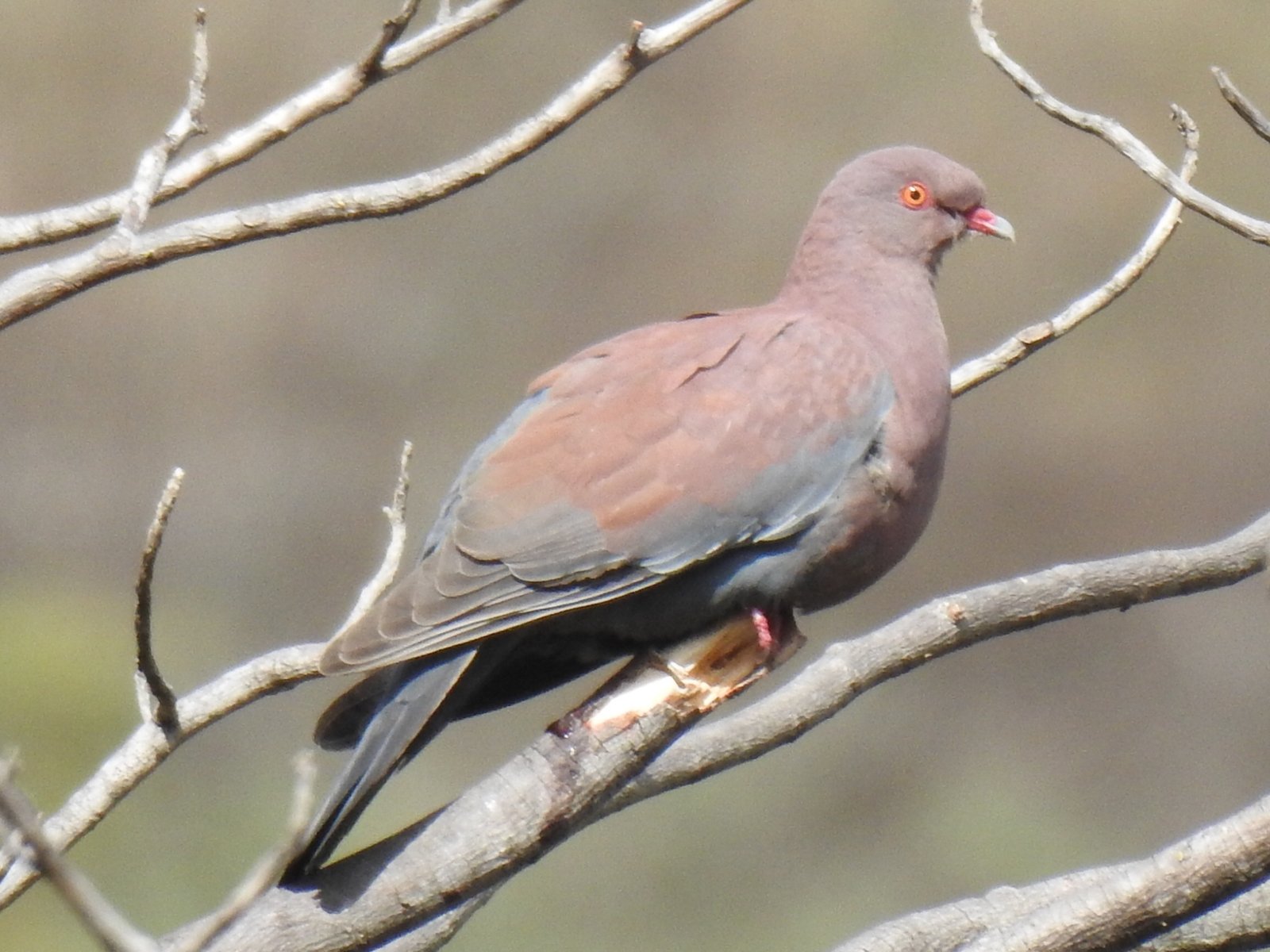
30–32 cm. The head, neck and breast are vinaceous to purplish, the mantle and lesser wing coverts chestnut to chestnut-red. The flight feathers, rump, belly and undertail are blue-grey, the tail dark grey. The bill has a red base and a pale, yellowish tip; the eye-ring and legs are red. The sexes are similar; juveniles are duller and browner.
Confusion species
Pale-vented Pigeon Patagioenas cayennensis has a black bill and whitish undertail coverts and lives mainly in the lowlands. Band-tailed Pigeon Patagioenas fasciata is greyer, has a white nape collar and a yellow bill and lives higher up in montane forest. Spot-winged Pigeon Patagioenas maculosa has white spots on the wing and a dark bill. Eared Dove Zenaida auriculata is much smaller and slimmer.
Habitat
Riparian woodland, dry forest with tall trees and semi-open farmland with groves and fruit trees in the dry valleys, roughly from the valley floor to about 2000 m. It eats fruit and seeds in trees and sometimes on the ground. The nest is a platform of twigs in a tree.
Where the bird is most at home, classified by the vegetation units of the Andes and the west coast.


Range and movements
In Ecuador only in the extreme south, in the Chinchipe area. In Peru in the valley of the Marañón and its tributaries in the north, including Cajamarca and Amazonas. Not in Colombia, Bolivia or the Galápagos. Endemic to the guide area.
- Resident
- dark = core range, pale = thinly spread
How and when to look
In the Marañón valley search along the river and side streams for pigeons perched in tall trees near riparian woodland and orchards, especially in the early morning; listen for the cooing from the treetops.
Conservation status
Near Threatened (NT). The range is small; riparian and dry forest in the Marañón valley is being converted to farmland, including rice fields, and the species is hunted locally.
Scientific name
Patagioenas oenops | (Salvin, 1895)
Salvin described the species in 1895 as Columba oenops; because it was later moved to another genus, the author and year stand in brackets. The genus Patagioenas was introduced in 1853 by Reichenbach. The genus name combines Greek patageō, 'to clatter', with oinas, 'pigeon'. The species name comes from Greek oinōps, 'wine-coloured'. The specimen the first description was based on came from Huamachuco and Cajabamba, Peru.