All species › Pigeons and doves › Doves and pigeons › Band-tailed Pigeon
Band-tailed Pigeon | Patagioenas fasciata
Bandstaartduif | Paloma de collar | Pomba-de-cauda-barrada
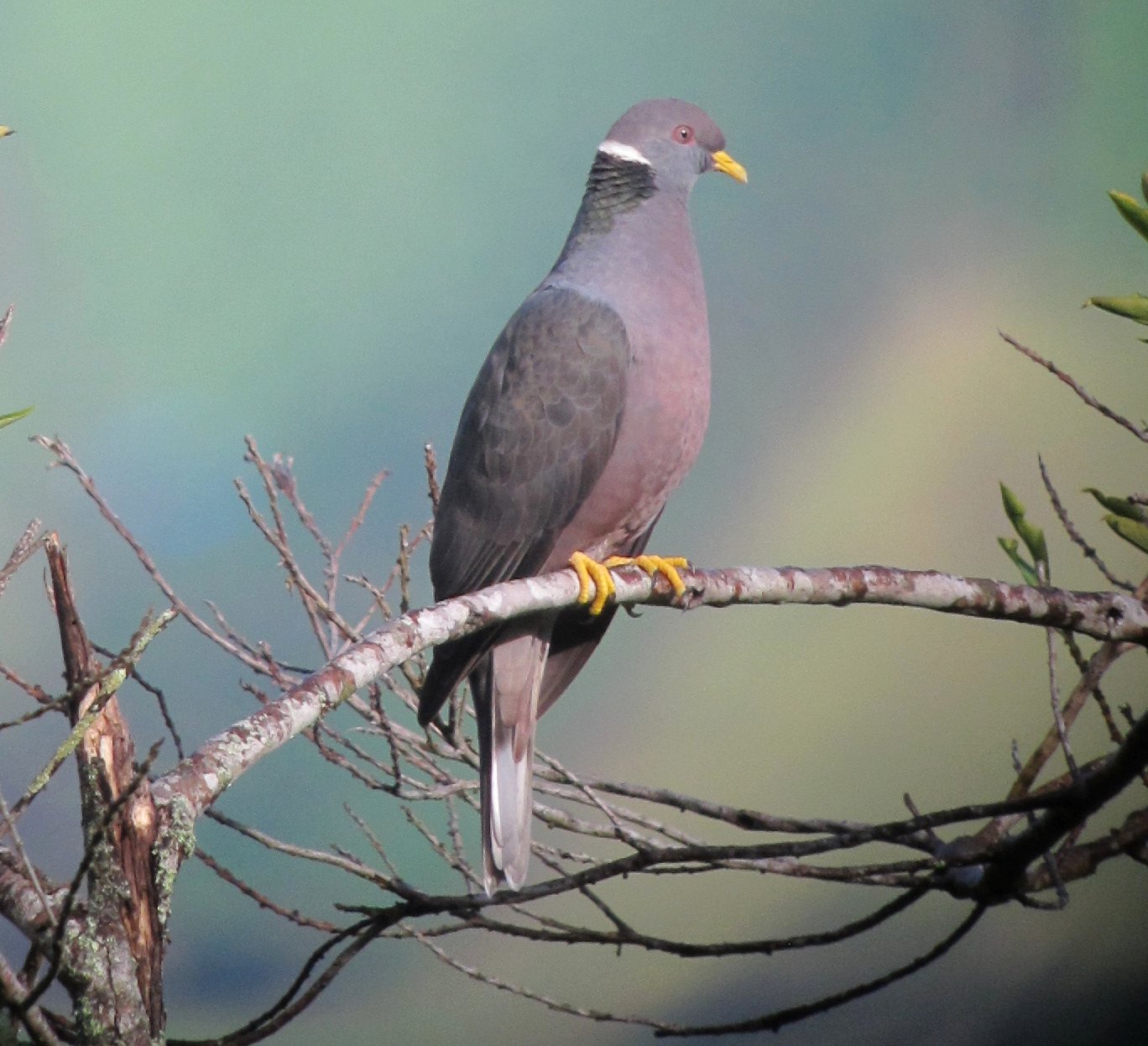
The Band-tailed Pigeon is the large, grey pigeon of Andean montane forest, recognized by the white half-collar above a glossy nape patch and the yellow bill. It lives in flocks that wander widely in search of fruiting trees and often fly fast and high over the ridges.
Voice
A low, owl-like cooing, usually two notes, roughly hoo-whooo, repeated a few times in succession from a treetop.
Recording: Manuel Grosselet — CC BY-NC-SA 4.0 · xeno-canto
Identification
35–38 cm. The head, neck and breast are grey with a purplish-pink tinge, the belly paler grey. On the hindneck there is a narrow white half-collar, with a glossy bronze-green patch below it. The mantle and wings are dark blue-grey, the flight feathers darker. The tail has a dark band across the middle and a pale grey terminal band. The bill and legs are yellow, the bill tip sometimes darker. The female is duller, with a less distinct collar; juveniles lack the white collar.
Confusion species
Plumbeous Pigeon Patagioenas plumbea and Ruddy Pigeon Patagioenas subvinacea are smaller and darker, lack the white collar and have a dark bill; they live mainly at lower elevations. Spot-winged Pigeon Patagioenas maculosa of the dry valleys of Peru and Bolivia has white spots on the wing coverts and a dark bill. Rock Pigeon Columba livia in villages and towns has black wing bars and often a white rump.
Habitat
Humid montane forest, cloud forest and forest edges, also semi-open country with groves and oak forest, roughly between 1500 and 3500 m, locally lower or higher. It eats fruit, berries, acorns and seeds, often in flocks in the treetops, and sometimes visits salt licks. The nest is a flimsy platform of twigs in a tree.
Where the bird is most at home, classified by the vegetation units of the Andes and the west coast.


Range and movements
In Colombia in all three Andean ranges, the Serranía del Perijá and the Sierra Nevada de Santa Marta. In Ecuador on both slopes of the Andes. In Peru along the entire Andes. In Bolivia in the Andes, south to the border region with Argentina. Absent from the Galápagos. Outside the guide area from western North America through Central America and northern Venezuela to northwestern Argentina.
- Resident
- dark = core range, pale = thinly spread
How and when to look
From a viewpoint above the cloud forest, watch for flocks of large pigeons flying fast along the slopes; in the early morning they often perch on bare branches above the canopy.
Conservation status
Not Evaluated (NE). Widespread and locally common in the Andes; hunting and clearing of montane forest can reduce numbers locally.
Scientific name
Patagioenas fasciata | (Say, 1822)
Say described the species in 1822 as Columba fasciata; because it was later moved to another genus, the author and year stand in brackets. The genus Patagioenas was introduced in 1853 by Reichenbach. The genus name combines Greek patageō, 'to clatter', with oinas, 'pigeon'. The species name comes from Latin fasciatus, 'banded'. The specimen the first description was based on came from Plum Creek near Castle Rock, Colorado, United States.