All species › Pigeons and doves › Doves and pigeons › White-crowned Pigeon
White-crowned Pigeon | Patagioenas leucocephala
Witkapduif | Paloma cabeciblanca | Pomba-de-coroa-branca
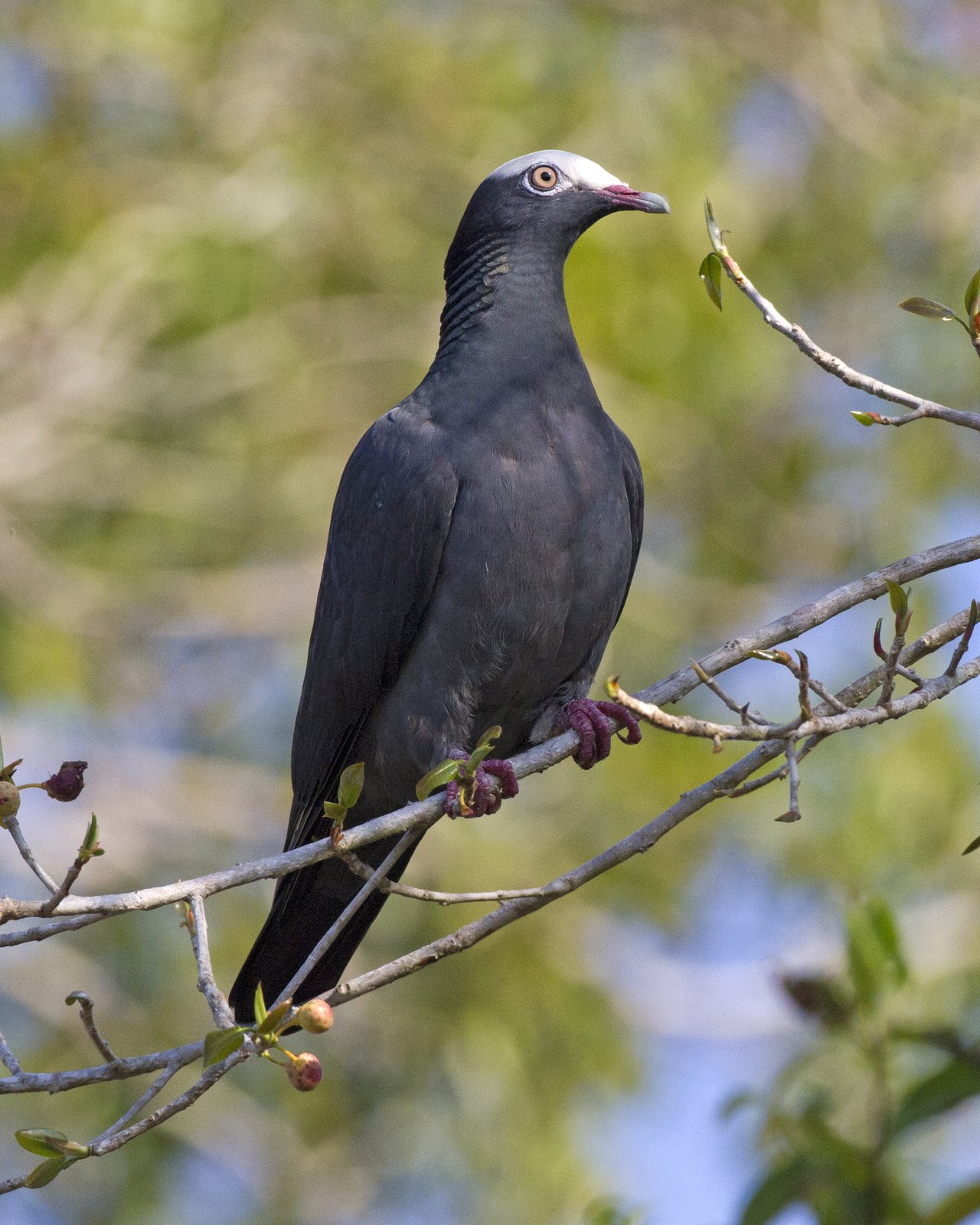
The White-crowned Pigeon is a dark, slate-grey pigeon of the Caribbean islands, with a bright white crown. In the guide area it occurs mainly on the Colombian islands of San Andrés and Providencia. It breeds in colonies in mangroves and flies daily over the sea or across the island to fruiting trees.
Voice
A deep, owl-like coo in a fixed rhythm, roughly coo-coo-cooo-coo, repeated at intervals, often from dense foliage.
Recording: Paul Marvin — CC BY-NC-SA 3.0 · xeno-canto
Identification
33–36 cm. The entire plumage is dark slate-grey to blackish. The crown is bright white in the male, greyer white and smaller in the female. On the hindneck is a patch of glossy green, black-edged feathers, with a purplish band above it. The bill is red with a whitish tip, the iris white, the legs red. Juveniles are browner and have a grey crown.
Confusion species
No other pigeon in the guide area has a white crown. Rock Pigeon Columba livia is paler grey, with a white rump and black wing bars. From behind and in poor light a juvenile without a white crown can resemble a plain dark pigeon such as Plumbeous Pigeon Patagioenas plumbea, which, however, lives only on the mainland in closed forest.
Habitat
Mangroves, coastal forest, dry woodland and scrub, gardens and yards with fruit trees on islands. It feeds mainly on fruit and berries, which it picks high in trees. It often breeds in colonies; the nest is a platform of twigs in mangrove or another dense tree.
Where the bird is most at home, classified by the vegetation units of the Andes and the west coast.


Range and movements
In Colombia mainly on the islands of San Andrés and Providencia in the western Caribbean Sea; from the mainland there are at most a few records. Absent from Ecuador, Peru, Bolivia and the Galápagos. Outside the guide area in southern Florida, the Bahamas, the Greater and Lesser Antilles and on islands off the coast of Central America.
- Resident
- dark = core range, pale = thinly spread
How and when to look
On Providencia and San Andrés in the morning and evening, when small groups fly fast and low along the coast to mangroves or fruiting trees.
Conservation status
Near Threatened (NT). The population is declining through hunting, clearance of mangrove and dry coastal forest, and disturbance of breeding colonies.
Scientific name
Patagioenas leucocephala | (Linnaeus, 1758)
Linnaeus described the species in 1758 as Columba leucocephala; because it was later moved to another genus, the author and year stand in brackets. The genus Patagioenas was introduced in 1853 by Reichenbach. The genus name combines Greek patageō, 'to clatter', with oinas, 'pigeon'. The species name combines Greek leukos, 'white', with kephalē, 'head'. The specimen the first description was based on came from The Bahamas.