All species › Pigeons and doves › Doves and pigeons › Spot-winged Pigeon
Spot-winged Pigeon | Patagioenas maculosa
Vlekduif | Paloma de ala moteada | Pomba-do-orvalho
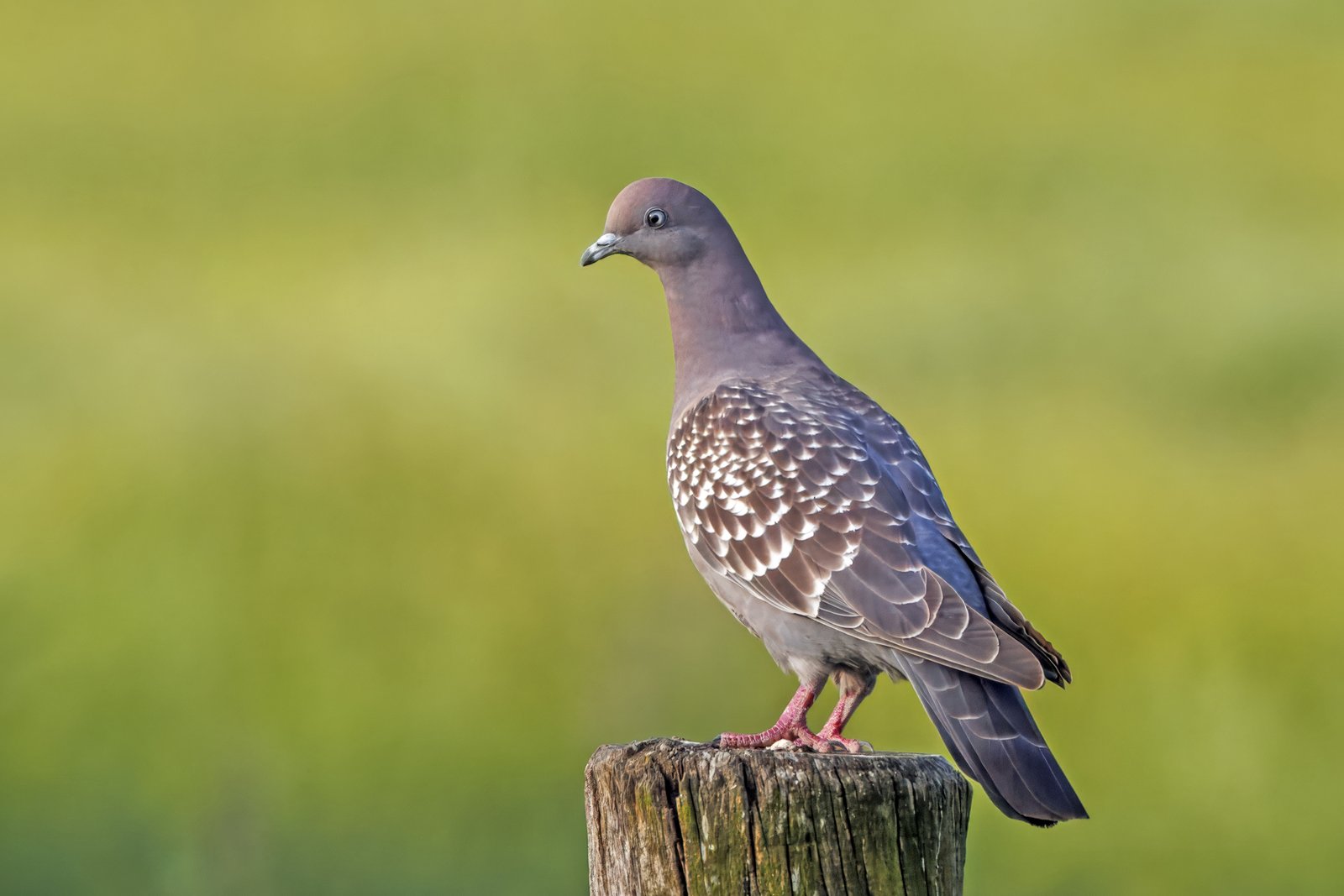
The Spot-winged Pigeon is a large, grey pigeon of the dry Andes of Peru and Bolivia, named for the white spots on its wing coverts. It lives in open, dry country with shrubs, fields and villages and often feeds in flocks on the ground. In south-eastern Bolivia the lowland form also occurs.
Voice
A deep, growling coo, roughly grroo, whoo-whooo, repeated at intervals, also from roofs and rocks.
Recording: Bernard BOUSQUET — CC BY-NC-SA 4.0 · xeno-canto
Identification
31–34 cm. Mainly slate-grey, with a faint vinaceous-pink tinge on the head and breast. The wing coverts are dark brown with white edges and spots, giving a speckled pattern; in the Andean form the white edges on the outer wing form a pale stripe in flight. The flight feathers and tail are dark, the tail with a slightly paler base. The bill is black, the iris pale, the legs red. The sexes are similar; juveniles are browner, with less distinct spots.
Confusion species
Picazuro Pigeon Patagioenas picazuro is larger, with a continuous white wing band, a scaled nape patch and red skin around the eye. Band-tailed Pigeon Patagioenas fasciata has a yellow bill, a white crescent on the nape and a pale terminal tail band, and lives in humid montane forest. Rock Pigeon Columba livia has a white rump and two black wing bars.
Habitat
Dry mountain slopes with scrub, fields and terraces, Polylepis groves, shrubby puna, villages and towns in the Andes, roughly between 2000 and 4000 m, locally higher or lower; the lowland form in Chaco woodland and open country in south-eastern Bolivia. It searches for seeds and grain on the ground. The nest is a platform of twigs in a tree or shrub, sometimes on a rock ledge or building.
Where the bird is most at home, classified by the vegetation units of the Andes and the west coast.


Range and movements
In Peru in the Andes, mainly in the centre and south, on both slopes and in the dry valleys. In Bolivia in the Andes and the dry valleys, and with the lowland form in the Chaco in the south-east. Absent from Colombia, Ecuador and the Galápagos. Outside the guide area in northern Chile, Argentina, Paraguay, Uruguay and southern Brazil.
- Resident
- dark = core range, pale = thinly spread
How and when to look
Around fields, villages and eucalyptus groves in the dry Andean valleys, for example around Cusco, Arequipa, La Paz and Cochabamba, where flocks forage on the ground and perch on roofs.
Conservation status
Not Evaluated in this treatment of the species. The species is widespread and locally common, also in human-modified landscapes.
Scientific name
Patagioenas maculosa | (Temminck, 1813)
Temminck described the species in 1813 as Columba Maculosa; because it was later moved to another genus, the author and year stand in brackets. The genus Patagioenas was introduced in 1853 by Reichenbach. The genus name combines Greek patageō, 'to clatter', with oinas, 'pigeon'. The species name comes from Latin maculosus, 'spotted'. The specimen the first description was based on came from Paraguay.