All species › Pigeons and doves › Doves and pigeons › Bare-eyed Pigeon
Bare-eyed Pigeon | Patagioenas corensis
Naaktoogduif | Paloma cardonera | Pomba-de-olho-nu
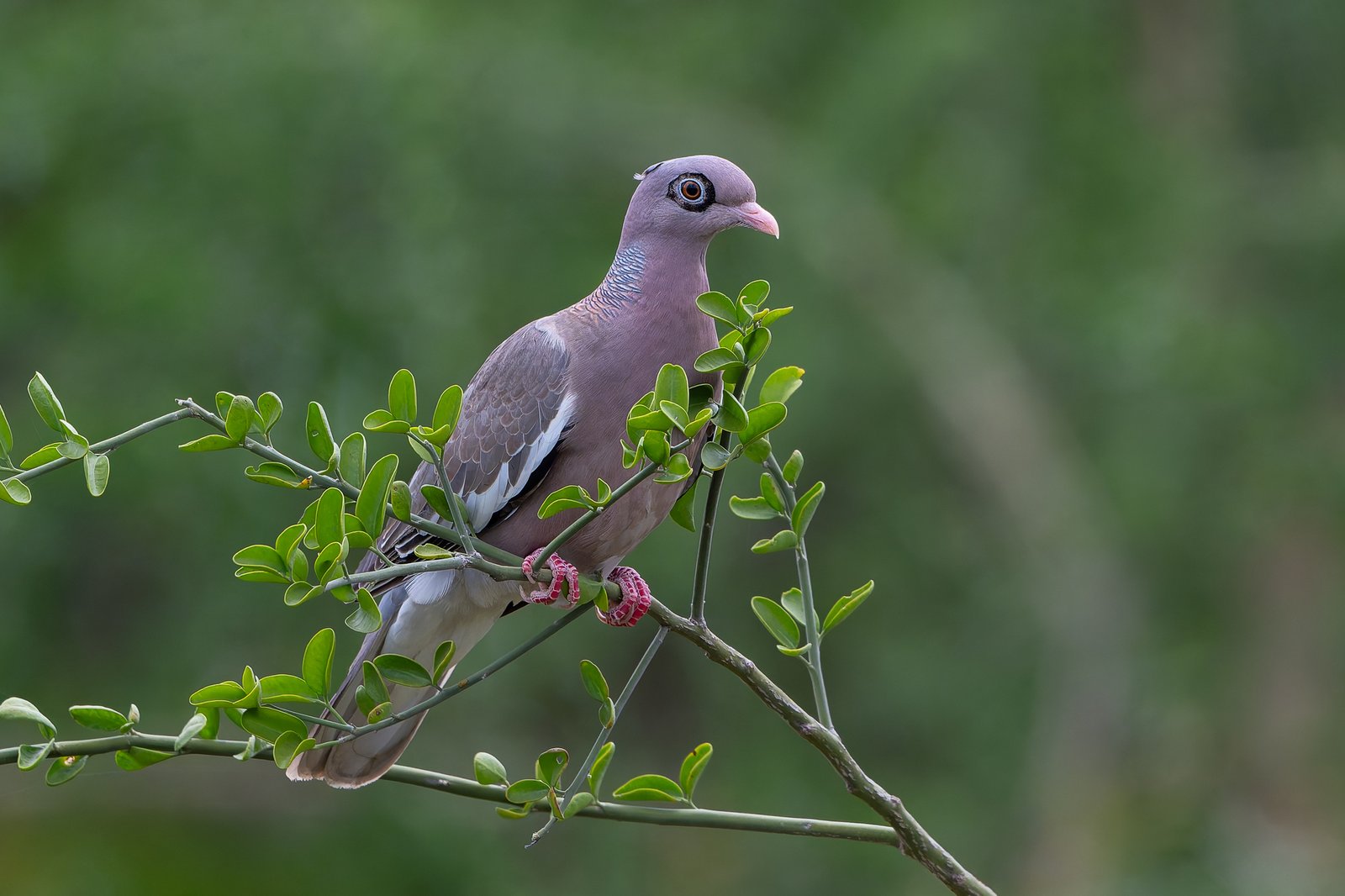
The Bare-eyed Pigeon is a pale grey pigeon of dry coastal regions around the southern Caribbean, named for the broad, bare, blue-grey skin around the eye. In the guide area it lives only in the dry north of Colombia, where it moves in flocks through cactus scrub, dry woodland and villages.
Voice
A deep coo, usually a few short notes followed by a long one, roughly whoo-whoo-cooooo, repeated from a high branch or a cactus.
Recording: Francisco contreras — CC BY-NC-SA 4.0 · xeno-canto
Identification
32–34 cm. The head, neck and breast are pale vinaceous-pink to greyish pink, the upperparts brownish grey. On the hindneck is a patch of glossy, scaled feathers. Along the wing coverts runs a white band, visible as a white stripe in flight. The belly is pale grey, the tail grey with a dark terminal band. Around the eye lies a broad patch of bare, blue-grey skin with a dark rim; the iris is pale, the bill dark, the legs pink. The sexes are similar; juveniles are duller with a smaller eye patch.
Confusion species
Pale-vented Pigeon Patagioenas cayennensis is a darker vinaceous, without a white wing band or bare eye patch. Eared Dove Zenaida auriculata is much smaller, brown, with black spots on the wing and a black line on the face. Rock Pigeon Columba livia has a white rump and black wing bars.
Habitat
Dry thorn scrub and cactus vegetation, dry woodland, the edges of mangroves, pasture with trees and villages in the lowlands of the Caribbean coast. It searches for seeds and fruit, including those of cacti, in trees and on the ground. The nest is a platform of twigs in a tree or cactus.
Where the bird is most at home, classified by the vegetation units of the Andes and the west coast.


Range and movements
In Colombia along the dry Caribbean coast, mainly on the Guajira Peninsula and around Santa Marta. Absent from Ecuador, Peru, Bolivia and the Galápagos. Outside the guide area along the north coast of Venezuela and on the offshore islands, such as Aruba, Bonaire and Curaçao.
- Resident
- dark = core range, pale = thinly spread
How and when to look
In the dry scrub and villages of La Guajira, where birds perch on high branches and cacti and fly to drinking sites in the morning.
Conservation status
Least Concern. Common within its small range and tolerant of human settlement; hunted locally.
Scientific name
Patagioenas corensis | (Jacquin, 1784)
Jacquin described the species in 1784 as Columba corensis; because it was later moved to another genus, the author and year stand in brackets. The genus Patagioenas was introduced in 1853 by Reichenbach. The genus name combines Greek patageō, 'to clatter', with oinas, 'pigeon'. The species name corensis refers to Coro in Venezuela, not necessarily the type locality. The specimen the first description was based on came from Coro, Venezuela.