All species › Pigeons and doves › Doves and pigeons › Picazuro Pigeon
Picazuro Pigeon | Patagioenas picazuro
Picazuroduif | Paloma picazuró | Asa-branca
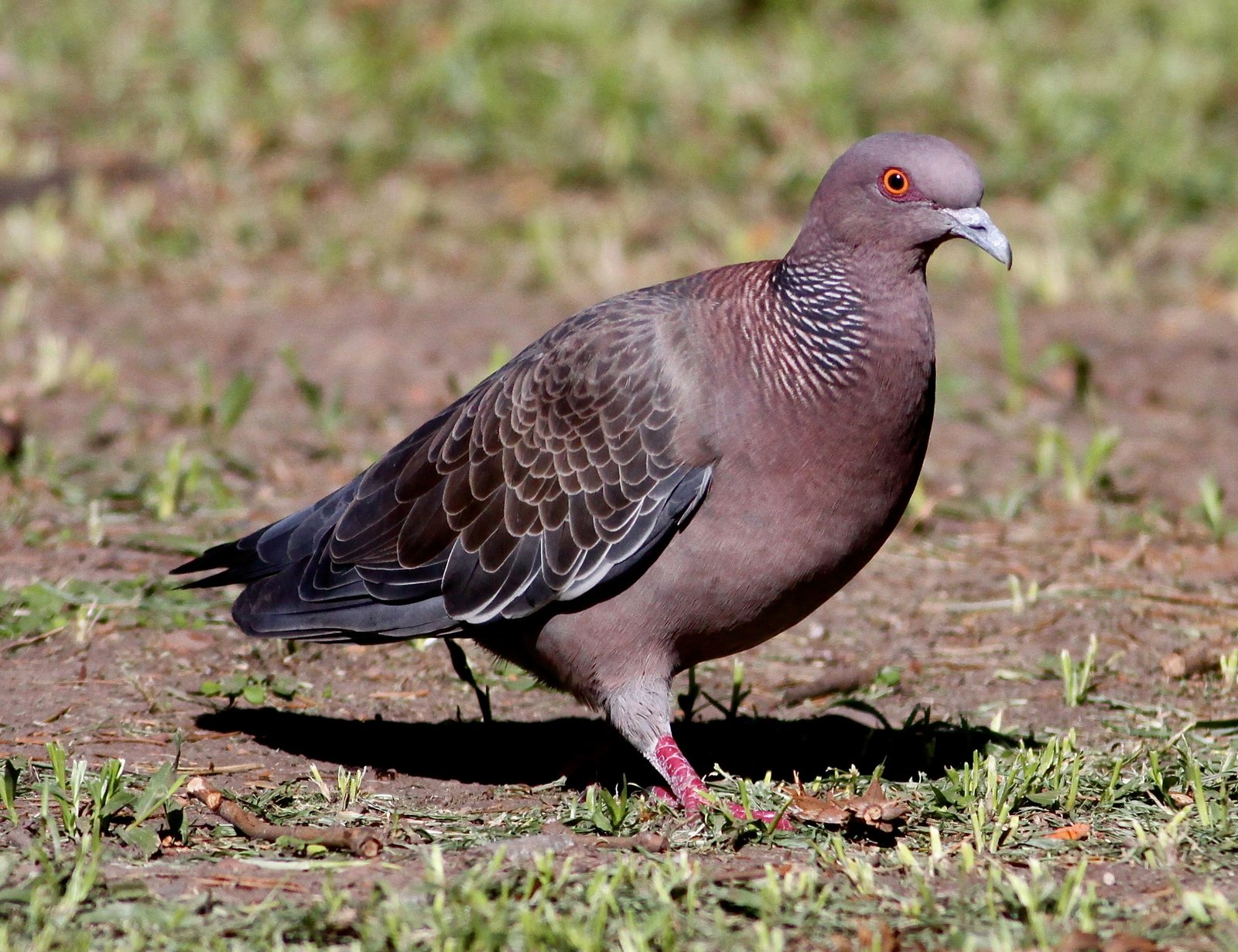
The Picazuro Pigeon is a large, grey pigeon of dry, open country in southern South America, with a white wing band and a scaled patch on the nape. In the guide area it occurs mainly in Bolivia, from the Chaco lowlands up into the dry Andean valleys. The species has spread widely with agriculture and often feeds in fields and villages.
Voice
A deep, rhythmic cooing, roughly whoo, whoo-cooo, whoo-cooo, repeated at length from a branch or roof. On take-off the wings clap audibly.
Recording: Marcos E. Sosa — CC BY-NC-SA 4.0 · xeno-canto
Identification
34–37 cm. Mainly grey, with a vinaceous-pink head, neck and breast. On the hindneck is a patch of silvery-white, black-edged feathers forming a scaled pattern. Along the wing coverts runs a white band, visible as a narrow white line at rest and as a broad white stripe in flight. The tail is grey with a dark terminal band. The bare skin around the eye is red, the bill dark, the legs red. The sexes are similar; juveniles are browner and lack the nape patch.
Confusion species
Spot-winged Pigeon Patagioenas maculosa is smaller and has white spots on the wing coverts instead of a continuous band, and no scaled nape patch. Scaled Pigeon Patagioenas speciosa is browner, with a scaled neck and breast and a red bill, and lives in humid forest. Rock Pigeon Columba livia has a white rump and two black wing bars.
Habitat
Chaco woodland, dry forest, cerrado, open country with groves, fields, pasture and villages and towns; in the dry Andean valleys up to roughly 3000 m. It searches for seeds and grain on the ground, often in flocks, and also eats fruit and buds. The nest is a flimsy platform of twigs in a tree.
Where the bird is most at home, classified by the vegetation units of the Andes and the west coast.


Range and movements
In Bolivia in the eastern lowlands, the Chaco and the dry Andean valleys, including Santa Cruz, Cochabamba, Chuquisaca and Tarija. In Peru at most a rare vagrant in the south-east. Absent from Colombia, Ecuador and the Galápagos. Outside the guide area in Brazil, Paraguay, Uruguay and Argentina.
- Resident
- dark = core range, pale = thinly spread
How and when to look
Around fields, villages and dry valleys near Santa Cruz and Cochabamba, where flocks perch along roads and on power lines.
Conservation status
Least Concern. The population is increasing and the range is expanding with the conversion of forest to farmland.
Scientific name
Patagioenas picazuro | (Temminck, 1813)
Temminck described the species in 1813 as Columba Picazuro; because it was later moved to another genus, the author and year stand in brackets. The genus Patagioenas was introduced in 1853 by Reichenbach. The genus name combines Greek patageō, 'to clatter', with oinas, 'pigeon'. The species name comes from picazuró, the Guaraní name that Félix de Azara used for this pigeon. The specimen the first description was based on came from Paraguay.