All species › Pigeons and doves › Doves and pigeons › Scaled Pigeon
Scaled Pigeon | Patagioenas speciosa
Geschubde duif | Paloma escamosa | Pomba-trocal
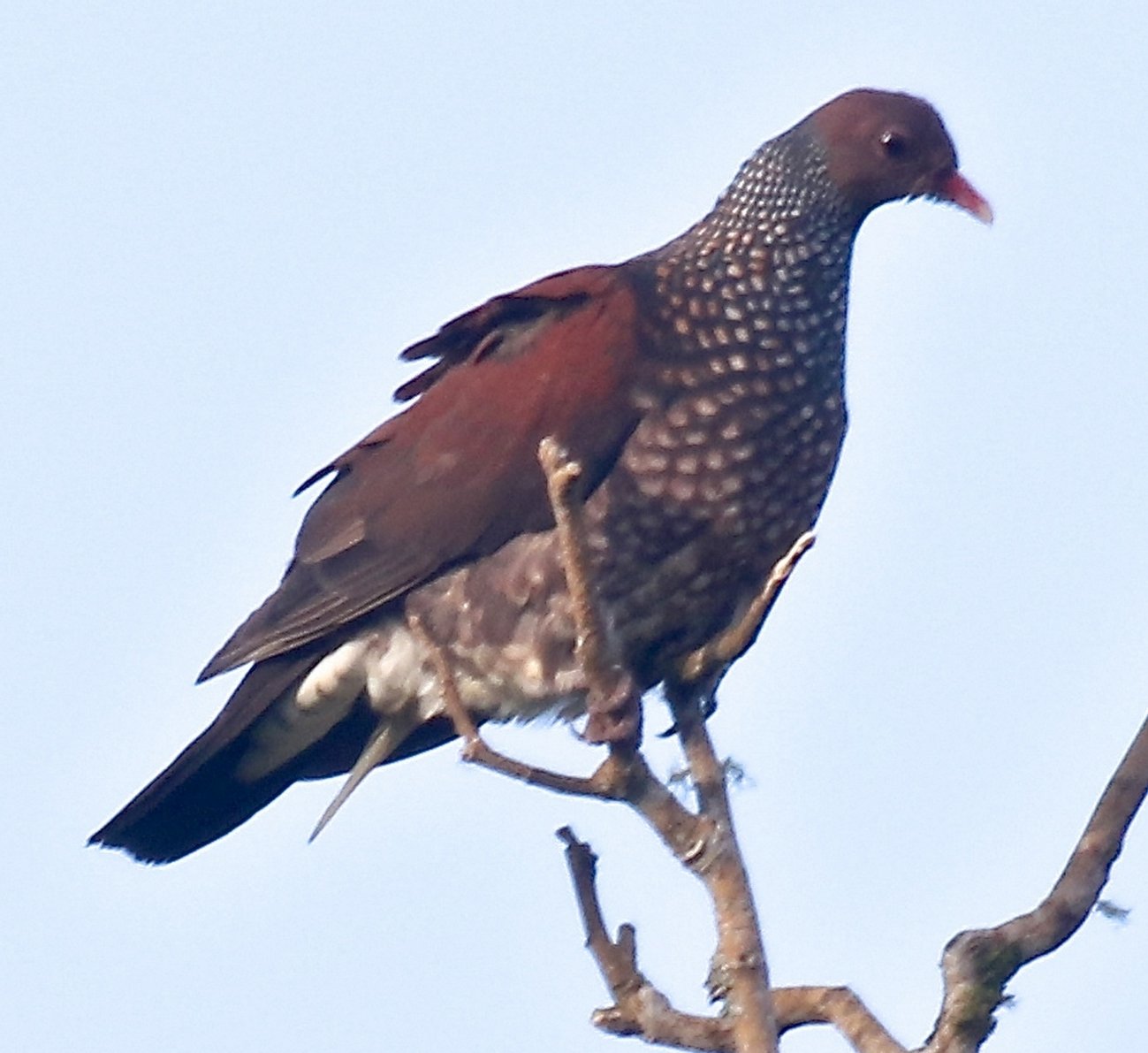
The Scaled Pigeon is a large, chestnut pigeon of lowland forest, recognized by the scaled pattern on the neck and breast and the red bill with a pale tip. It lives mainly in the canopy and at forest edges and often sits still for long periods high in a tree.
Voice
A deep, calm cooing, usually a long note followed by a few shorter ones, roughly whooo, whoo-whooo, repeated at intervals from a hidden branch high in the canopy.
Recording: JAYRSON ARAUJO DE OLIVEIRA — CC BY-NC-SA 4.0 · xeno-canto
Identification
30–33 cm. The upperparts are chestnut to purplish brown. The head, neck and breast are densely scaled: pale, whitish or buff feathers with dark edges on the neck, and vinaceous with pale scales on the breast. The belly is paler, creamy with fine scaling, the undertail whitish. The bill is red with a whitish tip, the eye-ring and legs red. The sexes are similar; the female is slightly duller. Juveniles are browner, with less distinct scaling.
Confusion species
Pale-vented Pigeon Patagioenas cayennensis lacks the scaling and has a black bill and a grey head. Ruddy Pigeon Patagioenas subvinacea and Plumbeous Pigeon Patagioenas plumbea are plain-coloured and smaller, with a dark bill. Picazuro Pigeon Patagioenas picazuro is greyer, with only a scaled patch on the nape and a white wing band, and lives in drier, open country.
Habitat
Tall forest and forest edges in the lowlands and foothills, also secondary forest, várzea and semi-open country with tall trees, mostly below 1000 m, locally higher. It feeds mainly on fruit and berries in the treetops. The nest is a platform of twigs high in a tree.
Where the bird is most at home, classified by the vegetation units of the Andes and the west coast.


Range and movements
In Colombia in the lowlands west and east of the Andes, including the Caribbean lowlands and the lower parts of the inter-Andean valleys. In Ecuador both in the west and in the east. In Peru and Bolivia in the lowlands and foothills east of the Andes. Absent from the Galápagos. Outside the guide area from southern Mexico to northern Argentina.
- Resident
- dark = core range, pale = thinly spread
How and when to look
In the early morning watch for birds perched on bare branches above the canopy, for example from a canopy tower or along a river; in flight the compact shape with dark upperparts stands out.
Conservation status
Least Concern. Widespread, but locally less numerous because of hunting and deforestation.
Scientific name
Patagioenas speciosa | (Gmelin, 1789)
Gmelin described the species in 1789 as Columba speciosa; because it was later moved to another genus, the author and year stand in brackets. The genus Patagioenas was introduced in 1853 by Reichenbach. The genus name combines Greek patageō, 'to clatter', with oinas, 'pigeon'. The species name comes from Latin speciosus, 'showy, conspicuous'. The specimen the first description was based on came from Cayenne, French Guiana.