All species › Pigeons and doves › Doves and pigeons › Pale-vented Pigeon
Pale-vented Pigeon | Patagioenas cayennensis
Rosse duif | Paloma colorada | Pomba-galega
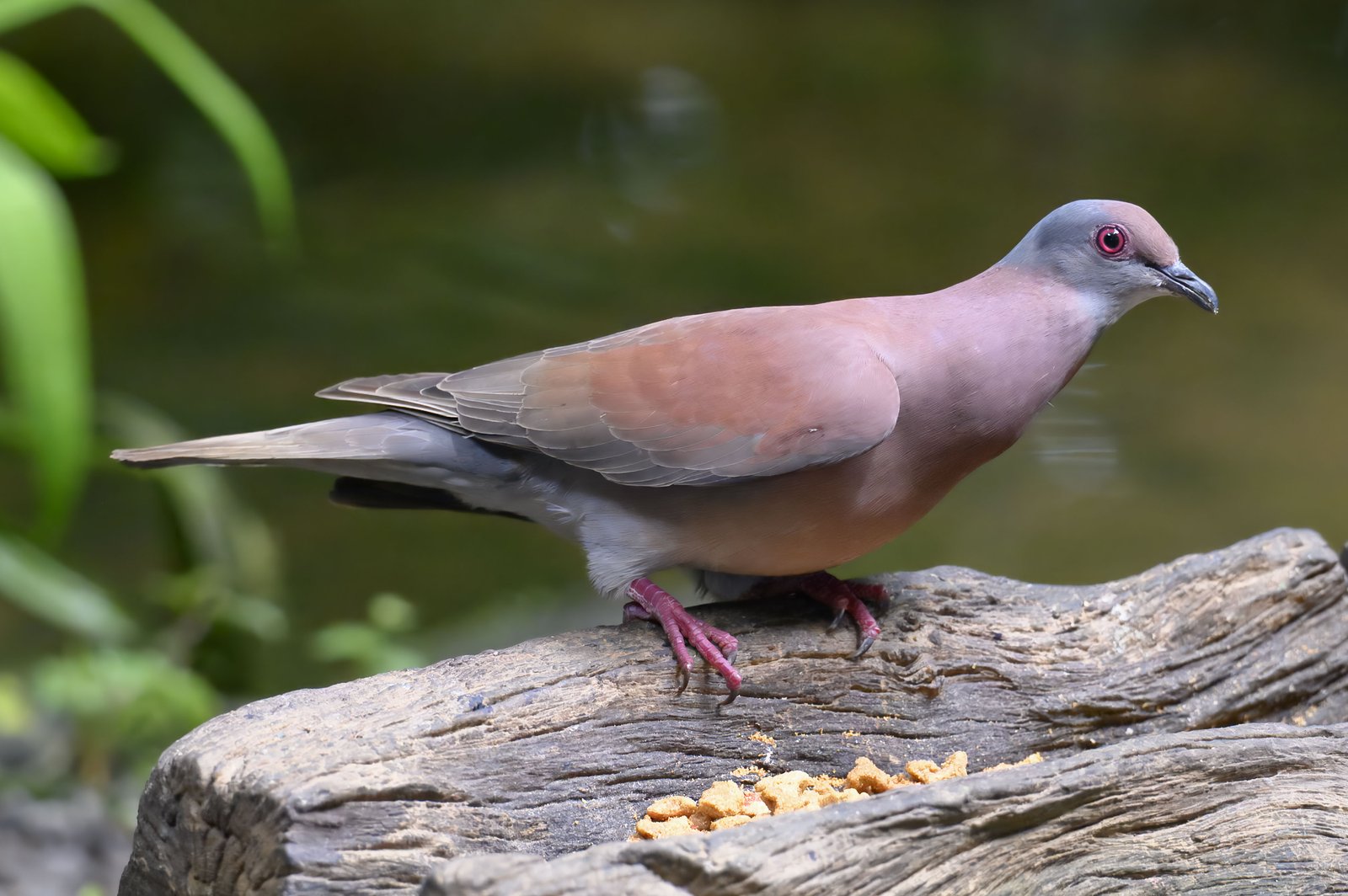
The Pale-vented Pigeon is a medium-sized, vinaceous pigeon of forest edges, riverbanks and semi-open lowland country. It often perches high and in the open on bare treetops along rivers and flies fast and straight. The pale undertail separates it from the other large lowland pigeons.
Voice
A deep, rhythmic coo, usually a long note followed by a few shorter ones, roughly wooo, coo-cooo-coo, often repeated from a high, exposed branch.
Recording: JAYRSON ARAUJO DE OLIVEIRA — CC BY-NC-SA 4.0 · xeno-canto
Identification
28–32 cm. The head and neck are greyish, with a green-bronze gloss on the nape and a whitish throat. The mantle and breast are purplish vinaceous, the rump and wings greyer. The belly and undertail coverts are pale greyish white, which shows well in flight and from below. The bill is black, the iris red to orange, the legs red. The female is slightly duller; juveniles are browner and lack the gloss.
Confusion species
Ruddy Pigeon Patagioenas subvinacea and Plumbeous Pigeon Patagioenas plumbea are darker, without a pale undertail, and live in the canopy of closed forest. Scaled Pigeon Patagioenas speciosa has a scaled neck and breast and a red bill with a pale tip. Red-billed Pigeon Patagioenas flavirostris, in the guide area at most in the extreme north-west, has a pale bill and no pale undertail.
Habitat
Forest edges, riverine forest and river islands, várzea, gallery forest in savanna, mangroves and semi-open country with scattered trees, mainly below 1000 m. Feeds on fruit, berries and seeds, both in trees and on the ground. The nest is a flimsy platform of twigs in a tree or shrub.
Where the bird is most at home, classified by the vegetation units of the Andes and the west coast.


Range and movements
In Colombia in the Caribbean lowlands, the large inter-Andean valleys, the Llanos and Amazonia. In Ecuador, Peru and Bolivia mainly in the lowlands east of the Andes, in Bolivia also in the Beni savannas. Absent from the dry coastal desert of Peru and the Galápagos. Outside the guide area from Mexico to northern Argentina and Uruguay.
- Resident
- dark = core range, pale = thinly spread
How and when to look
Along Amazonian rivers and lakes, where birds perch on bare branches above the water; from a boat or the bank they are often seen in the morning.
Conservation status
Least Concern. Common in semi-open country; locally it benefits from the opening of forest.
Scientific name
Patagioenas cayennensis | (Bonnaterre, 1792)
Bonnaterre described the species in 1792 as Columba cayennensis; because it was later moved to another genus, the author and year stand in brackets. The genus Patagioenas was introduced in 1853 by Reichenbach. The genus name combines Greek patageō, 'to clatter', with oinas, 'pigeon'. The species name cayennensis refers to Cayenne in French Guiana, not necessarily the type locality. The specimen the first description was based on came from Cayenne, French Guiana.