All species › Pigeons and doves › Doves and pigeons › Lined Quail-Dove
Lined Quail-Dove | Zentrygon linearis
Bruine kwartelduif | Paloma perdiz embridada | Pariri-listrado
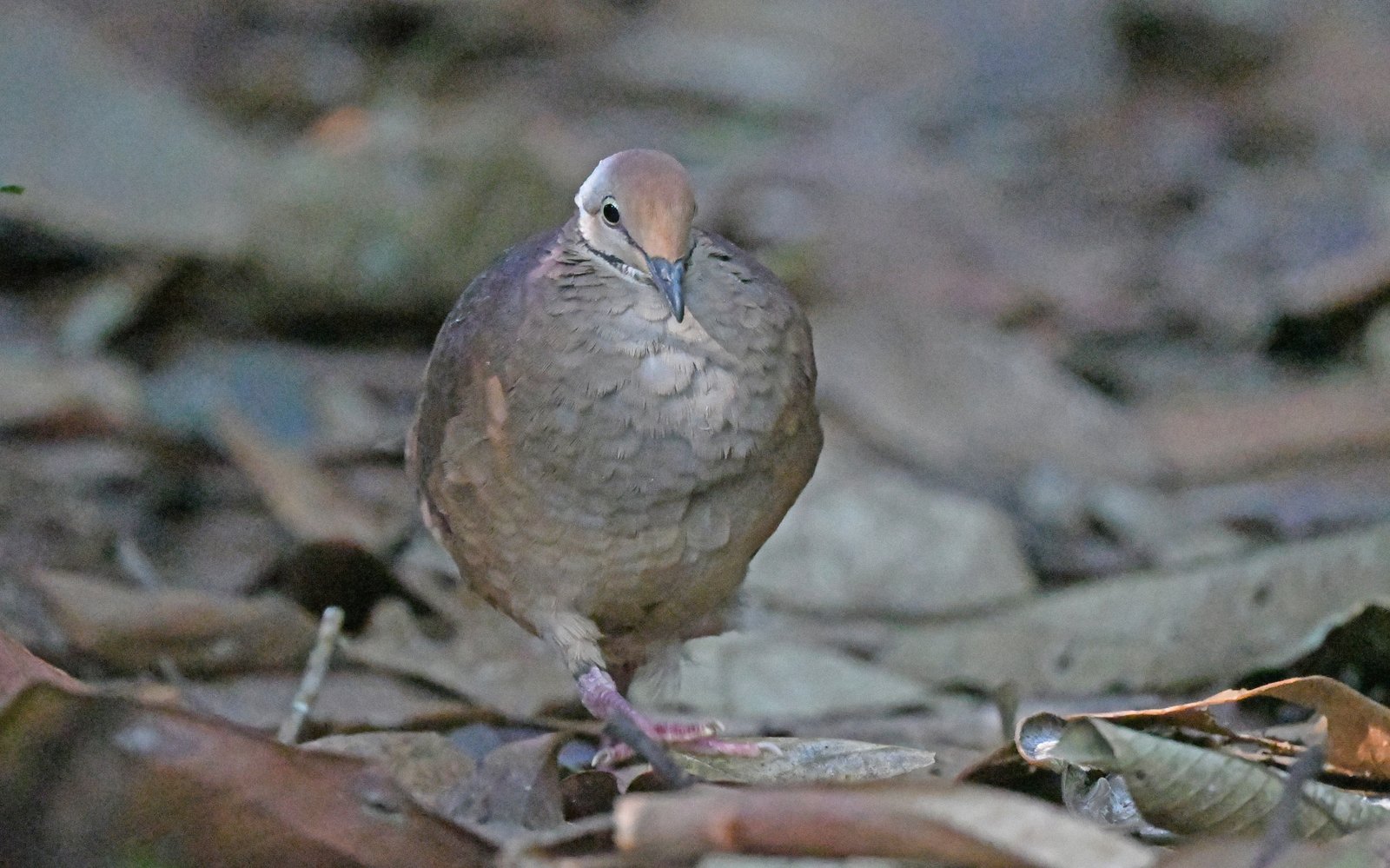
The Lined Quail-Dove is a stocky, terrestrial dove of humid montane forest in the northern Andes. It walks quietly over the dim forest floor and, when disturbed, flies off low and fast between the trunks. Its presence is usually revealed by its low, hollow call rather than by a sighting.
Voice
A low, hollow whooo, repeated slowly at regular intervals, sometimes slightly descending. Calls mainly in the morning from a low branch or the ground.
Recording: Niels Krabbe — CC BY-NC-SA 4.0 · xeno-canto
Identification
27–31 cm, with a round head, short tail and fairly long, pink legs. The forehead and face are cinnamon to buff, the crown and nape grey, and a black malar stripe runs below the eye alongside a whitish throat. The upperparts are olive-brown, with a purplish sheen on the mantle. The breast is greyish brown, the belly and undertail coverts pale cinnamon. The sexes are almost alike; juveniles are duller and have rusty feather edges.
Confusion species
White-throated Quail-Dove Zentrygon frenata is very similar but has a greyer head without a cinnamon forehead and lives mainly in southern and western Colombia and farther south along the Andes; where both occur it can hardly be separated in the field. Ruddy Quail-Dove Geotrygon montana is smaller and more rufous, with a pale stripe below the eye, and lives mainly lower. Russet-crowned Quail-Dove Zentrygon goldmani has a rusty crown and occurs only on the border with Panama.
Habitat
Humid montane forest and cloud forest with an open understorey, also old secondary forest and shaded coffee plantations, roughly between 800 and 2500 m. Forages on the forest floor for fallen seeds, fruit and small invertebrates. The nest is a loose platform of twigs, low in a shrub or sapling.
Where the bird is most at home, classified by the vegetation units of the Andes and the west coast.


Range and movements
In Colombia in the Andes, mainly in the north and east, and in the Sierra Nevada de Santa Marta and the Serranía de Perijá. In Ecuador, Peru and Bolivia replaced by White-throated Quail-Dove. Absent from the Galápagos. Outside the guide area in the mountains of Venezuela and on Trinidad.
- Resident
- dark = core range, pale = thinly spread
How and when to look
Walk slowly along quiet forest trails in cloud forest in the early morning and look ahead along the trail; birds often walk on the ground there. The hollow call helps to locate a site.
Conservation status
Least Concern. Locally the species declines through clearance of montane forest, but it tolerates well-developed secondary forest.
Scientific name
Zentrygon linearis | (Prévost, 1843)
Prévost described the species in 1843 as Columbi-Gallina linearis; because it was later moved to another genus, the author and year stand in brackets. The genus Zentrygon was introduced in 2013 by Banks, Weckstein, Remsen & Johnson. The genus name is a blend of the genera Zenaida and Geotrygon; Banks and colleagues (2013) chose it to reflect the relationship with Zenaida and the quail-dove form. The species name is Latin linearis, 'lined', after the stripes on the head. The specimen the first description was based on came from Bogotá, Colombia.