All species › Pigeons and doves › Doves and pigeons › White-throated Quail-Dove
White-throated Quail-Dove | Zentrygon frenata
Teugelkwartelduif | Paloma perdiz goliblanca | Pariri-de-garganta-branca
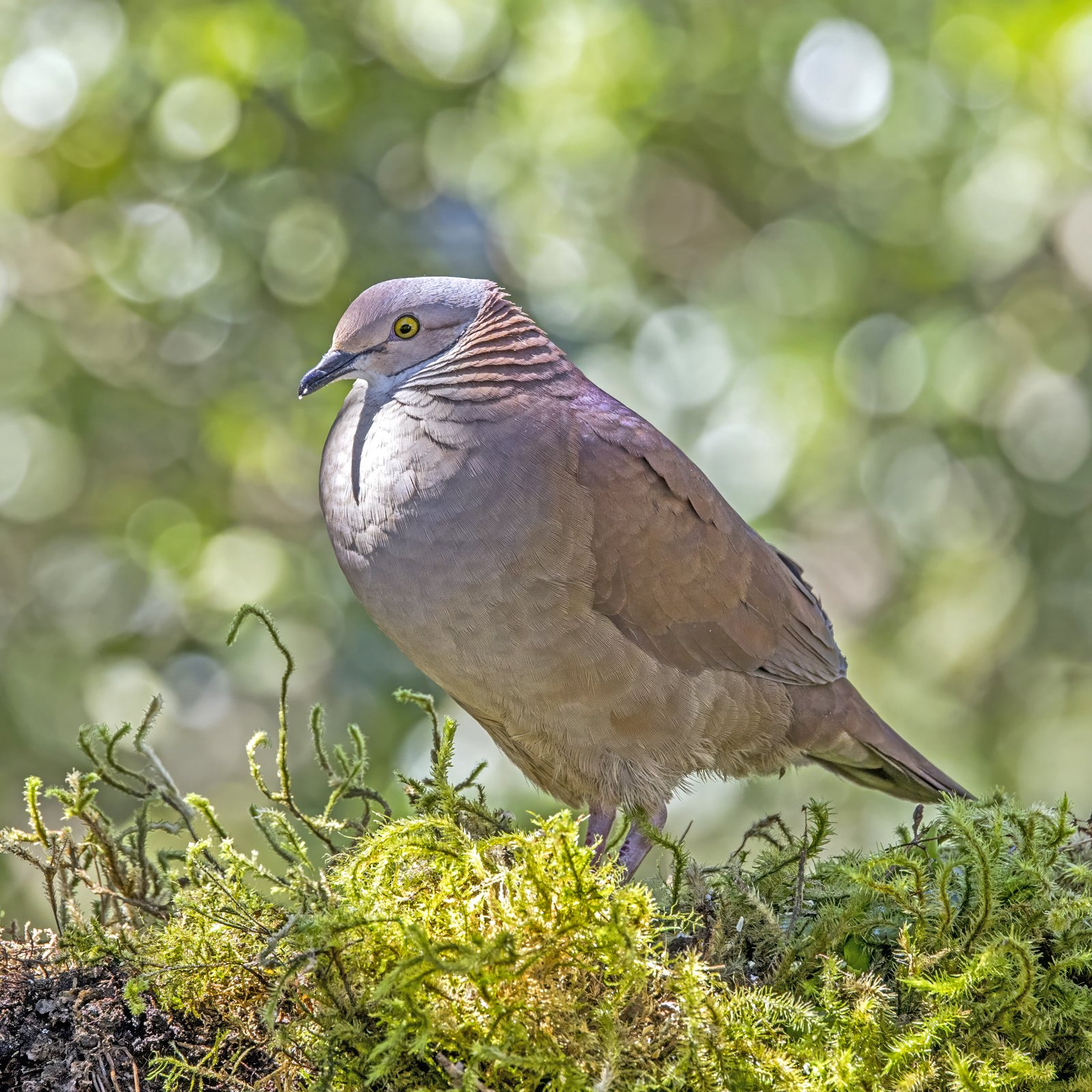
The White-throated Quail-Dove is a large, compact quail-dove of the Andean montane forests, from Colombia to Bolivia. It lives on the forest floor, walks over the leaf litter with nodding head and, when disturbed, flies off low with loud clattering. The white throat with a black malar stripe, the 'bridle' to which the scientific name (frenata, 'bridled') refers, is the key feature.
Voice
A deep, hollow, single call, wooo, repeated at intervals of a few seconds for long periods, often at dusk; it carries far through the forest.
Recording: Juan Freile — CC BY-NC-SA 4.0 · xeno-canto
Identification
30–34 cm, compact, with a short tail and fairly long legs. Crown and nape grey, forehead paler. The throat is white, bordered by a narrow black malar stripe, with a pale cheek and a dark line behind the eye. Mantle and wings warm rufous-brown with a purple gloss on the upper back. Breast grey, belly and undertail coverts ochre-brown. Legs pink to red. The sexes are alike; young birds are darker and browner, with rusty barring.
Confusion species
Lined Quail-Dove Zentrygon linearis lives in northern Colombia and Venezuela; it has a more rufous crown, a browner breast and a less distinct malar stripe. Russet-crowned Quail-Dove Zentrygon goldmani in north-western Colombia has a rusty crown and lives lower. Ruddy Quail-Dove Geotrygon montana is smaller and redder, with a pale cheek stripe, and lives mainly in lowland and lower montane forest.
Habitat
Humid montane forest and cloud forest, especially the forest interior with an open understorey and much leaf litter, also ravines and older secondary forest, roughly between 1000 and 3000 m, mostly between 1500 and 2500 m. It walks on the ground and eats seeds, fallen fruit and small invertebrates. The nest is a platform of twigs low in a shrub or tree.
Where the bird is most at home, classified by the vegetation units of the Andes and the west coast.


Range and movements
In Colombia in all three Andean ranges; in Ecuador on both slopes of the Andes; in Peru on the east slope and locally on the west slope in the north; in Bolivia on the east slope in the Yungas. Absent from the lowlands and from the Galápagos. Outside the guide area in north-western Argentina.
- Resident
- dark = core range, pale = thinly spread
How and when to look
Listen at dusk for the deep call in cloud forest, for example around Mindo or along the roads on the east slope of Ecuador and Peru. It sometimes appears at antpitta feeding stations.
Conservation status
Least Concern. Fairly common in continuous montane forest, but sensitive to logging and disturbance of the understorey.
Scientific name
Zentrygon frenata | (Tschudi, 1843)
Tschudi described the species in 1843 as Columba frenata; because it was later moved to another genus, the author and year stand in brackets. The genus Zentrygon was introduced in 2013 by Banks, Weckstein, Remsen & Johnson. The genus name is a blend of the genera Zenaida and Geotrygon; Banks and colleagues (2013) chose it to reflect the relationship with Zenaida and the quail-dove form. The species name is Latin frenatus, 'bridled', after the dark stripe on the cheek. The specimen the first description was based on came from Eastern slope of the Andes, Peru.