All species › Pigeons and doves › Doves and pigeons › Eared Dove
Eared Dove | Zenaida auriculata
Geoorde treurduif | Tórtola orejuda | Avoante
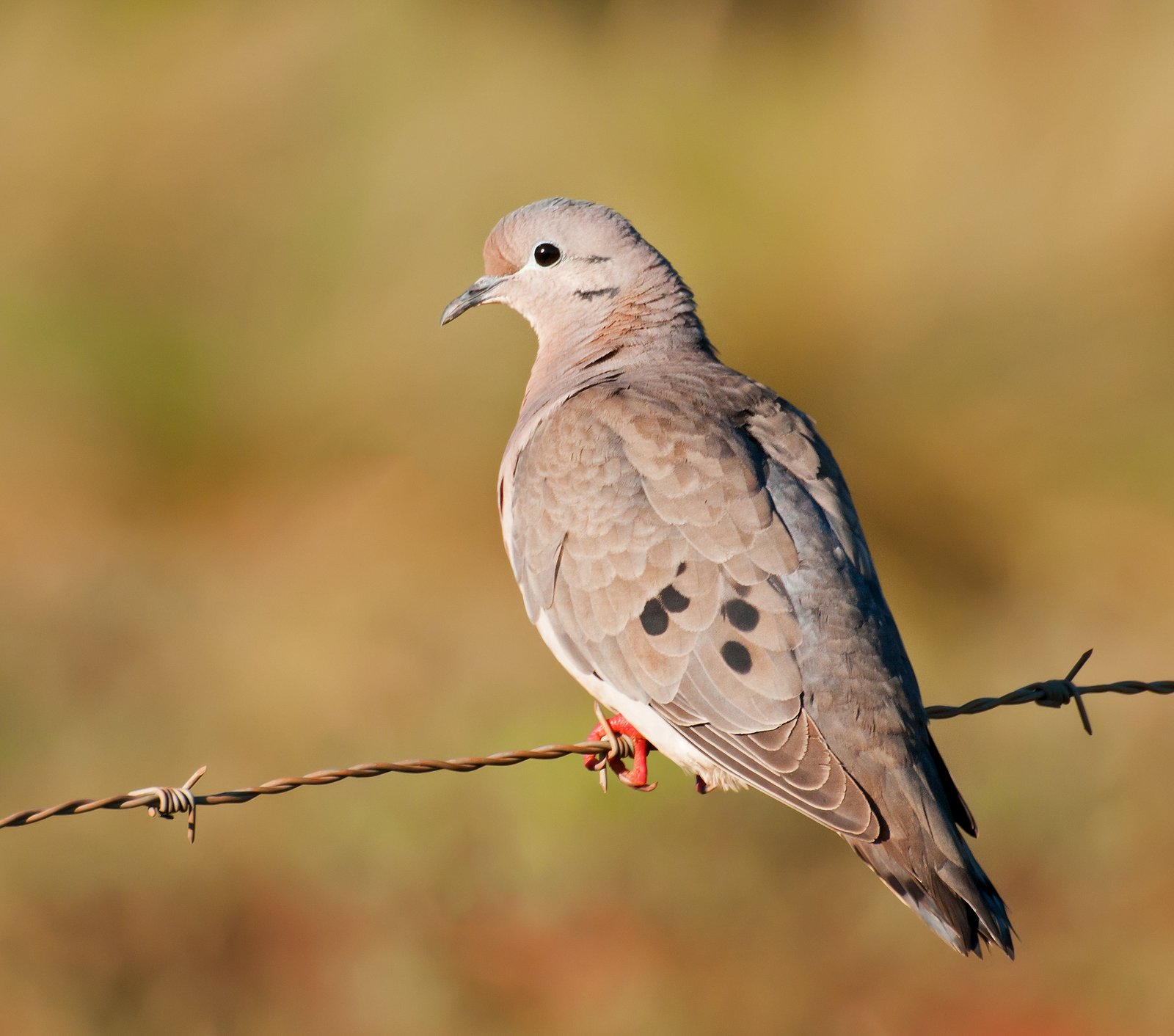
The Eared Dove is a slender, brownish-grey dove with two small black marks on the side of the head, and one of the commonest birds of open country in South America. In the guide area it is found throughout the Andes and on the Pacific coast, from fields and dry valleys to city centres. Outside the breeding season it forms flocks, which can become very large in the grain-growing regions of the south of the continent.
Voice
A soft, somewhat husky cooing of a few notes, oo-ooo-oo-oo, the second note slightly higher. The wings whistle on take-off.
Recording: JAYRSON ARAUJO DE OLIVEIRA — CC BY-NC-SA 4.0 · xeno-canto
Identification
22–26 cm, slender, with a fairly short, rounded tail. The upperparts are greyish brown, with a few black spots on the coverts and tertials. The head is greyish, with a short black line behind the eye and a second below the ear coverts; a purplish-pink patch glosses the sides of the neck. The underparts are warm pinkish brown. The outer tail feathers have a black band and pale, creamy white to cinnamon tips. The legs are pink to red. The female is slightly duller and browner; young birds have pale feather fringes.
Confusion species
West Peruvian Dove Zenaida meloda on the coast of Ecuador and Peru is larger and greyer, with a broad white wing band and blue bare skin around the eye. Galapagos Dove Zenaida galapagoensis occurs only on the Galápagos and has white in the wing and more rufous plumage. Smaller ground doves such as Croaking Ground Dove Columbina cruziana and Ruddy Ground Dove Columbina talpacoti are much smaller and shorter-tailed.
Habitat
Fields and terraces, dry valleys with scrub and cacti, irrigated farmland in the coastal valleys, riparian woodland, villages, towns and parks, from sea level to over 4000 m. It avoids closed forest. It eats seeds and grain, gathered on the ground, and drinks frequently.
Where the bird is most at home, classified by the vegetation units of the Andes and the west coast.


Range and movements
In Colombia in the Andes and in the north; in Ecuador mainly in the Andes and the dry valleys; in Peru in the Andes and on the coast; in Bolivia in the Andes and also in the lowlands of the south and east. Absent from most of the Amazonian lowlands and from the Galápagos. Outside the guide area in the Lesser Antilles, Venezuela and the Guianas, and further across much of southern South America to Tierra del Fuego.
- Resident
- dark = core range, pale = thinly spread
How and when to look
Everywhere in high-altitude towns and villages and on Andean farmland, often in pairs or small groups on the ground along roads and in squares. In the dry valleys in flocks near water.
Conservation status
Least Concern. Very common; it benefits greatly from agriculture and settlement.
Scientific name
Zenaida auriculata | (des Murs, 1847)
Des Murs described the species in 1847 as Peristera auriculata; because it was later moved to another genus, the author and year stand in brackets. The genus Zenaida was introduced in 1838 by Bonaparte. The genus name honours Zénaïde Laetitia Julie Bonaparte (1801–1854), wife of Charles Lucien Bonaparte, who described the genus, and niece of Napoleon. The species name is Latin auriculatus, 'eared', after the dark spot on the ear coverts. The specimen the first description was based on came from Central Chile (probably Santiago).