All species › Pigeons and doves › Doves and pigeons › Galapagos Dove
Galapagos Dove | Zenaida galapagoensis
Galápagostreurduif | Tórtola de Galápagos | Pomba-de-galápagos
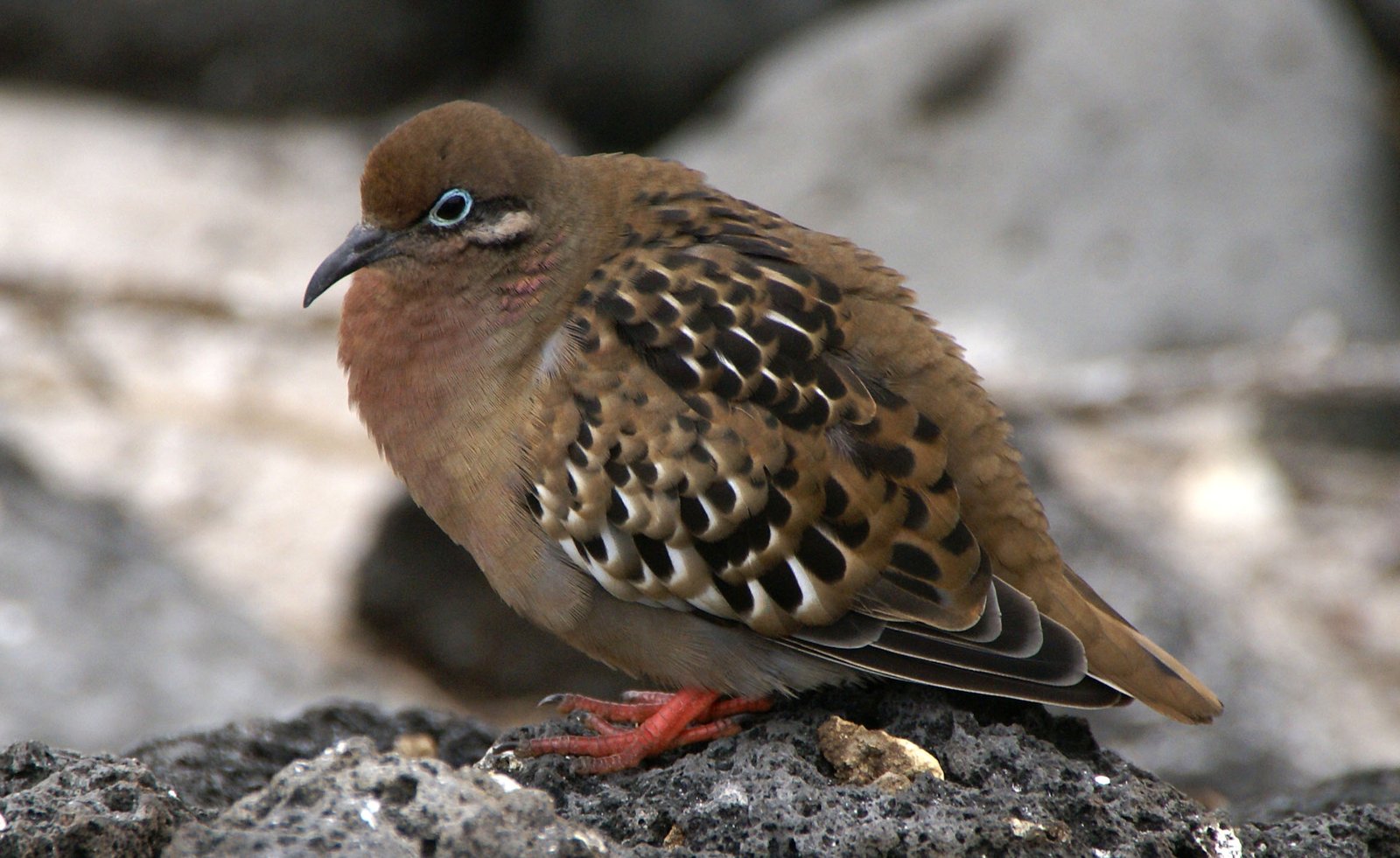
The Galapagos Dove is a small, compact dove found only on the Galápagos, with rufous-brown plumage, blue skin around the eye and black-and-white spots on the wing. It lives mainly on the ground in the arid lowlands and shows little fear on uninhabited islands. On islands with cats and people it has become much scarcer.
Voice
A soft, low cooing of a few notes, coo-oo-oo-oo, somewhat lower and shorter than that of Eared Dove.
No recording with a suitable Creative Commons licence is available for this species yet.
Identification
18–23 cm, compact, with a fairly short, rounded tail and a relatively long, slightly decurved bill. Upperparts warm rufous-brown, with black and white spots on the coverts and tertials forming a dotted pattern on the folded wing. A black and a bluish line on the sides of the neck, with a bronze-green to purple gloss. A bright blue ring of skin around the eye. Underparts pinkish brown. The tail is grey with a black band. Legs red. The female is slightly duller; young birds are browner and less marked.
Confusion species
On the Galápagos it is the only native dove. Feral Rock Pigeons Columba livia formerly occurred in the villages of Santa Cruz, San Cristóbal and Isabela, but have largely been eradicated; they are larger and grey. Eared Dove Zenaida auriculata of the mainland does not occur on the Galápagos.
Habitat
Arid lowlands with cacti, shrubs and lava fields, coastal zones and locally higher in open woodland, mainly below 500 m. It walks on the ground and eats seeds, especially of Opuntia cacti, as well as fruit pulp, caterpillars and nectar from cactus flowers. It nests in rock crevices, lava cavities and old nests of other birds, sometimes on the ground.
Where the bird is most at home, classified by the vegetation units of the Andes and the west coast.


Range and movements
Only on the Galápagos (Ecuador), on most of the larger and smaller islands, including Española, Genovesa, Fernandina, Santiago, Santa Fe and the northern islands of Darwin and Wolf, where a separate subspecies lives. On the inhabited islands of Santa Cruz, San Cristóbal, Floreana and Isabela scarcer and more confined to remote areas. Absent from Colombia, Peru, Bolivia and mainland Ecuador.
- Resident
How and when to look
On Española and Genovesa often on the visitor trails, where the birds walk about calmly picking seeds from the ground. On Santa Cruz in the arid zone along the coast.
Conservation status
Near Threatened. The population has declined on inhabited islands through predation by feral cats and formerly through hunting; habitat change by introduced plants and animals also plays a part. On uninhabited islands it is still common.
Scientific name
Zenaida galapagoensis | Gould, 1841
Gould described the species in 1841 and placed it straight away in the genus where it still stands. The genus Zenaida was introduced in 1838 by Bonaparte. The genus name honours Zénaïde Laetitia Julie Bonaparte (1801–1854), wife of Charles Lucien Bonaparte, who described the genus, and niece of Napoleon. The species name refers to the Galápagos Islands. The specimen the first description was based on came from Galápagos Islands, Ecuador.