All species › Passerines › New World sparrows › Sierra Nevada Brushfinch
Sierra Nevada Brushfinch | Arremon basilicus
Bangs' struikgors | Cerquero de Bangs | Tico-tico-da-serra-nevada
The Sierra Nevada Brushfinch is a large brushfinch found only in the Sierra Nevada de Santa Marta in northern Colombia. It was formerly included in Stripe-headed Brushfinch Arremon torquatus in the broad sense, a group now split into a series of species with small, separate ranges. Its Dutch and Spanish names honour the American zoologist Outram Bangs. It lives in pairs close to the ground in the undergrowth of montane forest.
Voice
Very high, thin calls, roughly tseet, with which the members of a pair keep in contact. The song is a short series of high, thin whistles and trills, mainly in the early morning.
Recording: Jerome Fischer — CC BY-NC-SA 4.0 · xeno-canto
Identification
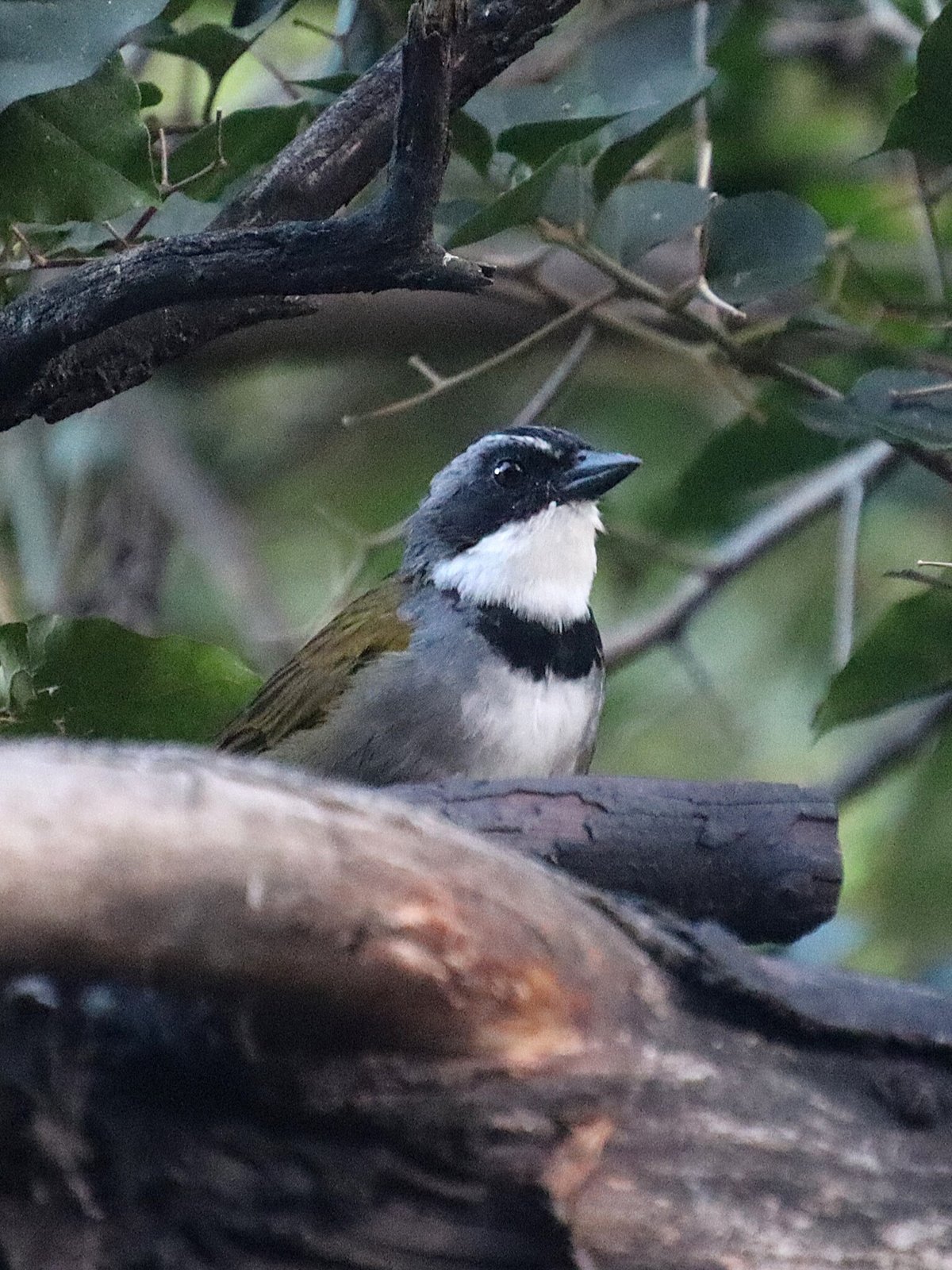
19 cm, sturdy, with a black bill and a fairly long tail. The head is black, with a grey median crown stripe and a long greyish-white supercilium. The throat is white and is bordered below by a narrow black breast band. The back, wings and tail are olive-green; the breast and flanks are grey and the centre of the belly is white. The legs are dark. The sexes are alike. Juveniles are duller and browner, with a less sharp head pattern.
Confusion species
Santa Marta Brushfinch Atlapetes melanocephalus lives in the same mountains, but has a black head with a silvery-grey ear patch and yellow underparts. Chestnut-capped Brushfinch Arremon brunneinucha has a chestnut crown, a white throat with a black breast band and no grey head stripes. Perija Brushfinch Arremon perijanus and Grey-browed Brushfinch Arremon assimilis are very similar, but do not occur in the Santa Marta.
Habitat
Undergrowth of humid montane forest and cloud forest, forest edges, old secondary forest and scrub, roughly between 1500 and 3000 m. It forages on and just above the ground among leaf litter for insects, other invertebrates and seeds. The nest is a cup placed low in a shrub or in dense scrub.
Where the bird is most at home, classified by the vegetation units of the Andes and the west coast.


Range and movements
In Colombia only in the Sierra Nevada de Santa Marta, in the departments of Magdalena, La Guajira and Cesar. Absent from Ecuador, Peru, Bolivia and the Galápagos. Does not occur outside the guide area.
- Resident
- dark = core range, pale = thinly spread
How and when to look
Search along the mountain road to the Cuchilla de San Lorenzo above Minca, where pairs forage on the ground at forest edges and along the road in the early morning. Listen for high calls from the undergrowth.
Conservation status
Near Threatened. The range is small and confined to a single mountain massif; montane forest in the Santa Marta has been cleared on a large scale for farming and cattle ranching, but part of the habitat lies in protected areas.
Scientific name
Arremon basilicus | (Bangs, 1898)
Bangs described the species in 1898 as Buarremon basilicus; because it was later moved to another genus, the author and year stand in brackets. The genus Arremon was introduced in 1816 by Vieillot. The genus name comes from Greek arrhēmōn, 'silent, without speech'. The species name is Latin basilicus, 'princely, splendid', from Greek basilikos, 'royal' (from basileus, 'king'). The specimen the first description was based on came from Pueblo Viejo, Sierra Nevada de Santa Marta, Colombia.